Negative Externalities (Cambridge International A-Level Economics)
Negative externalities of consumption
- Negative externalities of consumption occur when consuming a good or service imposes costs on third parties who are not involved in the transaction
- Consumers only consider their private costs, ignoring the external costs to society
- As a result, the market over-consumes these goods, leading to market failure
- If external costs were considered, the socially optimal level of output would be lower
- Examples include cigarettes, alcohol, fatty foods and single-use plastics, which impose health or environmental costs on society
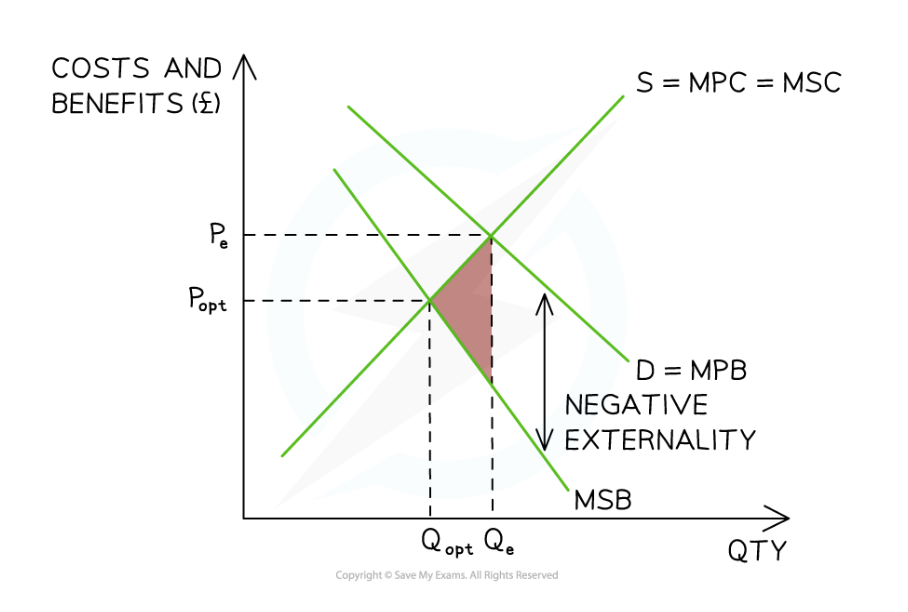
External costs of consumption result in overconsumption, as shown by the gap between Qopt and Qe
Diagram analysis
-
The MSC is assumed to equal the MPC, as the externality arises from the consumption (demand) side of the market
-
The free-market equilibrium occurs at PeQe, where MPB = MSC, representing the private optimum
-
Because consumers ignore the external costs of consumption, the MPB lies above the MSB
-
The socially optimal level of output occurs where MSB = MSC, at PoptQopt, which is allocatively efficient
-
As a result, the market produces too much output, creating over-consumption equal to Qe − Qopt
-
This generates a welfare loss (deadweight loss) shown by the pink triangle
- To achieve social efficiency, output must fall so that MSB = MSC
- This creates a role for government intervention, such as taxes, regulation or legislation
Worked Example The existence of negative externalities in consumption results in a misallocation of resources. This is because at the free market level of output:
A. The marginal social benefit exceeds the marginal social cost
B. The marginal private cost equals the marginal social cost.
C. The marginal social benefit is less than the marginal social cost
D. The marginal social cost is less than the marginal private benefit
Answer
C. The marginal social benefit is less than the marginal social cost
In the free market, resources are allocated at the private optimum, where:
MPB = MSC
- Consumers only consider their private benefits and ignore the external costs of consumption
- As a result, the marginal social benefit (MSB) is lower than the marginal social cost (MSC)
- This leads to over-consumption of the good, creating a misallocation of resources and market failure
Negative externalities of production
-
Negative externalities of production are often created during the production of a good or service
- These external costs arise from the production of the good or service and result in a negative external impact on a third party
-
As only the private costs are considered by producers and not the external costs, firms will over-produce these goods and services, causing market failure
- If external costs were considered, the socially optimal level of output would be lower
- E.g., the impact of air pollution, water contamination, noise pollution and health problems on local communities
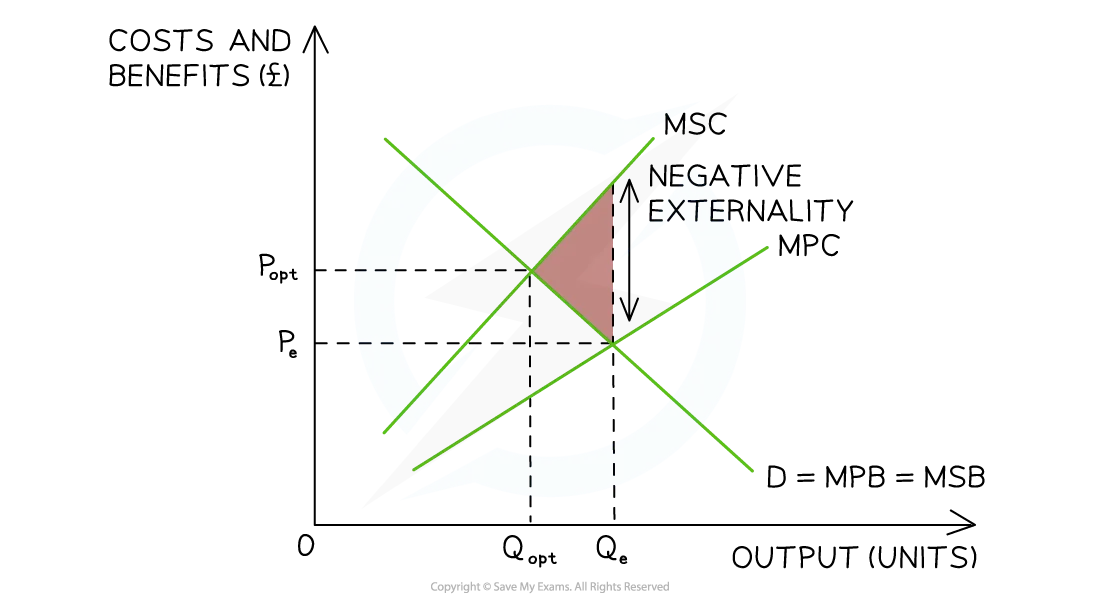
External costs of production lead to over-production equal to Qe − Qopt
Diagram analysis
- MSB is assumed to equal MPB, as the externality arises from the production (supply) side of the market
- The free-market equilibrium occurs at PeQe where MPC = MSB, representing the private optimum
- Because firms ignore the external costs of production, the MSC lies above the MPC
- The socially optimal level of output occurs where MSC = MSB, at PoptQopt, which is allocatively efficient
- Since the market produces Qe instead of Qopt, there is over-production equal to Qe − Qopt
- This creates a welfare loss (deadweight loss) shown by the shaded triangle
- To achieve social efficiency, output must fall so that MSC = MSB
- Government intervention, such as taxes, regulation or legislation, can reduce over-production and move the market closer to the socially efficient outcome
Exam Hint You should remember that there will be two supply curves when the external benefit or cost is on the producer side
When the benefit or cost is on the consumer side, there will be two demand curves
The direction of the triangle that shows the DWL should always point towards the social optimum equilibrium
Was this revision note helpful?
Build on this topic