Binary Arithmetic (Cambridge International A-Level Computer Science)
Exam board Cambridge International · A-LevelUpdated 2025-04-23
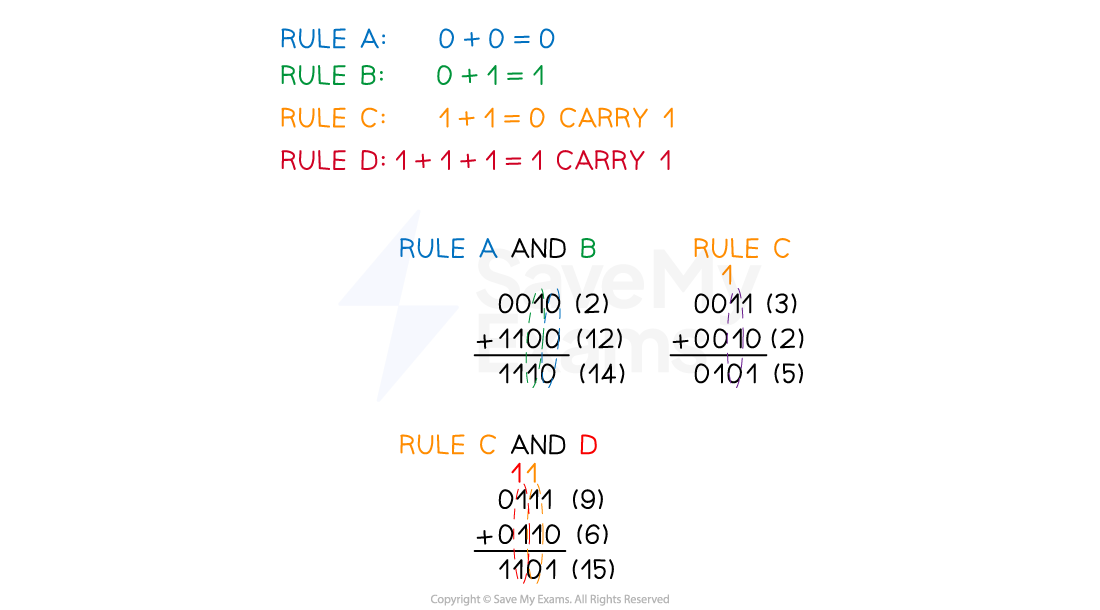
Binary addition
What is binary addition?
- Binary addition involves summing numbers in base-2, which uses only the digits 0 and 1
- Like denary addition, start from the rightmost digit and move towards the left
- Carrying over occurs when the sum of a column is greater than 1, passing the excess to the next left column
Example addition
Worked Example Add the following two binary integers using binary addition. Show your working. [2]
1 0 0 1 1 0 1 0 + 0 0 1 0 1 1 1 1
Final answer: Answer
carry 1 1 1 1 1 1 0 0 1 1 0 1 0 + 0 0 1 0 1 1 1 1 Final answer: 1 Final answer: 1 Final answer: 0 Final answer: 0 Final answer: 1 Final answer: 0 Final answer: 0 Final answer: 1
- 1 mark for working [1 mark]
- 1 mark for answer [1 mark]
Overflow
What is an overflow?
- Overflow occurs when the sum of two binary numbers exceeds the given number of bits
- In signed number representations, the leftmost bit often serves as the sign bit; overflow can flip this, incorrectly changing the sign of the result
- Overflow generally leads to incorrect or unpredictable results as the extra bits are truncated or wrapped around

Binary subtraction
- To carry out subtraction, the number being subtracted is converted into its negative equivalent using two's complement
- The two numbers are then added together
Example
- 48 - 12
| -128 | 64 | 32 | 16 | 8 | 4 | 2 | 1 | ||
|---|---|---|---|---|---|---|---|---|---|
| 0 | 0 | 1 | 1 | 0 | 0 | 0 | 0 | = 48 | |
| 0 | 0 | 0 | 0 | 1 | 1 | 0 | 0 | = 12 | |
| find two's complement of -12 | |||||||||
| 0 | 0 | 0 | 0 | 1 | 1 | 0 | 0 | = 12 | |
| invert | |||||||||
| 1 | 1 | 1 | 1 | 0 | 0 | 1 | 1 | ||
| add 1 | |||||||||
| 1 | |||||||||
| result | |||||||||
| 1 | 1 | 1 | 1 | 0 | 1 | 0 | 0 | = -12 | |
| Add 48 and -12 | |||||||||
| -128 | 64 | 32 | 16 | 8 | 4 | 2 | 1 | ||
| 0 | 0 | 1 | 1 | 0 | 0 | 0 | 0 | = 48 | |
| 1 | 1 | 1 | 1 | 0 | 1 | 0 | 0 | = -12 | |
| carries | |||||||||
| 1 | 1 | 1 | 1 | ||||||
| result | |||||||||
| 0 | 0 | 1 | 0 | 0 | 1 | 0 | 0 | = 36 |
- 48 - 12 = 36
- The additional overflow bit is ignored leaving a result of 0010 0100, denary equivalent of 36, which is the correct answer
- In two's complement arithmetic, the overflow bit does not contribute to the actual value of the operation but is more of a by-product of the method
Was this revision note helpful?
Build on this topic