AI & Graphs (Cambridge International A-Level Computer Science)
Graphs to aid AI
What is a graph?
-
A graph is a set of vertices/nodes connected by edges/arcs
-
In AI, graphs are used to model relationships, networks, and decision-making problems
-
They can represent things like:
- Routes between cities (pathfinding)
- Connections in a neural network
- State transitions in decision trees or planning
Types of graphs
| Type | Use in AI |
|---|---|
| Directed Graph | Models one-way relationships, such as state transitions in search algorithms (e.g. A*) |
| Undirected Graph | Useful for bidirectional relationships, such as undirected social connections in a graph |
| Weighted Graph | Represents costs or heuristics, commonly used in shortest path algorithms like Dijkstra's or A* |
Representation of graphs
-
Graphs can be represented using:
- Adjacency Matrix – ideal for dense graphs and fast lookup
- Adjacency List – more space, efficient for sparse graphs (often used in AI search)
-
Both can be used in AI to represent problem spaces such as:
- Game boards
- Map-based navigation
- Resource allocation networks
Undirected, unweighted graph
-
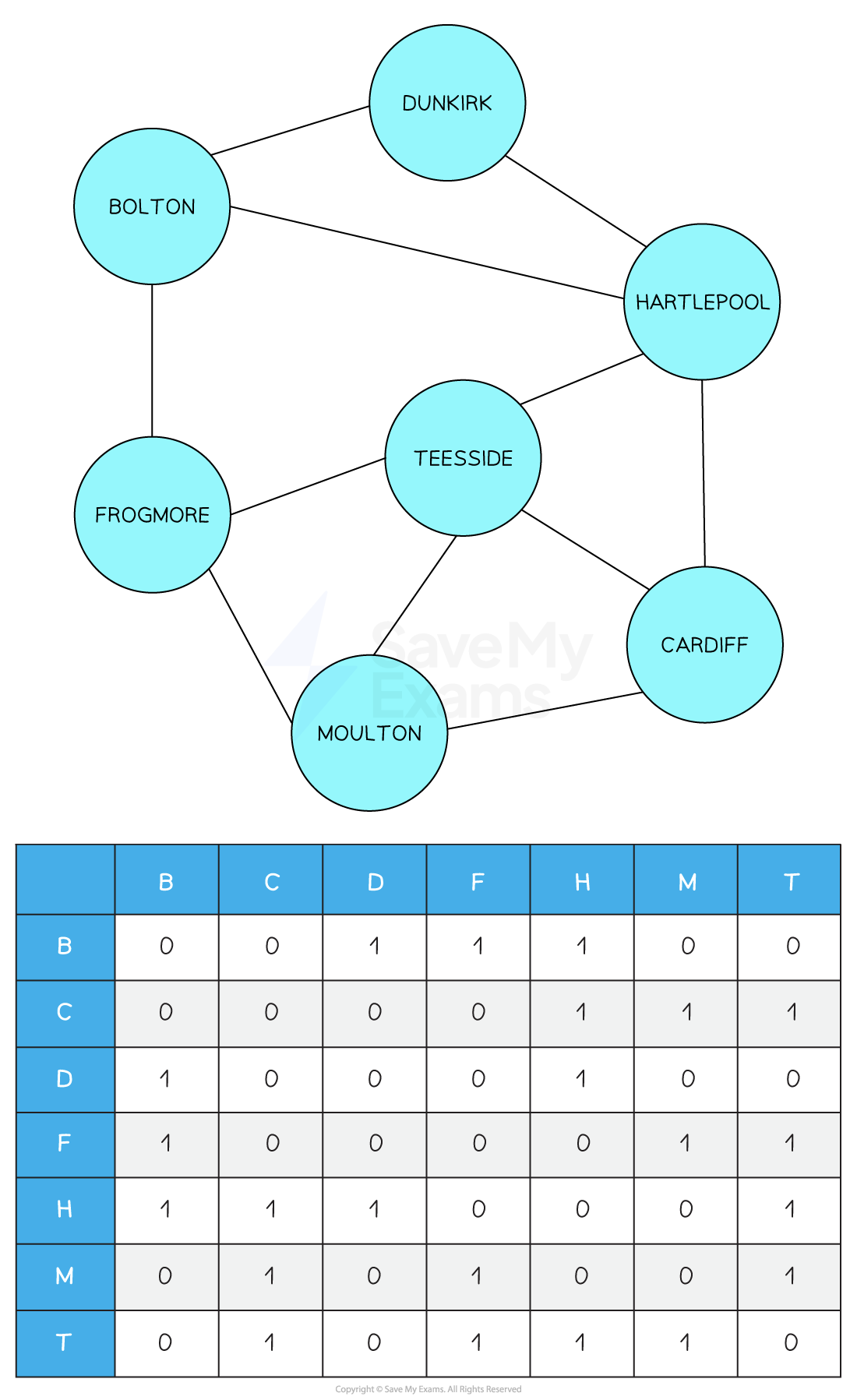
An undirected, unweighted graph is a type of graph where:
- Edges have no direction , connections go both ways
- All edges are equal, there are no weights or costs
- It is represented with a symmetric adjacency matrix, where a
1indicates a connection and a0means no connection
-
In this example:
- Each node is a town (e.g. Bolton, Dunkirk, Teesside)
- A
1in the matrix shows a connection exists between two towns - A
0means no direct connection
-
Example:
- Bolton and Frogmore have a
1at their intersection → they are connected - Dunkirk and Moulton have a
0→ no direct connection
- Bolton and Frogmore have a
-
The matrix is symmetric, confirming that the graph is undirected
AI relevance
-
Undirected, unweighted graphs are useful in AI for:
- Exploring environments, e.g. mapping rooms in a building with equal-cost connections
- Clustering in machine learning, where the presence of a connection implies similarity
- Social network analysis, where mutual connections (friendships, links) are undirected
-
These graphs are often used in:
- Depth-first or breadth-first search
- Graph traversal algorithms to explore all reachable nodes
Directed, unweighted graph
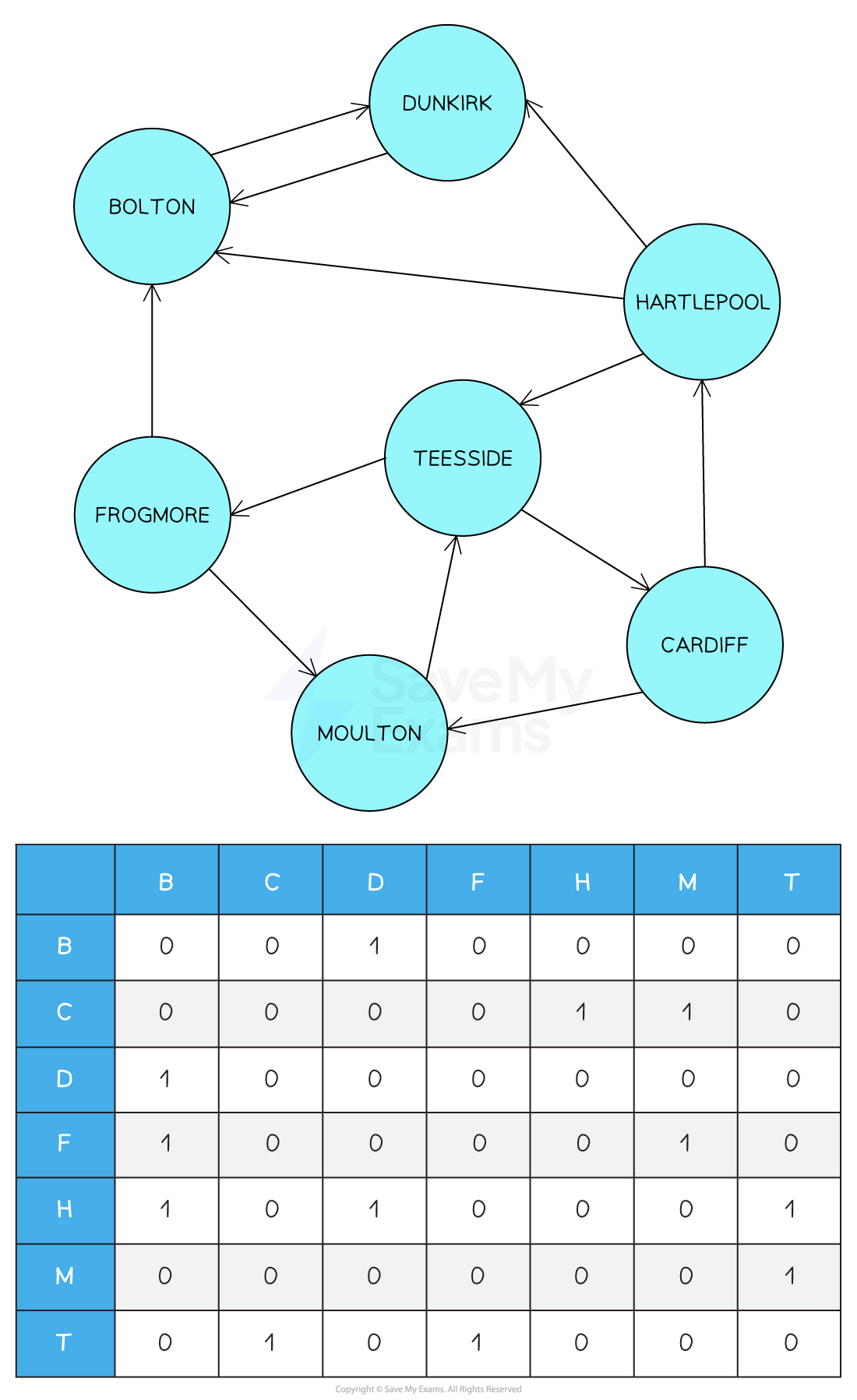
- A directed graph (or digraph) is one where edges have a direction
- This means connections go from one node to another
- Connections cannot be traversed in reverse unless another directed edge exists
-
In this example:
- Each node represents a town
- Arrows show the direction of travel
- A
1in the matrix at (row X, column Y) means there is a directed edge from X to Y - A
0means there is no direct connection
-
For instance:
B → Dis allowed (matrix value = 1)D → Cis not allowed (matrix value = 0)
-
Because this matrix is not symmetric, it reflects the one-way nature of connections
AI relevance
- Directed, unweighted graphs are essential in AI for:
| Use case | How the graph is used |
|---|---|
| Search algorithms | Used in A, BFS, DFS where state transitions are directional |
| Expert systems / rule engines | Representing dependencies between logical conditions or actions |
| Planning and scheduling | Modelling prerequisites and directed workflows |
| Navigation | Handling one-way streets or directed transport systems |
Undirected, weighted graph
-
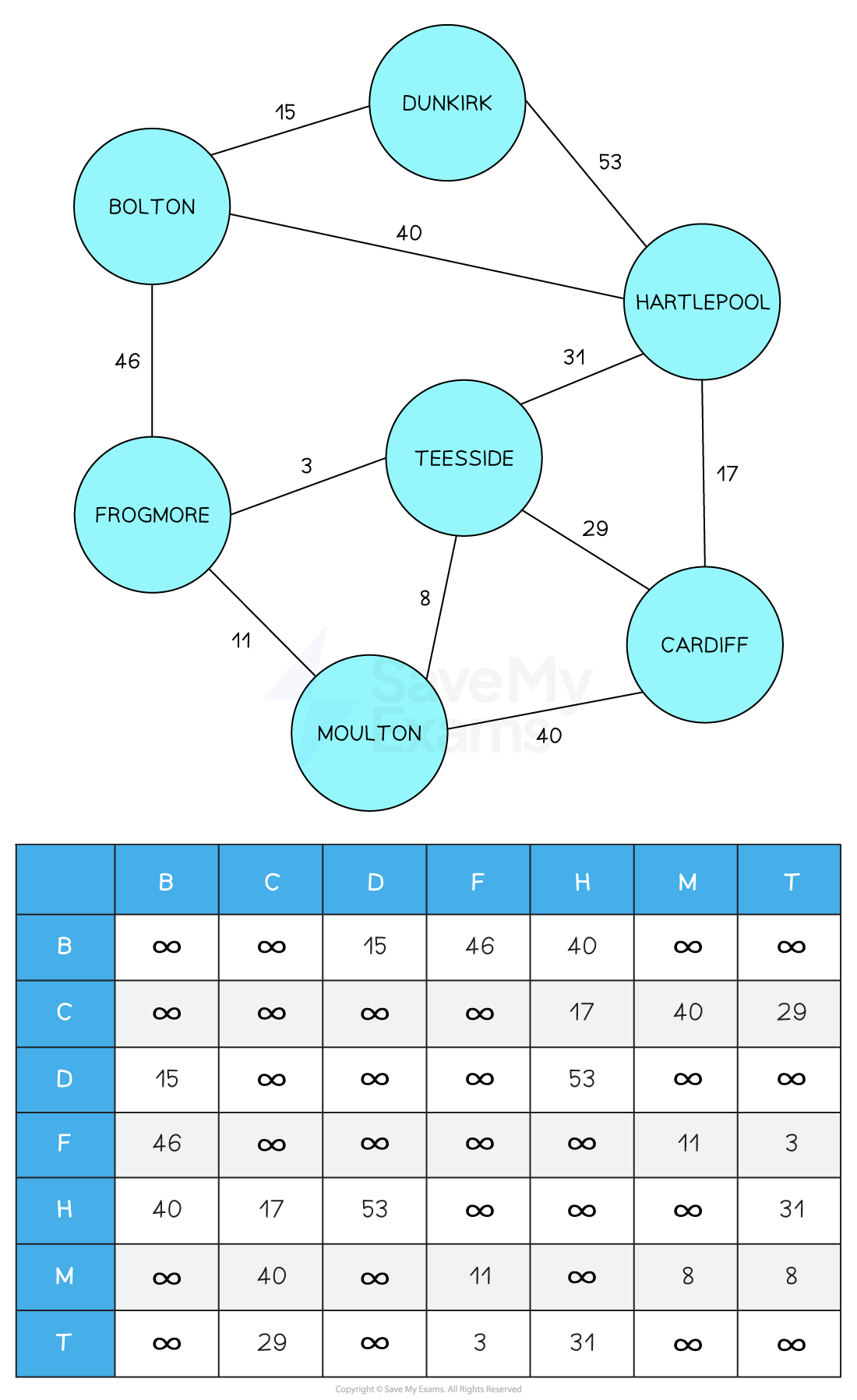
An undirected, weighted graph is a graph where:
-
Edges go both ways (no direction)
-
Each edge has a weight, which can represent:
- Cost
- Distance
- Time
- Risk
-
-
If no connection exists between two nodes, the matrix contains ∞ (infinity)
-
Nodes represent towns
-
Edges represent roads, and weights represent distances or costs
-
In the matrix:
matrix[B][D] = 15→ Bolton to Dunkirk is 15 unitsmatrix[B][C] = ∞→ Bolton and Cardiff are not directly connected
-
The matrix is symmetric, confirming this is an undirected graph
AI relevance
- Undirected, weighted graphs are widely used in AI when:
| Use case | How It helps AI |
|---|---|
| Pathfinding (e.g. A, Dijkstra)* | Finding the lowest cost path between nodes |
| Clustering & similarity graphs | Edges represent strength of relationships or similarity weights |
| Recommendation engines | Connecting users or items based on weighted similarity |
| Robotics & navigation | Planning efficient movement paths through environments |
- In AI, the weights are crucial for deciding the best route or option when multiple paths are available
Directed, weighted graph
-
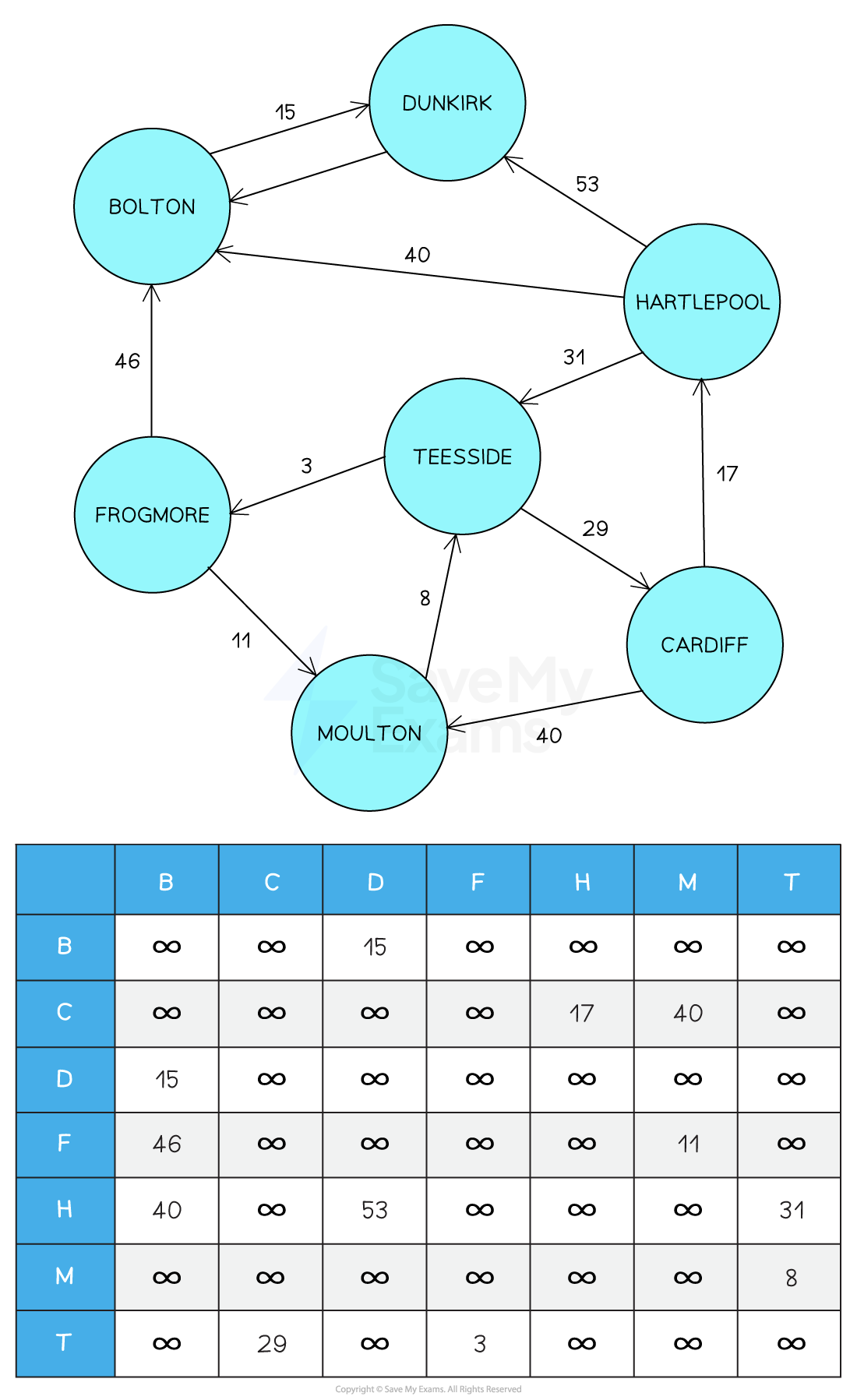
A directed, weighted graph is a graph where:
-
Edges have a direction (e.g.
A → Bbut notB → A) -
Each edge has a weight, such as:
- Distance
- Cost
- Time
- Probability
-
-
If there is no edge, the value is ∞ (infinity)
-
Nodes = Towns
-
Edges = One-way roads
-
Weights = Travel cost or distance
-
The adjacency matrix:
B → D = 15→ there is a road from Bolton to Dunkirk costing 15 unitsC → H = 17→ Cardiff to Hartlepool has a weight of 17H → T = 31butT → H = ∞→ you can get from Hartlepool to Teesside, but not the other way
-
This matrix is not symmetric, confirming the graph is directed
AI relevance
- Directed, weighted graphs are critical in AI for:
| Use case | Purpose in AI |
|---|---|
| *A and Dijkstra algorithms | Choosing the shortest path where direction and cost matter |
| Route planning in robotics | Modelling direction-sensitive travel (e.g. traffic rules) |
| Search algorithms | Tracking cost between transitions between states |
| Reinforcement learning | Modelling rewards/costs for state transitions in decision environments |
| Game AI | Movement systems with terrain costs or restrictions |
Was this revision note helpful?
Build on this topic