11 markeasy
Which solid has a giant covalent lattice structure?
Choose your answer
Calcium fluoride
Nickel
Silicon (IV) dioxide
Sulfur
10 questions · 10 marks · ≈ 10 min
Which solid has a giant covalent lattice structure?
Choose your answer
Calcium fluoride
Nickel
Silicon (IV) dioxide
Sulfur
The table shows the physical properties of four substances, A, B, C and D.
Which substance has a giant ionic lattice?
| substance | melting point / °C | boiling point / °C | electrical conductivity of solid | electrical conductivity of liquid | electrical conductivity of aqueous solution |
|---|---|---|---|---|---|
| A | −119 | 39 | poor | poor | insoluble |
| B | −115 | −85 | poor | poor | good |
| C | 993 | 1695 | poor | good | good |
| D | 1610 | 2230 | poor | poor | insoluble |
Choose your answer
Three substances, R, S and T, have the physical properties shown.
| substance | melting point / °C | boiling point / °C | electrical conductivity of liquid |
|---|---|---|---|
| R | 772 | 1407 | good |
| S | 114 | 183 | poor |
| T | 1610 | 2205 | poor |
Which row gives the most likely lattice structure for each substance?
| R | S | T | |
|---|---|---|---|
| A | giant molecular | simple molecular | ionic |
| B | ionic | giant molecular | simple molecular |
| C | ionic | simple molecular | giant molecular |
| D | simple molecular | ionic | giant molecular |
Choose your answer
Each diagram shows a type of giant lattice structure.
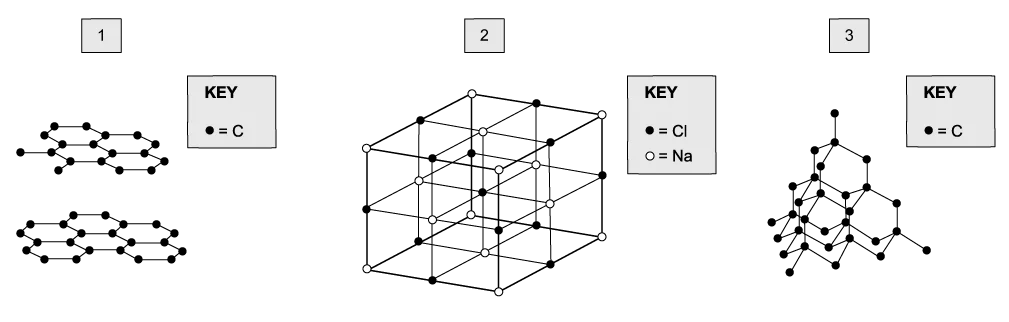
Which row gives the type of lattice shown in each diagram?
| Diagram 1 | Diagram 2 | Diagram 3 | |
|---|---|---|---|
| A | giant covalent | giant ionic | giant covalent |
| B | giant covalent | giant covalent | giant ionic |
| C | giant ionic | giant ionic | giant covalent |
| D | giant ionic | giant covalent | giant ionic |
Choose your answer
Three substances, X, Y and Z, have the physical properties shown.
| substance | melting point / °C | boiling point / °C | electrical conductivity of solid | electrical conductivity of liquid |
|---|---|---|---|---|
| X | 801 | 1413 | poor | good |
| Y | 2852 | 3600 | poor | good |
| Z | 3550 | 4827 | good | not known |
Which row gives the identities of substances X, Y and Z?
| X | Y | Z | |
|---|---|---|---|
| A | CaF2 | KCl | Cu |
| B | NaCl | MgO | C (graphite) |
| C | NaBr | CaO | C (diamond) |
| D | NaBr | BaO | SiO2 |
Choose your answer
Which row gives the physical states where sodium chloride can conduct electricity?
| solid | molten | aqueous | |
|---|---|---|---|
| A | ✓ | ✓ | ✗ |
| B | ✓ | ✗ | ✓ |
| C | ✗ | ✓ | ✓ |
| D | ✗ | ✗ | ✓ |
Choose your answer
Which substance has the highest melting point?
Choose your answer
Calcium oxide
Lithium
Sodium fluoride
Sulfur
Which compounds form a giant ionic lattice in the solid state?
| silicon dioxide | ammonium sulfate | potassium iodide | |
|---|---|---|---|
| A | ✓ | ✓ | ✗ |
| B | ✓ | ✗ | ✓ |
| C | ✗ | ✓ | ✓ |
| D | ✗ | ✗ | ✓ |
Choose your answer
Which row gives the properties of hydrogen fluoride?
| contains localised covalent bonds | highly soluble in polar solvents | lowest bond energy of the hydrogen halides | highest boiling point of the hydrogen halides | |
|---|---|---|---|---|
| A | ✗ | ✓ | ✗ | ✓ |
| B | ✓ | ✓ | ✗ | ✓ |
| C | ✗ | ✓ | ✓ | ✓ |
| D | ✗ | ✗ | ✓ | ✗ |
Choose your answer
Which sequence shows the metal oxides in order of decreasing melting point?
Choose your answer
Na2O > MgO > CaO
MgO > CaO > Na2O
MgO > Na2O > CaO
Na2O > CaO > MgO