Benzene reacts with bromine in the presence of an aluminium bromide, AlBr3, catalyst to form bromobenzene. Fig. 1.1 shows an incomplete mechanism for the generation of the Br+ electrophile.
Complete the mechanism in Fig. 1.1. Include all relevant curly arrows, lone pairs, and dipoles.

Fig. 1.1
Complete the mechanism in Fig. 1.2 to show the reaction between benzene and the Br+ electrophile. Include all relevant curly arrows and charges.
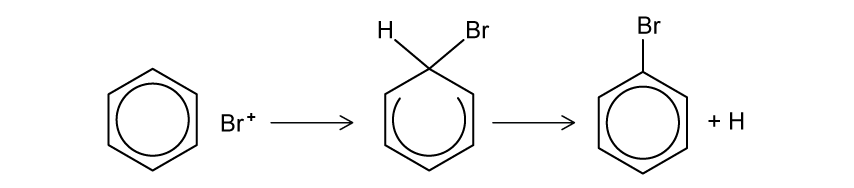
Fig. 1.2
Extract:
Benzene reacts with bromine in the presence of an aluminium bromide, AlBr3, catalyst to form bromobenzene. Fig. 1.1 shows an incomplete mechanism for the generation of the Br+ electrophile.
A lone pair of electrons from the δ– bromine atom is donated to AlBr3, forming a coordinate bond. This draws electrons away from the other bromine atom, making it electron-deficient and generating the Br+ electrophile.
The intermediate then loses a proton, restoring the delocalised electron system.
Construct an equation to show how the AlBr3 catalyst is regenerated.