11 markeasy
Which of the following corresponds to the base peak in a mass spectrum?
Choose your answer
Any fragment ion
The ion with the lowest m/z ratio
The molecular ion
The most abundant ion
23 questions · 23 marks · ≈ 23 min
Which of the following corresponds to the base peak in a mass spectrum?
Choose your answer
Any fragment ion
The ion with the lowest m/z ratio
The molecular ion
The most abundant ion
The diagram shows the structural formula of ricinoleic acid.
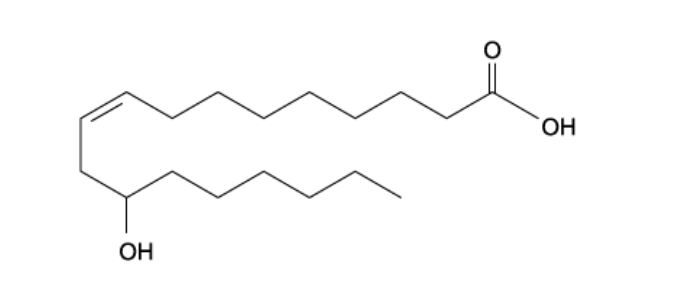
The mass spectrum of ricinoleic acid shows a peak at m/z = 55.
Which fragment ion is responsible for this peak?
Choose your answer
C4H7+
CH2CO2+
CHCHCHOH+
COOH+
In a mass spectrometer, the ions are separated.
Which of the following species will be deflected to the greatest extent?
Choose your answer
35Cl+
35Cl2+
37Cl
37Cl+
A sample of silicon contains the following isotopes.
| Isotope | Percentage abundance |
|---|---|
| 28Si | 81.21 |
| 29Si | 14.10 |
| 30Si | 4.69 |
Which is the relative atomic mass of silicon in this sample, to 1 dp?
Choose your answer
28.0
28.2
29.0
29.8
Chlorine exists as two isotopes with mass numbers 35 and 37. A sample of chlorine contains 75.3% of chlorine-35 atoms.
Which is the relative atomic mass of chlorine in this sample, to 2 dp?
Choose your answer
35.00
35.49
36.00
36.51
A sample of neon contains the following isotopes.
| Isotope | Percentage abundance |
|---|---|
| 20Ne | 90.92 |
| 21Ne | 0.26 |
| 22Ne | 8.82 |
Which is the relative atomic mass of neon in this sample, to 2 dp?
Choose your answer
20.00
20.09
20.18
21.00
Nitrogen trichloride has the formula NCl3. A sample contains only 14N atoms and chlorine atoms with mass numbers 35 and 37.
Which ion and m/z value in the table is not correct?
| Ion | m/z | |
|---|---|---|
| A | [14N(35Cl)3]+ | 119 |
| B | [14N(35Cl)2(37Cl)]+ | 121 |
| C | [14N(35Cl)(37Cl)2]+ | 123 |
| D | [14N(37Cl)2]+ | 125 |
Choose your answer
The mass spectrum of silicon is shown below.
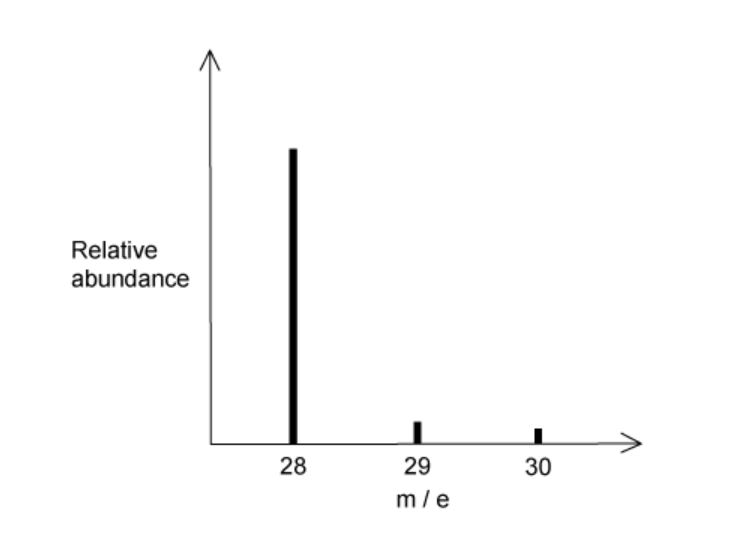
Which is the relative atomic mass of silicon in this sample, to 1 dp?
Choose your answer
28.0
28.3
28.8
29.0
Which alcohol does not have a fragment ion at m/z = 43 in its mass spectrum?
Choose your answer
(CH3)2CHCH2OH
CH3CH(OH)CH2CH2CH3
CH3CH2CH(OH)CH3
CH3CH2CH2CH2OH
Which of the compounds below is not likely to have a fragment ion at m/z = 43 in its mass spectrum?
Choose your answer
Assuming chlorine exists as two isotopes and that carbon and hydrogen each exist as a single stable isotope only, how many molecular ion peaks are shown in the mass spectrum of C4H6Cl4?
Choose your answer
2
3
4
5
Bromine exists as two isotopes 79Br and 81Br, which are found in almost equal abundance.
Which of the following statements is correct?
Choose your answer
79Br is more reactive than 81Br.
The mass spectrum of C3H7Br has two molecular ion peaks at 122 and 124.
The atomic radius of 79Br is less than the atomic radius of 81Br.
The first ionisation energy of 79Br is less than the first ionisation energy of 81Br.
Which alcohol is likely to have a fragment ion at m/z = 31 in its mass spectrum?
Choose your answer
(CH3)2CHCH2OH
CH3CH(OH)CH2CH2CH3
CH3CH2CH2C(OH)(CH3)2
CH3CH2CH(OH)CH3
Which pair of compounds would you expect to both have a singly charged peak at m/z = 29 in the mass spectrum?
Choose your answer
Propan-1-ol and propan-2-ol
Propan-1-ol and propanal
Propan-2-ol and propanal
Propanal and propanone
Which of the ketones listed would not be expected to have a peak in its mass spectrum at m/z = 57?
Choose your answer
(CH3)2CHCOCH3
CH3CH2CH2COCH2CH3
CH3CH2COCH2CH3
CH3CH2COCH3
Chlorine has two isotopes, 35Cl and 37Cl.
Which of the following is the number of molecular ion peaks in the mass spectrum of a sample of Cl2?
Choose your answer
2
3
4
5
Which of the following statements about the mass spectrum of CH3Br is correct?
Choose your answer
The molecular ion peaks are of equal size and occur at m/z values of 94 and 96.
The molecular ion peaks have abundances in the ratio 3:1 and occur at m/z values of 94 and 96.
There is one peak for the molecular ion with an m/z value of 44.
There is one peak for the molecular ion with an m/z value of 95.
Two stable isotopes of bromine, 79Br and 81Br, exist in approximately equal abundance.
Which is the correct pattern of peaks in the mass spectrum of Br2?
Choose your answer
The mass spectra of three compounds A, B and C are shown below.
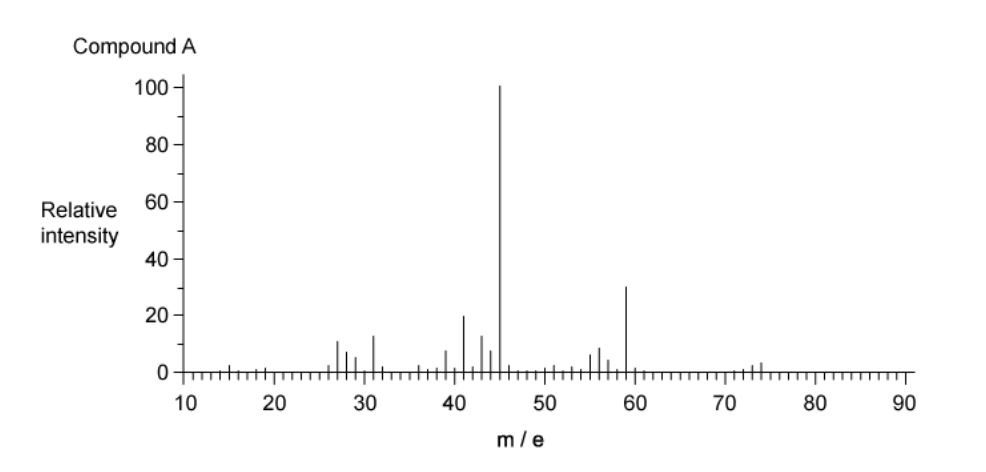
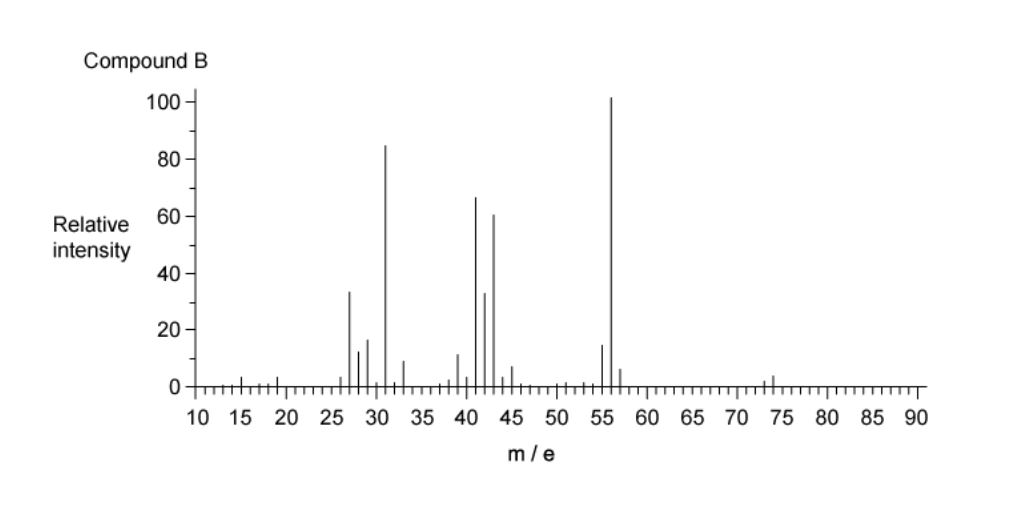
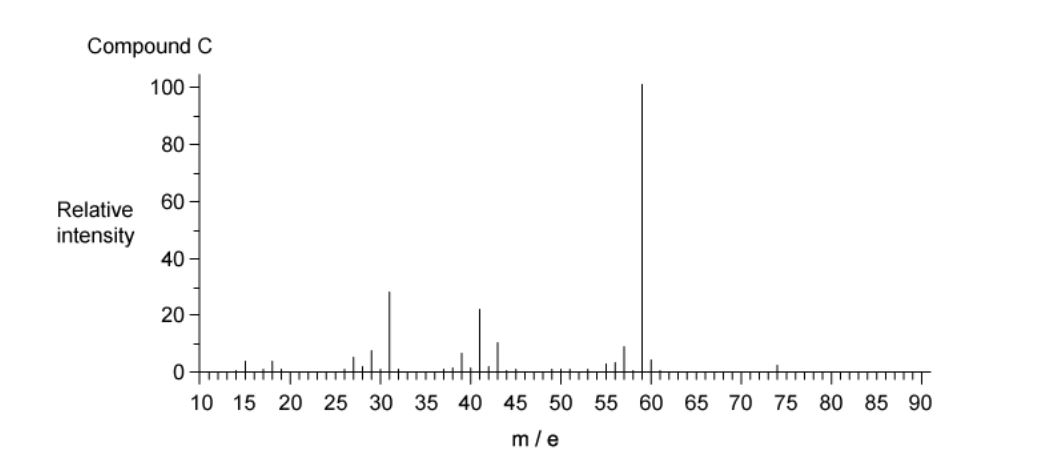
Which feature of the three mass spectra confirms that all three compounds have the molecular formula C4H10O?
Choose your answer
All show a base peak at m/z = 73
All show a fragment ion peak at m/z = 15
All show a fragment ion peak at m/z = 33
All show a molecular ion peak at m/z = 74
Chlorine exists as two isotopes, 35Cl and 37Cl, in the ratio 3:1.
Which of the following statements about the molecular ion peaks in the mass spectrum of Cl2 is correct?
Choose your answer
Peaks at m/z = 70 and 72 in the ratio 3:1
Peaks at m/z = 70 and 74 in the ratio 3:1
Peaks at m/z = 70, 72 and 74 in the ratio 9:3:1
Peaks at m/z = 70, 72 and 74 in the ratio 9:6:1
A compound XFn is a fluoride of another halogen, X, and it is known that n > 1. The highest mass peak in the mass spectrum of XFn is assigned to the molecular ion and appears as a single peak at m/z = 222.
Which of the following statements is not correct?
Choose your answer
n = 5
The compound could contain bromine
The compound is a fluoride of iodine
X and F each exist as a single stable isotope
In the mass spectrum of trifluoroacetic acid, CF3CO2H, intense peaks are observed at m/z = 69 and 45 (base peak) in addition to other peaks.
The peak at m/z = 69 is accompanied by a peak at m/z = 70, which is about 1.1% the intensity of the peak at m/z = 69.
Which of the following statements is not supported by this information?
Choose your answer
C−C bond cleavage occurs
CF3CO2H fragments by sequential loss of F atoms
Fluorine exists as a single stable isotope
[HO2C]+ is a fragment ion
A sample is analysed by mass spectrometry and infrared spectroscopy. The data obtained are shown below.
| Mass spectrometry | Infrared spectroscopy |
|---|---|
| Molecular ion peak at m/z = 128 | Strong absorption at 1720 cm-1 |
| Fragment ion peak at m/z = 15 | No broad absorption around 3200 cm-1 |
Which compound is consistent with these spectroscopic data?
Choose your answer