There are three possible isomers, A, B and C, with the molecular formula C3H8O.
Isomers A and B are positional isomers of each other.
Isomer C is a functional group isomer of A and B.
The percentage by mass of carbon in all three isomers is 60.0%.
Calculate the percentage by mass of hydrogen and oxygen in all three isomers.
Extract:
There are three possible isomers, A, B and C, with the molecular formula C3H8O.
Isomers A and B are positional isomers of each other.
Isomer C is a functional group isomer of A and B.
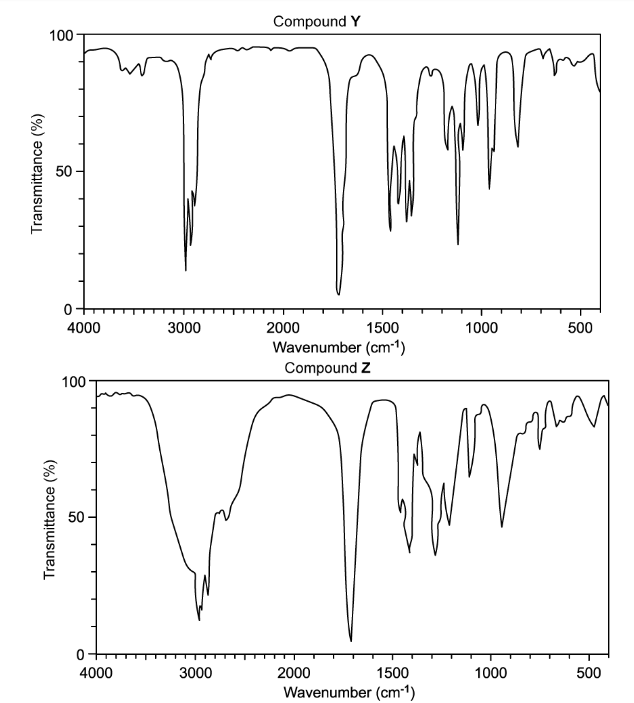
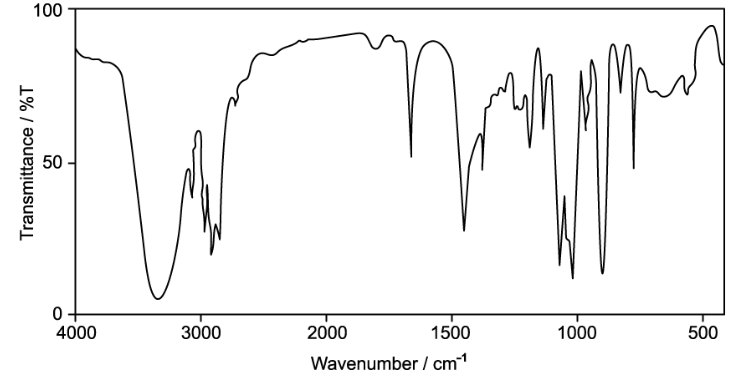
The infrared spectrum of isomer C shown in Fig. 1.1 does not have an absorption in the region of 3200–3600 cm-1.
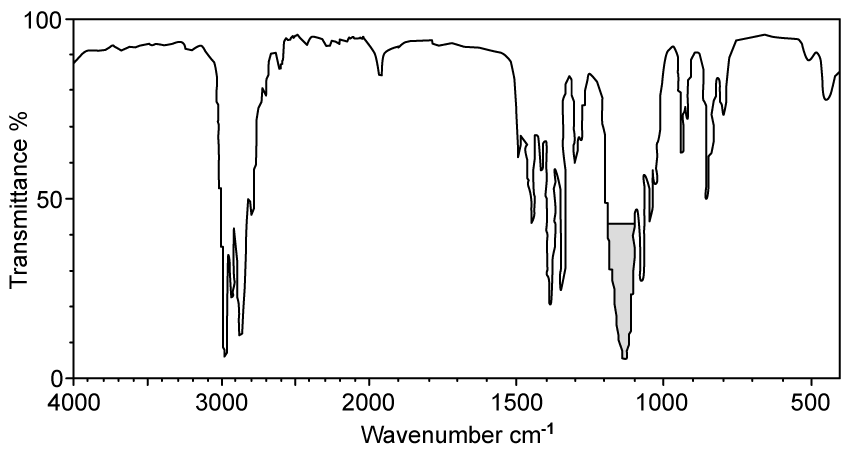
Fig. 1.1
i) Using the infrared spectrum in Fig. 1.1 and Table 1.1, deduce the fully displayed formula of isomer C.
Table 1.1
| **Bond ** | Functional groups containing the bond | Characteristic infrared absorption range (in wavenumber) / cm–1 |
|---|---|---|
| C−O | hydroxy, ester | 1040 – 1300 |
| C=C | aromatic compound, alkene | 1500 – 1680 |
| C=O | amide carbonyl, carboxyl ester | 1640 – 1690 1670 – 1740 1710 – 1750 |
| C≡N | nitrile | 2200 – 2250 |
| C−H | alkane | 2850 – 2950 |
| N−H | amine, amide | 3300 – 3500 |
| O−H | carboxyl hydroxy | 2500 – 3000 3200 – 3600 |
(1 mark)
ii) Identify the bond responsible for the absorption at around 1130 cm-1.
(1 mark)
Extract:
There are three possible isomers, A, B and C, with the molecular formula C3H8O.
Isomers A and B are positional isomers of each other.
Isomer C is a functional group isomer of A and B.
Isomers A and B both have an absorption at 3200–3600 cm-1 in their infrared spectra.
State the systematic names of isomers A and B.
Extract:
There are three possible isomers, A, B and C, with the molecular formula C3H8O.
Isomers A and B are positional isomers of each other.
Isomer C is a functional group isomer of A and B.
Isomers A and B both have an absorption at 3200–3600 cm^-1^ in their infrared spectra.
The systematic names of isomers A and B are:
- Propan-1-ol
- Propan-2-ol
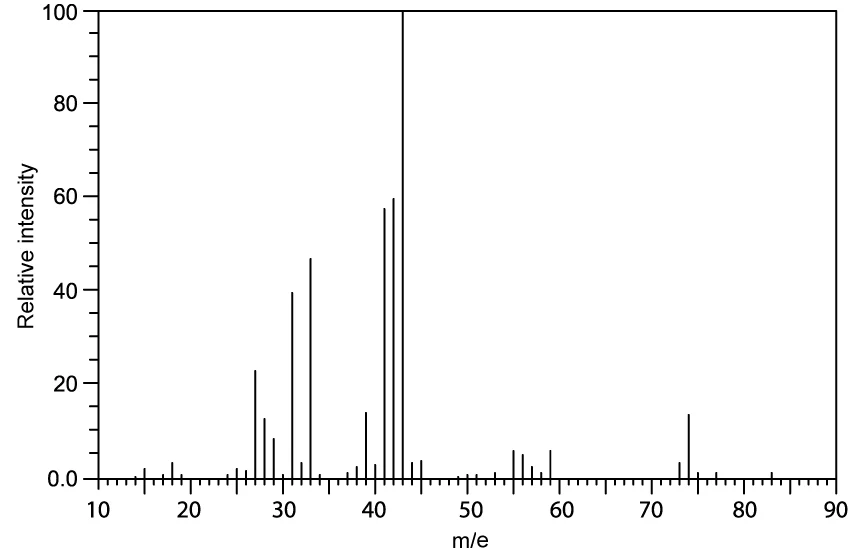
Isomer A has a major peak at m/e = 31 in its mass spectrum.
Deduce which isomer is compound A. Explain your reasoning by identifying the fragment ion responsible for the peak at m/e = 31.