11 markeasy
Which equation represents a valid propagation step in the free radical reaction between ethane and chlorine?
Choose your answer
C2H5Cl + Cl• → C2H4Cl• + HCl
C2H5• + Cl• → C2H5Cl
C2H6 + Cl• → C2H5Cl + H•
C2H6 + H• → C2H5• + HCl
11 questions · 11 marks · ≈ 11 min
Which equation represents a valid propagation step in the free radical reaction between ethane and chlorine?
Choose your answer
C2H5Cl + Cl• → C2H4Cl• + HCl
C2H5• + Cl• → C2H5Cl
C2H6 + Cl• → C2H5Cl + H•
C2H6 + H• → C2H5• + HCl
One of the reactions taking place in a catalytic converter in a car exhaust system is between nitrogen oxide and octane (unburned petrol). The products of this reaction are non-toxic.
Which is the correct equation for the reaction?
Choose your answer
C8H16 + 16NO → 8CO + 8N2 + 8H2O
C8H16 + 24NO → 8CO2 + 12N2 + 8H2O
C8H18 + 17NO → 8CO + 8 N2 + 9H2O
C8H18 + 25NO → 8CO2 + 12 N2 + 9H2O
The hydrocarbon C17H36 can be cracked.
Which compound is the least likely to be produced in this reaction?
Choose your answer
C3H8
C4H8
C8H16
C16H34
In the presence of ultraviolet light, ethane and chlorine react to give a mixture of products.
Which compound could be present in the mixture of products?
Choose your answer
CH3Cl
CH3CH2CH2Cl
CH3CH2CH2CH3
CH3CH2CH2CH2CH3
The cracking of a single hydrocarbon molecule, CnH2n+2, produces two hydrocarbon molecules only. Each hydrocarbon product contains the same number of carbon atoms in one molecule. Each hydrocarbon product has non-cyclic structural isomers.
What is the value of n?
Choose your answer
4
6
8
9
Which hydrocarbon would not be collected in the inverted tube by heating pentane, CH3(CH2)3CH3, in the apparatus shown?
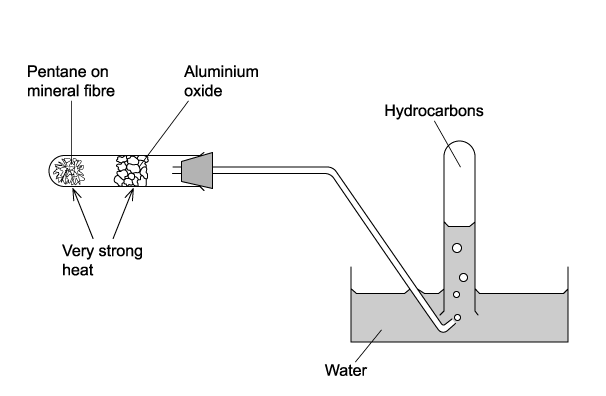
Choose your answer
CH4
CH3CH3
CH3CH2CH=CH2
CH3(CH2)8CH3
0.200 mol of a hydrocarbon undergoes complete combustion to give 35.2 g of carbon dioxide and 14.4 g of water as the only products.
What is the molecular formula of the hydrocarbon?
Choose your answer
C2H4
C2H6
C4H4
C4H8
Which statement about the free-radical substitution of ethane with chlorine is correct?
Choose your answer
Propagation steps involve the collision of two radicals to form a stable molecule
The final mixture will only contain chloroethane and hydrogen chloride
The initiation step involves heterolytic fission of a C–H bond
Ultraviolet light is required to provide the activation energy for the homolytic fission of Cl–Cl bonds
Samples of 10 cm3 of each of the first four members of the alkane series are separately mixed with 70 cm3 of oxygen. Each is then burned and the total volume, V, of residual gas measured again at room temperature and pressure.
Which graph represents the results that would be obtained?
Choose your answer
The petrol additive tetraethyl-lead (IV), Pb(C2H5)4, is now banned in many countries. When it is completely burned in air, lead (II) oxide, CO2 and H2O are formed.
How many moles of oxygen are required to burn one mole of Pb(C2H5)4?
Choose your answer
9.5
11
13.5
27
The cracking of eicosane, C20H42, produces a hydrocarbon that is in very high demand for transportation and also three consecutive members of the same homologous series of hydrocarbons.
What are the correct products of cracking for the given reaction?
Choose your answer
Butane, butene, hexene, octane
Butene, octane, pentene, propene
Ethane, hexene, heptene, pentene
Ethene, hexane, heptene, pentene