Random Sampling (Cambridge International A-Level Biology)
Spec point —
18.2.3· explain the importance of random sampling in determining the biodiversity of an area
Random sampling
- Measuring the different levels of biodiversity within an ecosystem can be a time-consuming task
- Finding out which species live in an ecosystem and the size of the populations requires the identification and cataloging of all organisms present to build a species list
- This is possible for areas that are very small or where the species are very large, like trees
- However, for larger and more complex ecosystems like rainforests, it is simply **impossible **to find, identify and count every organism that exists there
- When this is the case different** samples** of the area can be taken and used to make estimates of the total species numbers in the area
Sampling
-
Sampling is a method of investigating the abundance and distribution of species and populations
-
There are two different types of sampling:
- Random
- Systematic
-
In random sampling the positions of the sampling points are completely random or due to chance
- This method is beneficial because it means there will be no bias on the part of the person that is carrying out the sampling that may affect the results
-
In systematic sampling the sampling points are placed at regular intervals, for example every 2 m along a transect line; this is used when there is a gradient in conditions across the area
-
When a sampling area is reasonably uniform or has no clear pattern to the way the species are distributed then random sampling is the best choice
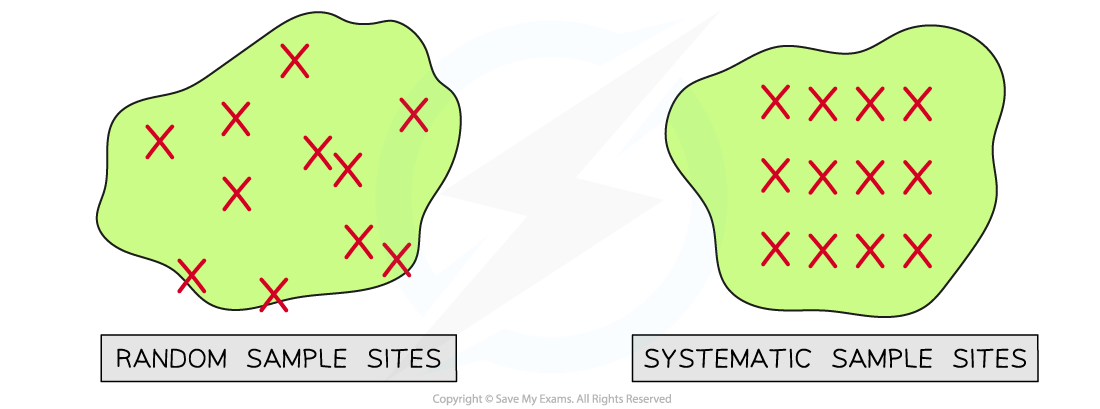
Random sampling differs from systematic sampling when choosing sample sites on an island
Was this revision note helpful?
Build on this topic