Protein Shape (Cambridge International A-Level Biology)
Proteins: Interactions & Shape
Spec point —
2.3.3· "describe the types of interaction that hold protein molecules in shape: • hydrophobic interactions • hydrogen bonding • ionic bonding • covalent bonding, including disulfide bonds"
Proteins: interactions & shape
-
A polypeptide chain will fold differently due to the interactions (and the bonds that form) between R groups
- The three-dimensional configuration that forms is called the tertiary structure of a protein
-
Each of the twenty amino acids that make up proteins has a unique R group
- This means that many different interactions can occur creating a vast range of protein configurations and therefore functions
-
Within proteins with a tertiary structure the following bonds occur:
- Strong covalent disulfide
- Ionic
- Weak hydrogen
- Weak hydrophobic interactions
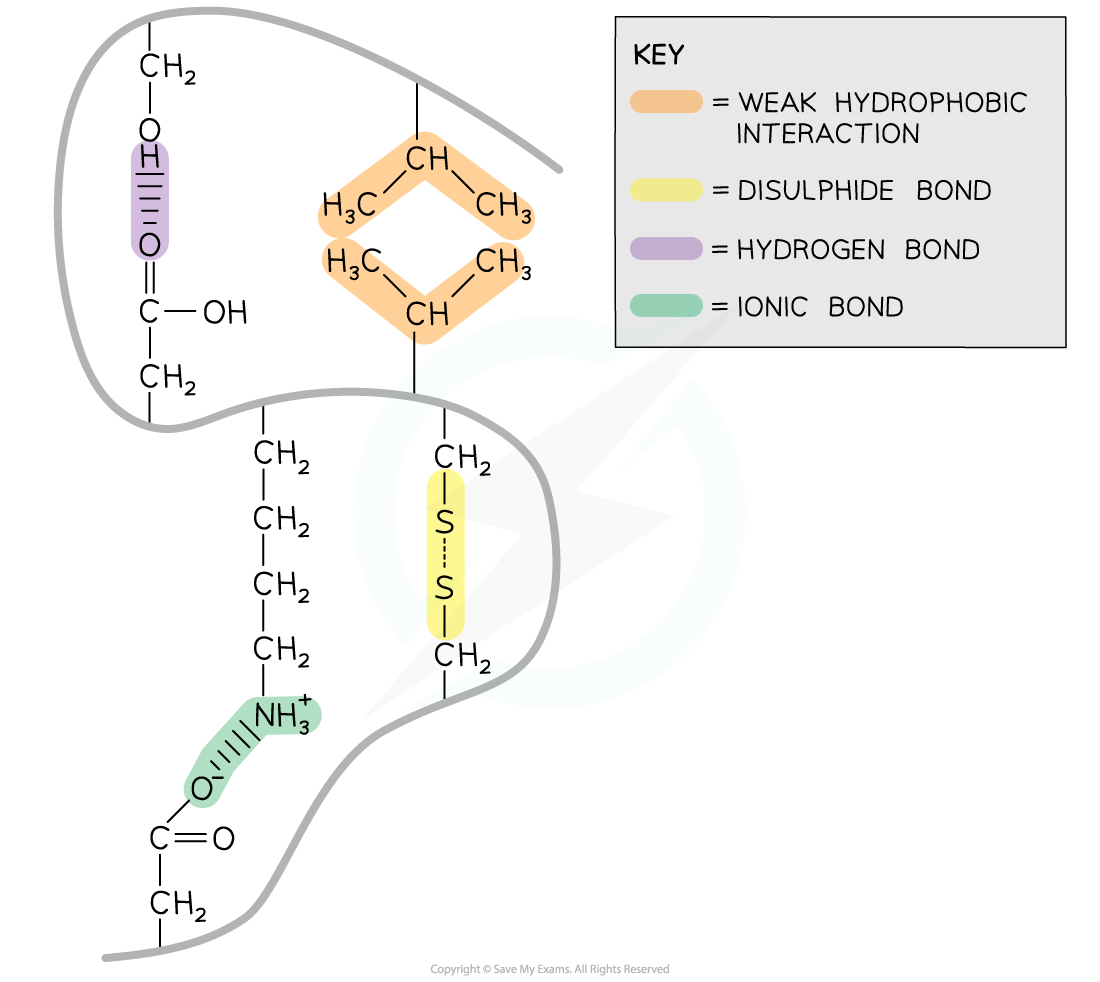
The interactions that occur between the R groups of amino acids determines the shape and function of a protein. These interactions are found within tertiary structures of proteins
Disulfide
- Disulfide bonds are strong covalent bonds that form between two cysteine R groups (as this is the only amino acid with an available sulfur atom in its R group)
- These bonds are the strongest within a protein, but occur less frequently, and help stabilise the proteins
- These are also known as disulfide bridges
- Can be broken by reduction
- Disulfide bonds are common in proteins secreted from cells e.g. insulin
Ionic
- Ionic bonds form between positively charged(amine group -NH3+) and negatively charged(carboxylic acid -COO-) R groups
- Ionic bonds are stronger than hydrogen bonds but they are not common
- These bonds are broken by pH changes
Hydrogen
- Hydrogen bonds form between strongly polar R groups. These are the weakest bonds that form but the most common as they form between a wide variety of R groups
Hydrophobic interactions
- Hydrophobic interactions form between the non-polar (hydrophobic) R groups within the interior of proteins
Exam Hint Note that an interaction is not the same as a bond. An interaction refers to a low energy attraction between two groups, whereas a bond is high energy and typically involves the electrons of the molecules concerned.
You need to be able to determine which bonds are found in tertiary structures and recognise them in diagrams.
Was this revision note helpful?
Build on this topic