Anaerobic Respiration (Cambridge International A-Level Biology)
Spec point — outline respiration in anaerobic conditions in mammals (lactate fermentation) and in yeast cells (ethanol fermentation)
Anaerobic respiration
-
Sometimes cells experience conditions with little or no oxygen
-
There are several consequences when there is not enough oxygen available for respiration:
- There is no final acceptor of electrons from the electron transport chain
- The electron transport chain stops functioning
- No more ATP is produced via oxidative phosphorylation
- Reduced NAD and FAD aren’t oxidised by an electron carrier
- No oxidised NAD and FAD are available for dehydrogenation in the Krebs cycle
- The Krebs cycle stops
-
However, there is still a way for cells to produce some ATP in low oxygen conditions through anaerobic respiration
Anaerobic pathways
-
Some cells are able to oxidise the reduced NAD produced during glycolysis so it can be used for further hydrogen transport
-
This means that glycolysis can continue and small amounts of ATP are still produced
-
Different cells use different pathways to achieve this
- Yeast and microorganisms use ethanol fermentation
- Other microorganisms and mammalian muscle cells use lactate fermentation
Ethanol fermentation
-
In this pathway, reduced NAD transfers its hydrogens to ethanal to form ethanol
-
In the first step of the pathway, pyruvate is decarboxylated to ethanal
- Producing CO2
-
Then ethanal is reduced to ethanol by the enzyme alcohol dehydrogenase
-
Ethanal is the hydrogen acceptor
-
Ethanol cannot be further metabolised; it is a waste product
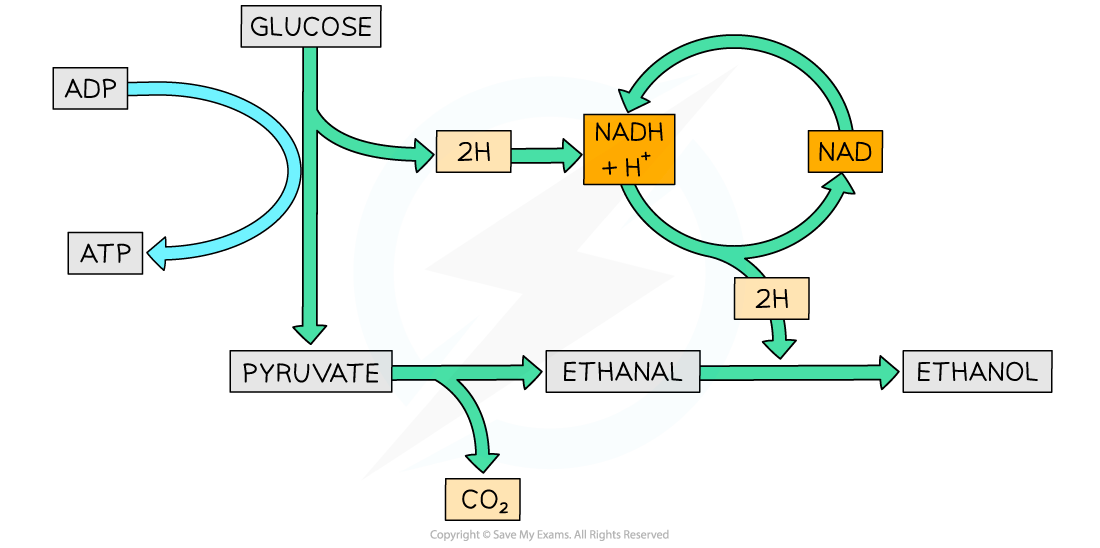
The pathway of ethanol fermentation
Lactate fermentation
- In this pathway, reduced NAD transfers its hydrogens to pyruvate to form lactate
- Pyruvate is reduced to lactate by the enzyme lactate dehydrogenase
- Pyruvate is the hydrogen acceptor
- The final product lactate can be further metabolised
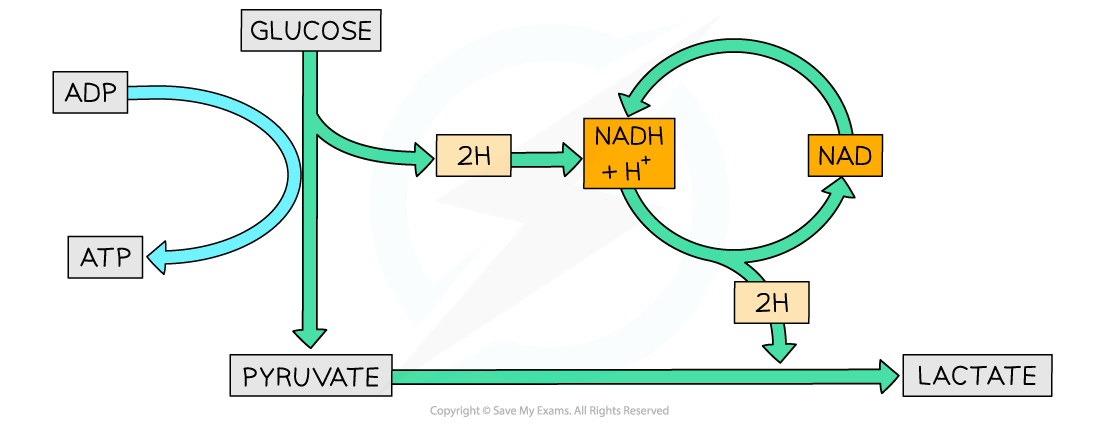
The pathway of lactate fermentation
Metabolisation of lactate
-
After lactate is produced two things can happen:
- It can be oxidised back to pyruvate which is then channelled into the Krebs cycle for ATP production
- It can be converted into glycogen for storage in the liver
-
The oxidation of lactate back to pyruvate needs extra oxygen
- This extra oxygen is referred to as an oxygen debt
- It explains why animals breathe deeper and faster after exercise
Exam Hint Note that ethanol fermentation is a two-step process (lactate fermentation is a one-step process). Carbon dioxide is also produced alongside the waste ethanol. This waste ethanol is what makes yeast vital in making alcoholic drinks like beer!
Was this revision note helpful?
Build on this topic