Red Blood Cells, Haemoglobin & Oxygen (Cambridge International A-Level Biology)
Spec point —
8.2.1· describe the role of red blood cells in transporting oxygen and carbon dioxide with reference to the roles of: • haemoglobin • carbonic anhydrase • the formation of haemoglobinic acid • the formation of carbaminohaemoglobin
Red blood cells, haemoglobin & oxygen
-
The majority of oxygen transported around the body is bound to the protein haemoglobin in red blood cells
-
Each molecule of haemoglobin contains four haem groups, each able to bond with one molecule of oxygen
- This means that each molecule of haemoglobin can carry four oxygen molecules, or eight oxygen atoms in total
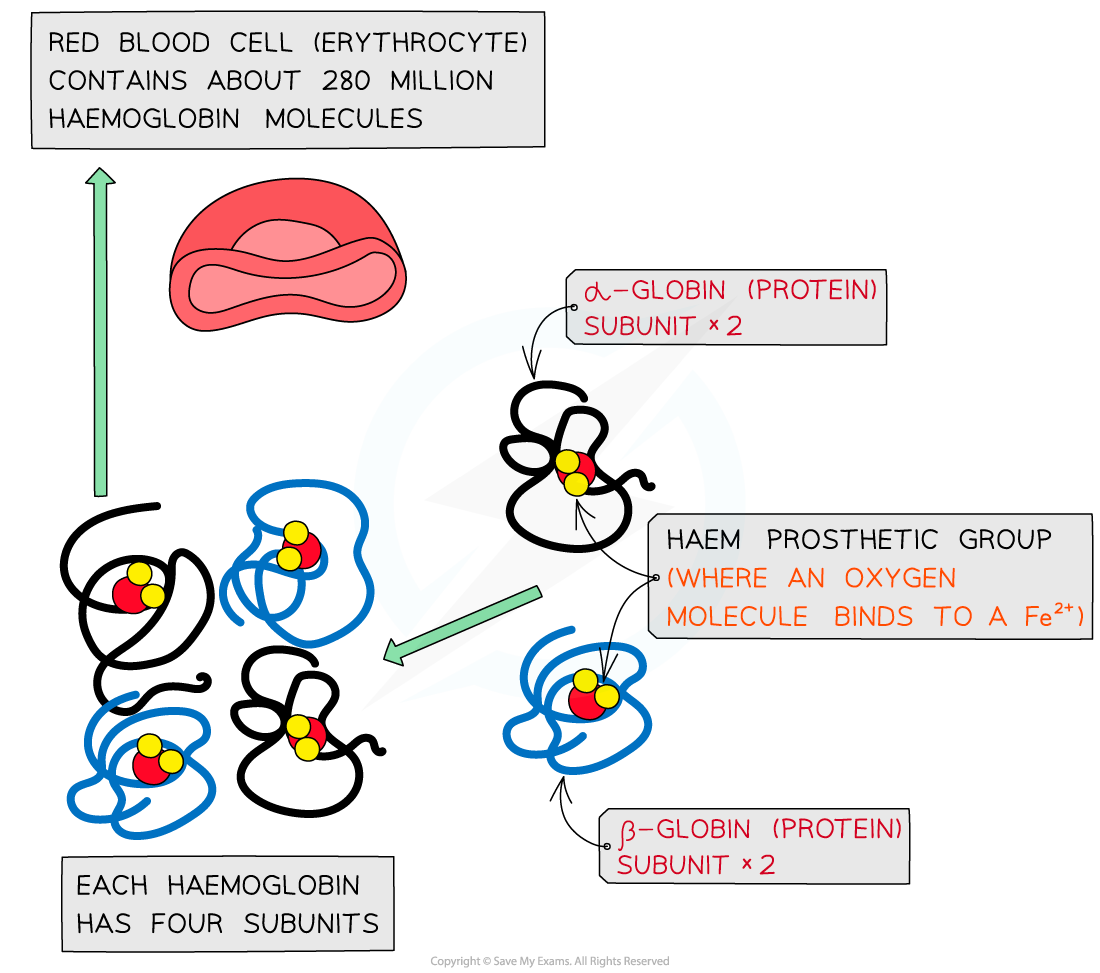
Haemoglobin proteins are made up of four subunits, each of which contains a region called a haem group to which oxygen can bind
- When oxygen binds to haemoglobin, oxyhaemoglobin is formed
Transport of carbon dioxide
-
Carbon dioxide produced in respiration is transported in the blood in three main ways:
- A small proportion is dissolved directly in the plasma
- Some binds to haemoglobin, forming carbaminohaemoglobin
- The majority is carried as hydrogencarbonate ions in the plasma
The role of carbonic anhydrase
-
Inside red blood cells, carbon dioxide combines with water to form carbonic acid
- This reaction is catalysed by the enzyme carbonic anhydrase
-
The carbonic acid then dissociates into hydrogencarbonate ions (HCO₃⁻) and hydrogen ions (H⁺)
-
The hydrogencarbonate ions move out of the red blood cells into the plasma, where they are carried in solution
Haemoglobinic acid
-
The hydrogen ions released in the dissociation of carbonic acid could lower blood pH
-
To prevent this, haemoglobin acts as a buffer:
- Haemoglobin binds with hydrogen ions to form haemoglobinic acid (HHb)
- This keeps the blood pH stable; binding of hydrogen ions also lowers haemoglobin's affinity for oxygen, so more oxygen is released in respiring tissues
Carbaminohaemoglobin
-
Some carbon dioxide binds directly to the amino groups of haemoglobin, forming carbaminohaemoglobin (HbCO₂)
- This binding occurs more readily when haemoglobin has released oxygen in the respiring tissues
Was this revision note helpful?
Build on this topic