Blood & Tissue Fluid (Cambridge International A-Level Biology)
Blood, Tissue Fluid & Lymph
Spec point —
8.1.7· state the functions of tissue fluid and describe the formation of tissue fluid in a capillary network
Blood & tissue fluid
-
Plasma is a straw-coloured liquid that constitutes around 55% of the blood
-
Plasma is largely composed of water (95%)
- Water is a good solvent, so many substances can dissolve in plasma, allowing them to be transported around the body
-
As blood passes through capillaries, some plasma leaks out through gaps in the walls of the capillary to surround the cells of the body
- This results in the formation of tissue fluid
-
The composition of plasma and tissue fluid are virtually the same, although tissue fluid does not contain large proteins
- Large proteins are unable to fit through gaps in the capillary walls and so remain in the blood
-
Tissue fluid bathes almost all the cells of the body outside of the circulatory system
-
Exchange of substances between cells and the blood occurs via the tissue fluid
- For example, carbon dioxide produced in aerobic respiration will leave a cell, dissolve into the tissue fluid surrounding it, and then diffuse into the capillary
Tissue fluid formation
-
How much liquid leaves the plasma to form tissue fluid depends on two opposing forces:
-
hydrostatic pressure
- This is blood pressure; the pressure exerted by the blood on the walls of the blood vessels
- Blood pressure pushes outwards from the blood vessels
-
the solute concentration gradient
- Proteins dissolved in the blood lower the blood water potential, meaning that there is a water potential gradient between the capillary and the surrounding tissue
- Water moves from high to low water potential by osmosis, so water is **drawn back in **from the tissues into the capillaries
-
-
When blood is at the arterial end of a capillary the** hydrostatic pressure is greater** than the osmotic pull
- This means molecules are forced out of the capillary down a pressure gradient
-
At the venous end of the capillary the volume of fluid is lower and the blood is further from the heart, so the hydrostatic pressure is reduced
-
The solute concentration gradient between the capillary and the tissue fluid remains the same as at the arterial end, so water begins to flow back into the capillary from the tissue fluid by osmosis
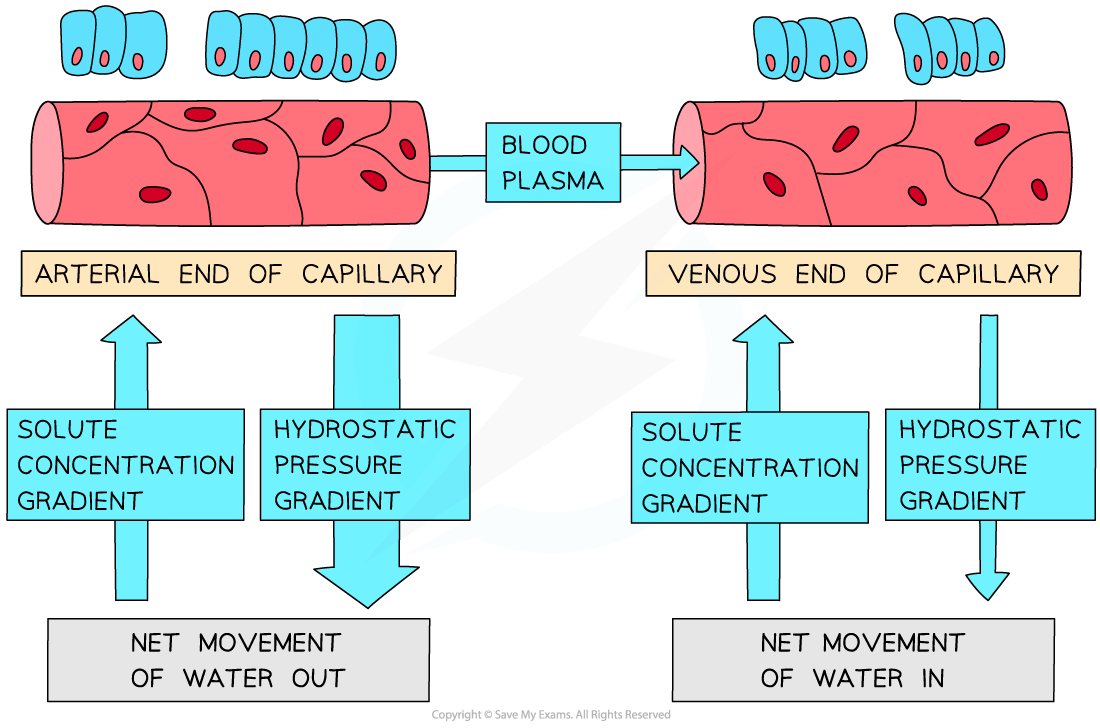
The formation of tissue fluid is caused by the solute concentration and hydrostatic pressure gradients
-
Tissue fluid formation can be affected by factors such as:
- High blood pressure: this can force extra fluid out of the capillaries, meaning that an increased volume of fluid is left behind after the effects of osmosis
- Low blood protein content: this can increase the water potential of the blood and so reduce the effect of osmosis, also resulting in a build-up of fluid in the tissues
Was this revision note helpful?
Build on this topic