Osmosis in Animals (Cambridge International A-Level Biology)
Osmosis: Animal Cells
Spec point — explain the movement of water between cells and solutions in terms of water potential and explain the different effects of the movement of water on plant cells and animal cells
-
Osmosis is the net movement of water molecules from a region of higher water potential(dilute solution) to a region of lower water potential (concentrated solution), through a selectively permeable membrane
-
Like plant cells, animal cells can also lose and gain water as a result of osmosis
-
Because animal cells do not have a supporting cell wall (unlike plant cells), the results of this loss or gain of water on the cell are more severe
-
For example, if an animal cell is placed in a solution with a lower water potential than the cell (such as a concentrated sucrose solution), water will leave the cell through its selectively permeable cell surface membrane by osmosis
- This will cause the cell to shrink and shrivel up
- This occurs when the cell is in a hypertonic environment (the solution outside of the cell has a higher solute concentration than the inside of the cell)
-
Conversely, if an animal cell is placed in pure water or a dilute solution, water will enter the cell through its selectively permeable cell surface membrane by osmosis, as the pure water or dilute solution has a higher water potential
- The cell will continue to **gain **water by osmosis until the cell membrane is stretched too far and the cell bursts (cytolysis), as it has no cell wall to withstand the increased pressure created
- This occurs when the cell is in a hypotonic environment (the solution outside of the cell has a lower solute concentration than the inside of the cell)
-
-
This is why a constant water potential must be maintained inside the bodies of animals
-
If an animal cell is in an isotonic environment (the solution outside of the cell has the** same solute concentration** as the inside of the cell), the movement of water molecules into and out of the cell occurs at the same rate (no net movement of water)
- This means there is no change to the cells
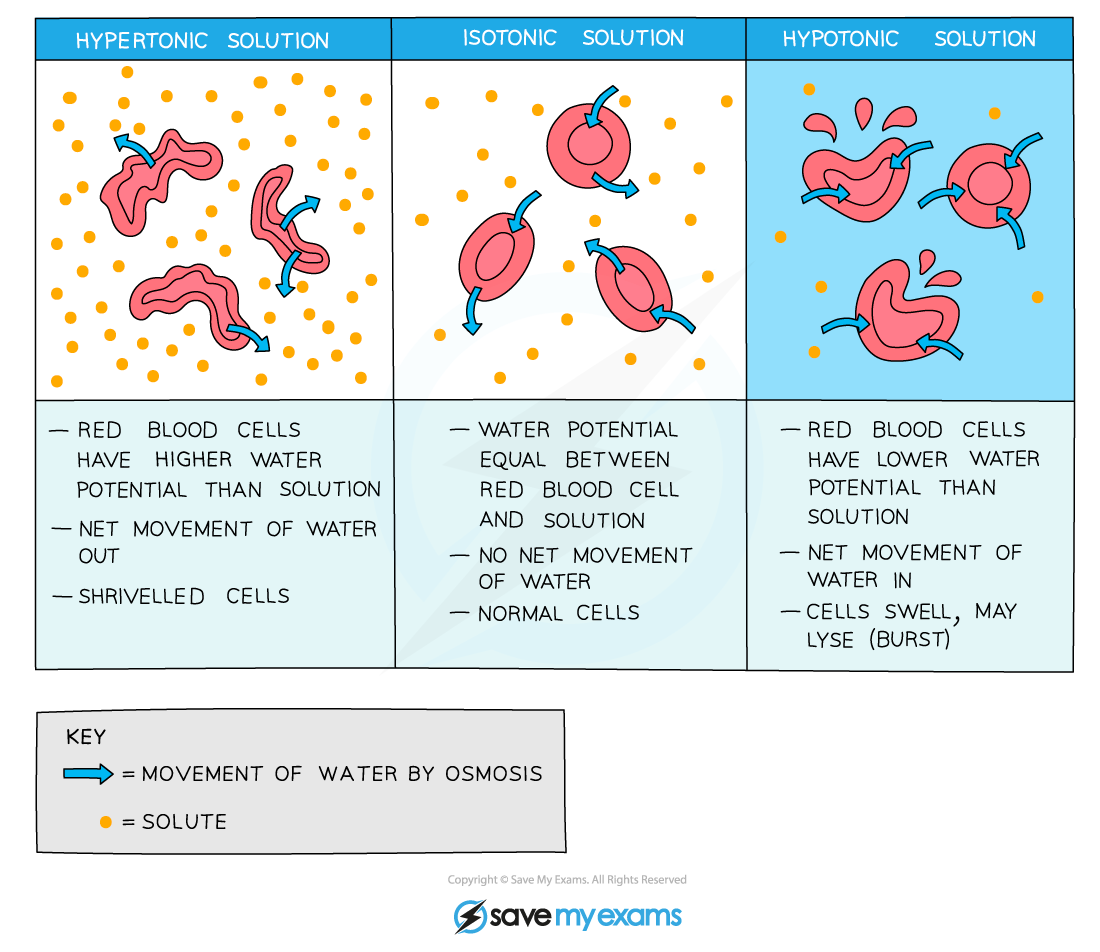
Effect of osmosis on animal cells
Exam Hint Be careful with your scientific terminology—animal cells do not plasmolyse because they do not have a cell wall.
In a solution with a lower water potential than the cell itself, animal cells will shrink.
Plasmolysis only occurs in plant cells.
Was this revision note helpful?
Build on this topic