The Role of Auxin in Elongation Growth (Cambridge International A-Level Biology)
Spec point —
15.2.2· explain the role of auxin in elongation growth by stimulating proton pumping to acidify cell walls
The role of auxin in elongation growth
-
Plant hormones (also known as plant growth regulators) are responsible for most communication within plants
-
Auxins are a type of plant growth regulator that influence many aspects of growth, including elongation growth which determines the overall length of roots and shoots
-
The principle chemical in the group of auxins made by plants is IAA (indole 3-acetic acid) and this chemical is often simply referred to as ‘auxin’
- Auxins are a class of plant hormones that regulate growth in plants
-
Auxin (IAA) is synthesised in the growing tips of roots and shoots (ie. in the meristems, where cells are dividing)
-
Growth in these meristems occurs in three stages:
- Cell division by mitosis
- Cell elongation by absorption of water
- Cell differentiation
-
Auxin (IAA) is involved in controlling growth by elongation
Controlling growth by elongation
- Auxin molecules bind to a receptor protein on the cell surface membrane
- Auxin stimulates ATPase proton pumps to pump hydrogen ions from the cytoplasm **into the cell wall **(across the cell surface membrane)
- This acidifies the cell wall (lowers the pH of the cell wall)
- This activates proteins known as expansins, which** loosen the bonds between cellulose microfibrils**
- At the same time, potassium ion channels are stimulated to open
- This leads to an increase in potassium ion concentration in the cytoplasm, which decreases the water potential of the cytoplasm
- This causes the cell to absorb water by osmosis (water enters the cell through aquaporins)
- This increases the internal pressure of the cell, causing the cell wall to stretch (made possible by expansin proteins)
- The cell elongates
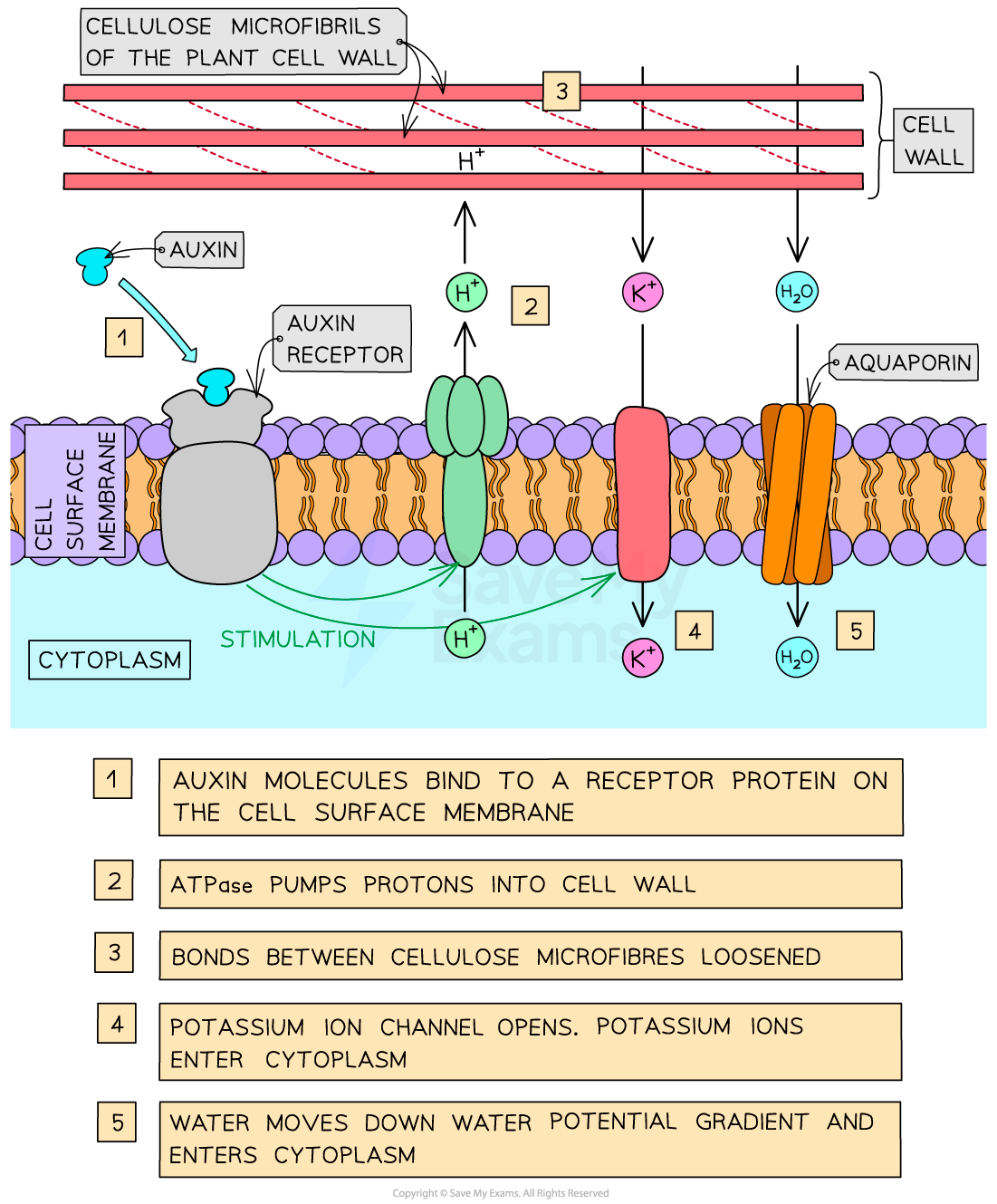
The role of auxin (IAA) in controlling growth by elongation
Was this revision note helpful?