Stages of Photosynthesis (Cambridge International A-Level Biology)
The Two Stages of Photosynthesis
Spec point —
13.1.2· explain that energy transferred as ATP and reduced NADP from the light-dependent stage is used during the light-independent stage (Calvin cycle) of photosynthesis to produce complex organic molecules
-
Photosynthesis occurs in two distinct stages:
- The light-dependent stage, which takes place in the thylakoids
- The light-independent stage, which takes place in the stroma
Summary of the light-dependent stage
-
Reduced NADP is produced when hydrogen ions combine with the carrier molecule NADP using electrons from the photolysis of water
-
ATP is produced in a process called photophosphorylation
- Photophosphorylation uses a proton (H+) gradient, set up when energy from electrons passing along the electron transport chain is used to pump protons into the thylakoid space
-
Energy from ATP and hydrogen from reduced NADP are passed from the light-dependent stage to the light-independent stage of photosynthesis
Summary of the light-independent stage
-
The energy and hydrogen (from the light-dependent stage) are used
-
This takes place in reactions known collectively as the Calvin cycle
-
Complex organic molecules are produced, including (but not limited to) carbohydrates, such as:
- Starch (for storage)
- Sucrose (for translocation around the plant)
- Cellulose (for making cell walls)
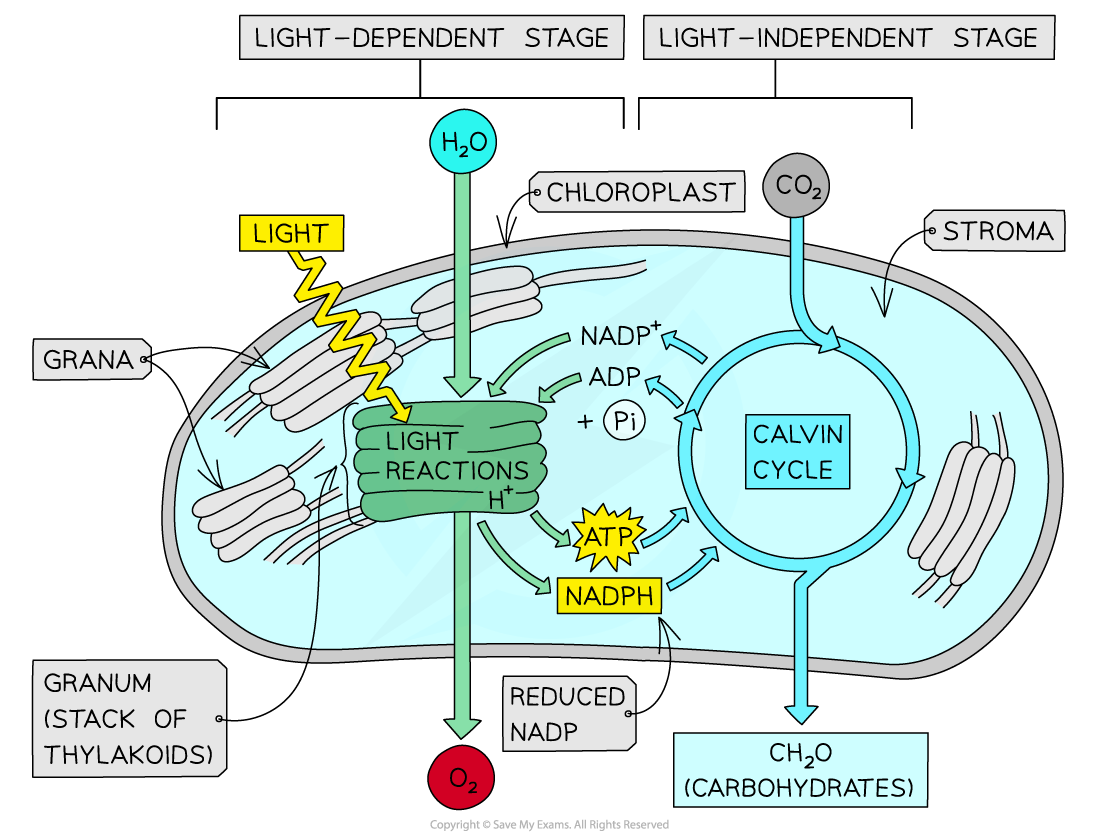
Photosynthesis occurs in two, closely-linked stages: the light-dependent stage, which takes place in the thylakoids, and the light-independent stage, which takes place in the stroma
Exam Hint Remember, the whole purpose of the light-dependent reactions is to produce ATP and reduced NADP, which are then supplied into the stroma and used to complete the process of photosynthesis through the light-independent reactions.
Was this revision note helpful?
Build on this topic