Kingdoms (Cambridge International A-Level Biology)
Spec point —
18.1.5· outline the characteristic features of the kingdoms Protoctista, Fungi, Plantae and Animalia
Kingdoms
-
The domain Eukarya can be divided into 4 kingdoms:
- Protoctista(protoctists)
- Fungi
- Plantae (plants)
- Animalia (animals)
-
Organisms from each of the four kingdoms have distinct characteristics and features
-
Although they share similarities:
- They have cells with membrane-bound nuclei separating genetic material from the cytoplasm
- They have compartmentalisation within their cells as a result of the presence of other organelles
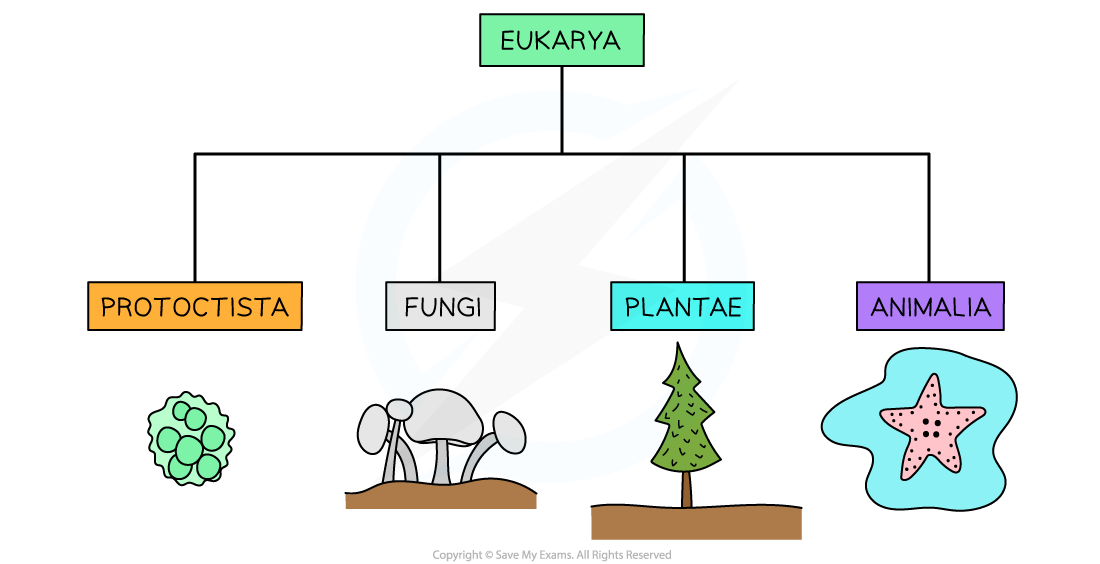
The four kingdoms within the Eukarya domain: protoctista, fungi, plantae and animalia
Kingdom Protoctista
-
All Protoctista are eukaryotic, and this broad group of cellular life encompasses all eukaryotic cells that do not belong to the other three eukaryotic kingdoms
-
Members of this kingdom show great diversity in all aspects of life including structure, life cycle, feeding and trophic levels and well as modes of locomotion
-
Protoctists can exist as single-celled organisms or as a group of similar cells
-
A group of Protoctista known as protozoa possess cells similar to animal cells
- Their cells have no cell wall
-
Another group of Protoctista known as algae possess cells similar to plant cells
- Their cells have cellulosecell walls and chloroplasts
Kingdom Fungi
-
The oldest organism in the world is thought to be a fungus aged somewhere between 1500 - 10,000 years old
-
All fungi are eukaryotic cells
-
The cells of fungi:
- Possess non-cellulose cell walls (often made of the polysaccharides chitin and glucans)
- Don’t have cilia
-
Fungi are heterotrophs:
- They use organic compounds made by other organisms as their source of energy and molecules for metabolism
- They obtain this energy and carbon by digesting dead/decaying matter extracellularly or from being parasites on living organisms
-
Fungi reproduce using spores that disperse onto the ground nearby
-
Fungi have a simple body form:
- They can be unicellular (like the common baker’s yeast Saccharomyces cerevisiae
- Some consist of long threads called hyphae that grow from the main fungus body (mycelium)
- Larger fungi possess fruiting bodies that release large numbers of spores
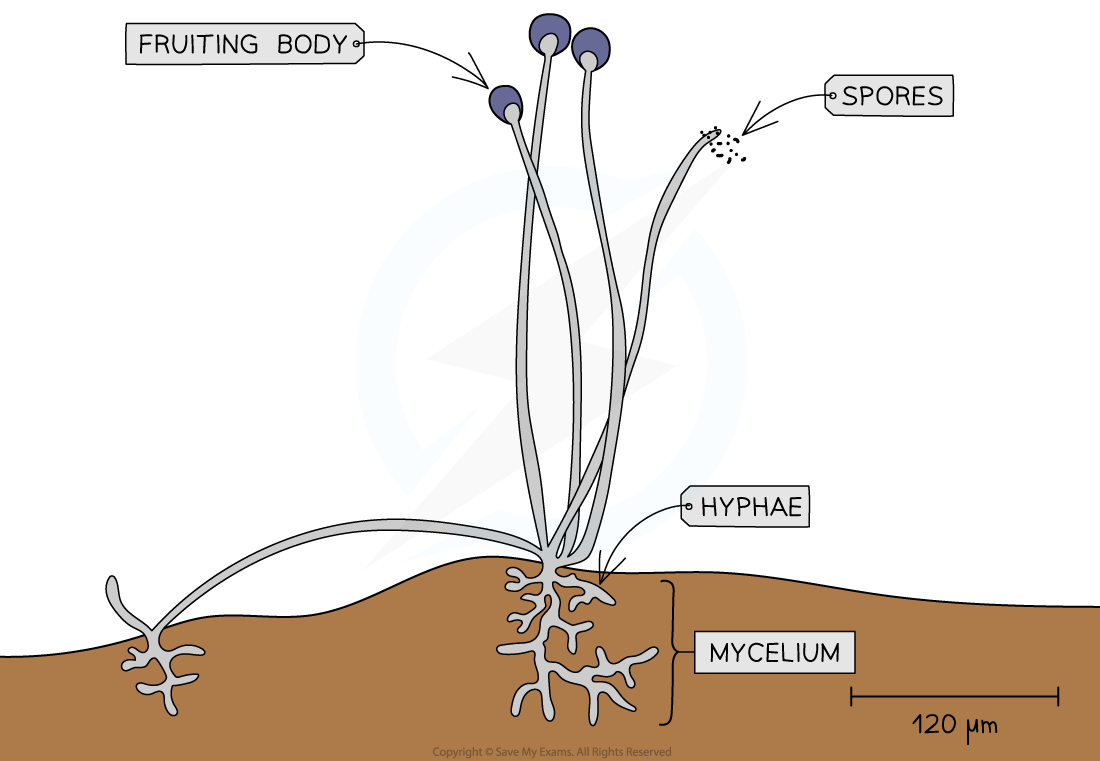
The structure of a fungus with its hyphae, mycelium and fruiting bodies
Kingdom Plantae
-
Plants are multicellular eukaryotic organisms
-
Plant cells:
- All have cell walls composed of cellulose
- Possess large (and usually permanent) vacuoles that provide structural support
- Are able to differentiate into specialised cells to form tissues and organs
- Possess chloroplasts that enable photosynthesis (not all plant cells have chloroplasts)
- Can sometimes have flagella
-
They are autotrophs
- This means they can synthesise their organic compounds and molecules for energy use and building biomass from inorganic compounds
-
Plants have complex body forms
- They have branching systems above and below the ground
Kingdom Animalia
-
Animals are also multicellular eukaryotic organisms
-
Animal cells:
- Are able to differentiate into many different specialised cell types that can form tissues and organs
- Have small temporary vacuoles (for example, lysosomes)
- Have no cell walls
- Sometimes have cilia
-
They are heterotrophs
- They have a wide range of feeding mechanisms
-
They have a wide range of body forms:
- Communication within their complex body forms takes place through a nervous system and chemical signalling
Was this revision note helpful?
Build on this topic