Active Transport (Cambridge International A-Level Biology)
The Process of Active Transport
Spec point — describe and explain the processes of active transport
-
Active transport is the movement of molecules and ions through a cell membrane from a region of lower concentration to a region of higher concentration using energy from respiration
-
Active transport requires carrier proteins (each carrier protein being **specific **for a particular type of molecule or ion)
-
Although facilitated diffusion also uses carrier protein, active transport is different as it requires an** input of additional energy**
- The energy is required to make the carrier protein change shape, allowing it to transfer the molecules or ions across the cell membrane
- The energy required is provided by hydrolysis of ATP (adenosine triphosphate), which is produced during respiration
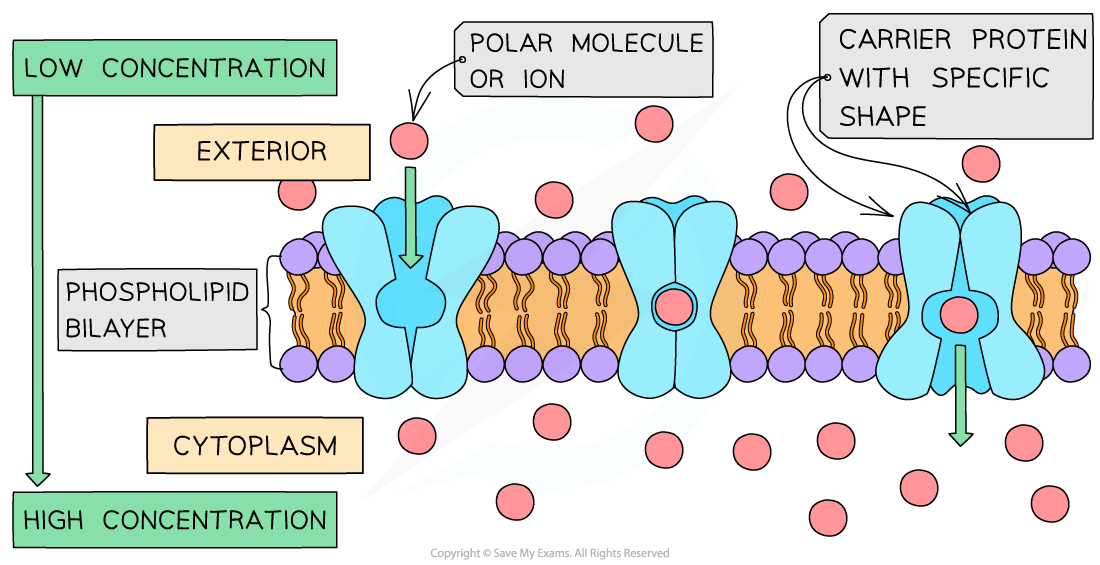
A carrier protein changing shape during active transport
Exam Hint Be careful not to get carrier proteins and channel proteins confused when answering questions on active transport.
Active transport requires carrier proteins (transmembrane transport proteins that undergo conformational change) not channel proteins.
Was this revision note helpful?
Build on this topic