11 markeasy
Which enzyme is required for transcription?
Choose your answer
Helicase
RNA polymerase
DNA ligase
DNA polymerase
30 questions · 30 marks · ≈ 30 min
Which enzyme is required for transcription?
Choose your answer
Helicase
RNA polymerase
DNA ligase
DNA polymerase
Name the molecule that is the end product of translation.
Choose your answer
tRNA
mRNA
polypeptide
amino acid
Sickle cell disease is caused by a change in the DNA sequence. The haemoglobin of affected people has a valine amino acid in its chain rather than glutamic acid.
What is the minimum number of base substitutions required to change the normal haemoglobin allele to the sickle cell allele?
Choose your answer
1
2
3
4
In a genetic engineering experiment a piece of double-stranded DNA containing 18000 nucleotides coding for a specific polypeptide is transcribed and translated.
What is the maximum number of amino acids in this polypeptide?
Choose your answer
3000
6000
9000
18000
This diagram shows two of polynucleotide strands.
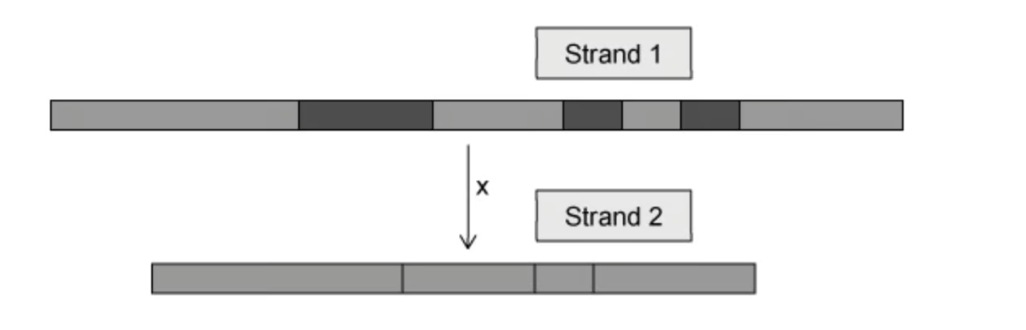
State the name of strand 2.
Choose your answer
tRNA
ribosomal RNA
DNA
mRNA
Which statement describes a process that occurs during protein synthesis?
Choose your answer
Translation is the synthesis of an mRNA molecule by base pairing of nucleotides with DNA.
RNA polymerase catalyses formation of covalent bonds in transcription.
Transcription is the linking together of amino acids coded by mRNA.
Transcription is the linking together of free DNA nucleotides.
Which of the following biological molecules are required for translation?
Choose your answer
amino acids, DNA and ribosomes
ribosomes, mRNA and protein synthase
mRNA, RNA polymerase and ribosomes
ribosomes, mRNA and tRNA
In a DNA molecule, the base sequence TGT codes for the amino acid threonine.
What is the base sequence of the anti-codon on the tRNA to which threonine becomes attached?
Choose your answer
UCU
TGT
ACA
UGU
A length of double-stranded DNA contains 180 nucleotides and codes for enzyme Z.
What is the maximum number of amino acids in enzyme X?
Choose your answer
30
60
180
540
The protein p53 is also known as the ‘Guardian of the Genome’. It is produced in response to DNA damage and helps prevent the formation of tumours.
Which of these could lead to an increase in the production of p53 in the body?
| 1 | X-rays |
|---|---|
| 2 | Sunbeds |
| 3 | Smoking |
Choose your answer
1, 2 and 3
1 and 2 only
2 and 3 only
1 and 3 only
A piece of DNA was analysed to find the number of nucleotide bases in each of the polynucleotide strands.
Some of the results are shown below:
| number of nucleotide bases | ||||
|---|---|---|---|---|
| A | T | G | C | |
| Strand 1 | 30 | 22 | ||
| Strand 2 | 30 | 38 |
What is the maximum number of amino acids that could be coded for by this DNA?
Choose your answer
22
29
34
40
What is the correct sequence for the processes involved in the formation of a protein?
Choose your answer
transcription → peptide bonding → translation → ionic bonding
transcription → translation → peptide bonding → hydrogen bonding
transcription → peptide bonding → translation → hydrogen bonding
translation → peptide bonding → transcription → ionic bonding
What terminates the formation of a polypeptide chain during protein synthesis in cells?
Choose your answer
when the ribosome reaches the end of the mRNA molecule
when there are no more tRNA molecules
when the ribosome reaches a stop codon on the mRNA
RNA polymerase detaches the polypeptide chain from the ribosome
DNA is composed of two strands, the transcribed strand and the non-transcribed strand.
Here is a section of DNA:
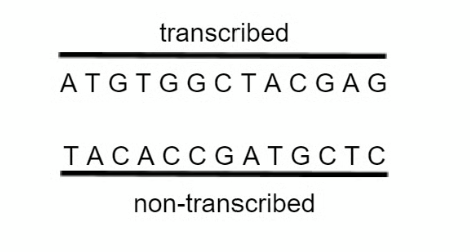
What would the corresponding mRNA sequence be for this section of DNA?
Choose your answer
T A C A C C G A T G C T C
A U G U G G C U A C G A G
A T G T G G C T A C G A G
U A C A C C G A U G C U C
If a polypeptide chain is comprised of 200 amino acids, it might be expected that the coding gene in the DNA would be comprised of 600 bases, however, in reality the DNA sequence is longer than this.
What is the reason for this difference?
Choose your answer
presence of introns and start/stop codons
presence of exons and start/stop codons
presence of introns
presence of exons
A polypeptide has the amino acid sequence alanine–valine–lysine–serine–glycine.
The table gives some possible tRNA anticodons for each amino acid.
| amino acid | tRNA anticodons |
|---|---|
| serine valine lysine alanine glycine | UCG UCA GUA GUC AAA AAG GCU GCG GGA GGC |
Which sequence of bases on DNA could code for the polypeptide?
Choose your answer
GCUGUCAAAGUAUGA
GCTGTCAAAAAGGAG
GCUGUAAAGUCGUAA
GCTGTAAAGTCGGGC
Which statements are correct about DNA replication, transcription and translation?
| DNA replication | transcription | translation | |
|---|---|---|---|
| A | produces mRNA | occurs in the cytoplasm | tRNA involved |
| B | DNA polymerase involved | RNA polymerase involved | produces mRNA |
| C | is semi-conservative | produces mRNA | occurs at a ribosome |
| D | occurs in the nucleus | occurs in the nucleus | RNA polymerase involved |
Choose your answer
Which term best describes a section of DNA that codes for the synthesis of a polypeptide?
Choose your answer
protein
gene
exon
triplet
Why does a silent mutation have no effect on the polypeptide chain?
Choose your answer
the dominant allele can compensate for the silent mutation
a silent mutation does not cause a frameshift
a silent mutation substitutes for a similar type of amino acid
multiple codons can code for the same amino acid
Which enzymes are not needed for DNA transcription?
| 1 | Helicase |
|---|---|
| 2 | DNA ligase |
| 3 | RNA polymerase |
| 4 | DNA polymerase |
Choose your answer
1, 2 and 3 only
2 and 3 only
2 and 4 only
1 and 3 only
Ribosomes exist as two separate subunits that join together during protein synthesis.
What do these subunits consist of?
Choose your answer
rRNA and protein
rRNA and lipid
rRNA and mRNA
rRNA and tRNA
The diagram shows a section of DNA.

What would the corresponding anticodon sequence be for the third DNA triplet?
Choose your answer
G A T
C T A
C U G
G A U
The diagram shows two sections of RNA.
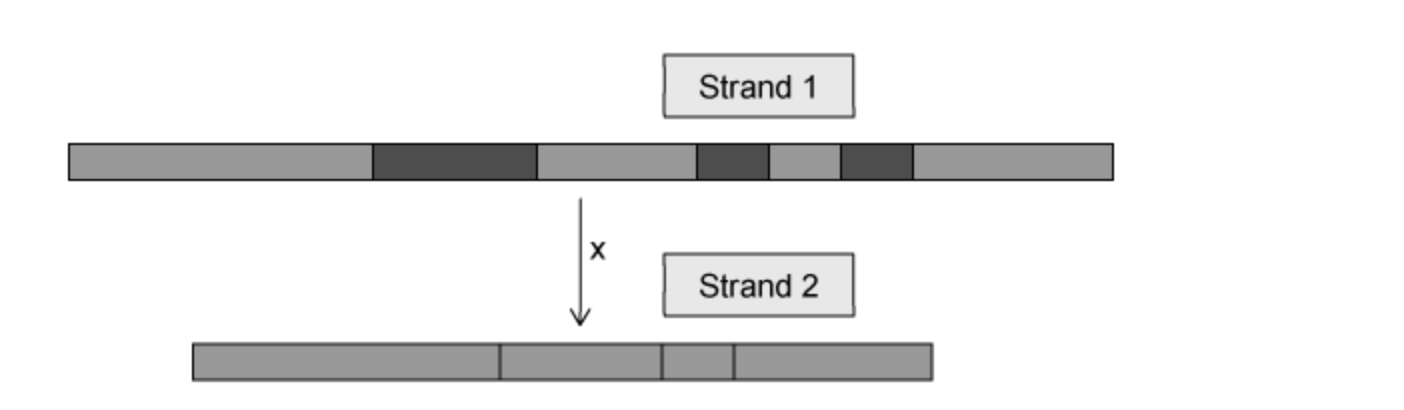
Which row of the table is correct?
| process X is needed to make a functional protein | strand 1 is mRNA | strand 2 is mRNA | process X removes exons | strand 1 contains introns and exons | |
|---|---|---|---|---|---|
| A | X | ✓ | X | X | ✓ |
| B | ✓ | X | ✓ | X | ✓ |
| C | X | X | ✓ | ✓ | ✓ |
| D | ✓ | ✓ | ✓ | X | X |
Choose your answer
A polypeptide has the amino acid sequence:
alanine – alanine – valine – lysine – valine – serine
The table gives the DNA triplets for each amino acid.
| amino acid | DNA triplets |
|---|---|
| serine valine lysine alanine stop | TCG GTA AAA GCT TAA |
A substitution mutation in the DNA coding for this polypeptide chain caused the tenth nucleotide to swap from an A to a T
How would the amino acid sequence in the polypeptide now look?
Choose your answer
alanine – alanine – valine – lysine – valine – serine
alanine – alanine – valine – stop – valine – serine
alanine – alanine – valine
alanine – alanine – valine – serine – valine – serine
Some antibiotics work by preventing protein synthesis in bacteria by binding to their ribosomes.
Which statement explains why these antibiotics kill bacterial cells but not human cells?
Choose your answer
ribosomes in human cells have a different structure to those in bacterial cells
antibiotics recognise human antigens on the cell membrane
both DNA and ribosomes are located in the cytoplasm in bacteria
bacterial cells have different nucleotides to human cells
Which of the following statements is not a description of a gene?
Choose your answer
Any section of a double stranded DNA molecule with a sequence of complementary nucleotides held together by hydrogen bonding.
A sequence of nucleotides that can be transcribed using a polymerase enzyme and free activated nucleotides, which results in the formation of mRNA.
A length of DNA which carries coded information as a sequence of nucleotides that can result in the formation of a polypeptide chain.
A sequence of nucleotides which can be copied by complementary base pairing and then be translated at a ribosome.
Which row in the table correctly shows situations in which both DNA and RNA are involved?
| replication | transcription | translation | protein synthesis | |
|---|---|---|---|---|
| A | ✓ | ✓ | X | X |
| B | ✓ | X | ✓ | X |
| C | X | X | ✓ | X |
| D | X | ✓ | X | ✓ |
key
✓ involved
X not involved
Choose your answer
A gene produces a pre-RNA that is 1450 bases in length and has the following intron-exon structure:
Exon 1 - 250 bp
Intron 1 - 150 bp
Exon 2 - 50 bp
Intron 2 - 250 bp
Exon 3 - 750 bp
How many bases would the mRNA created from this gene have?
Choose your answer
400
1050
1250
1400
In eukaryotes, which of the following statements is true with regards to introns and exons?
Choose your answer
mature mRNA contains a mix of introns and exons
failure to remove introns can lead to production of faulty protein
exons in protein coding genes are removed by spliceosomes
exons are repeating sequences that are typically found at the end of a gene
A polypeptide has the amino acid sequence:
histidine – glutamine – lysine – alanine – valine – histidine – valine
The table gives the tRNA anticodons for each amino acid.
| amino acid | tRNA anticodons |
|---|---|
| histidine valine lysine alanine glutamine | CAU GUA AAA GCU CAG |
A mutation causes the 18th base in the DNA sequence to be deleted.
What would the amino acid sequence look like following this change?
Choose your answer
histidine – glutamine – lysine – alanine – valine – histidine
histidine – glutamine – lysine – alanine – valine
histidine – glutamine – lysine – alanine – valine – glutamine
histidine – glutamine – lysine – alanine – valine – histidine – valine