Extract:
Mining for gold produces waste material which contains sulfur-bearing minerals. When surface water and shallow groundwater come into contact with these minerals a chemical reaction occurs which produces sulfuric acid. This process is known as acid mine drainage and it can lower the soil pH to a level where very few plants can survive.
Environmentalists studied the area around an abandoned gold mine and discovered a few earleaf acacia, Acacia auriculiformis, individuals surviving in the acidic soil. A. auriculiformis typically occurs in more neutral or alkaline soils.
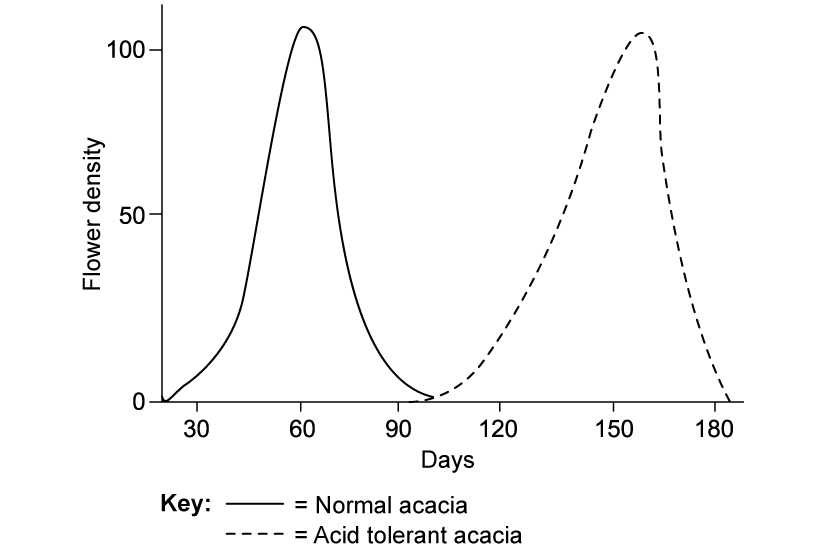
A. auriculiformis typically flowers from April to July in its native habitat. Ecologists studied the flowering time of the population of A. auriculiformis that are tolerant to low soil pH and compared it to the flowering time of a population growing in the surrounding habitat which was not tolerant to low soil pH. They measured the density of flowers found on the trees over a period of 180 days from 20 April.
Fig. 1 shows the results of this study.
The flowering times show that:
- Normal acacias have their peak flowering time 60/65 days (after the beginning of the study) WHILE acid tolerant acacias have peak flowering at (around) 160/165/170 days (after the beginning of the study)
- Normal acacia begin flowering at day 0 and finish flowering by (around) day 100 WHILE acid tolerant acacias begin flowering at (around) day 95 and finish flowering by (around) day 185
- There is a (very short) overlap in flowering times at (around) 95-100 days (after the start of the study)
Describe how the results shown in Fig. 1 could lead to the development of a new species of acacia.