Measuring Rates of Reactions (Edexcel IGCSE Science)
Measuring Rates
Measuring rates of reaction
-
Reactions take place at different rates depending on the chemicals involved and the conditions
- Some are extremely slow e.g. rusting and others are extremely fast e.g. explosives
-
You should be able to describe experiments to investigate the effect of surface area, concentration, temperature and a catalyst on a rate of reaction
Effect of surface area of a solid on the rate of reaction
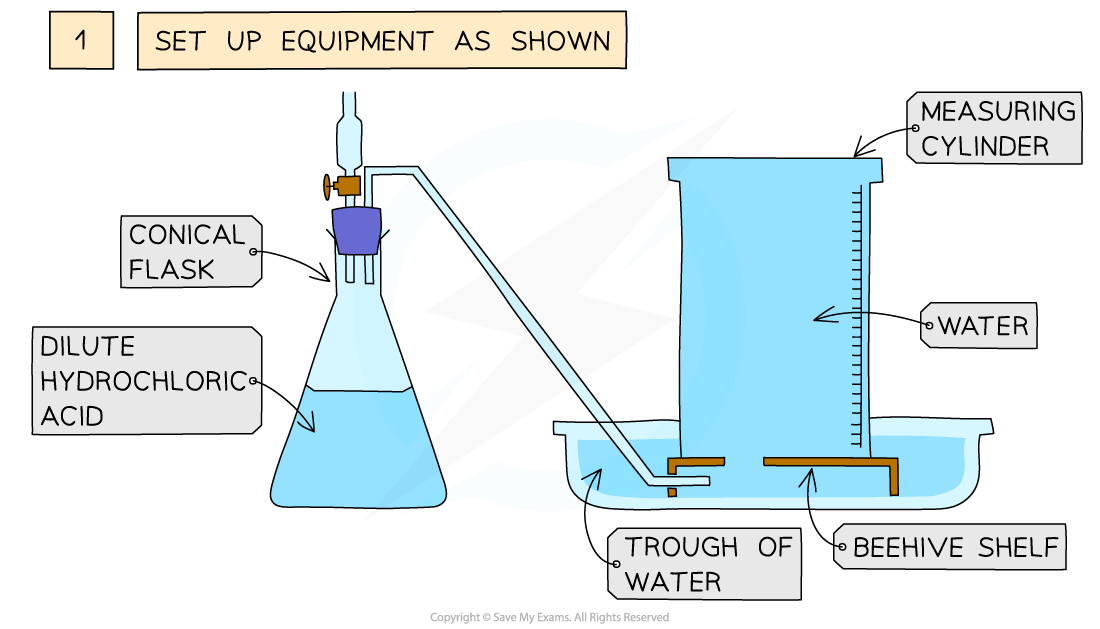
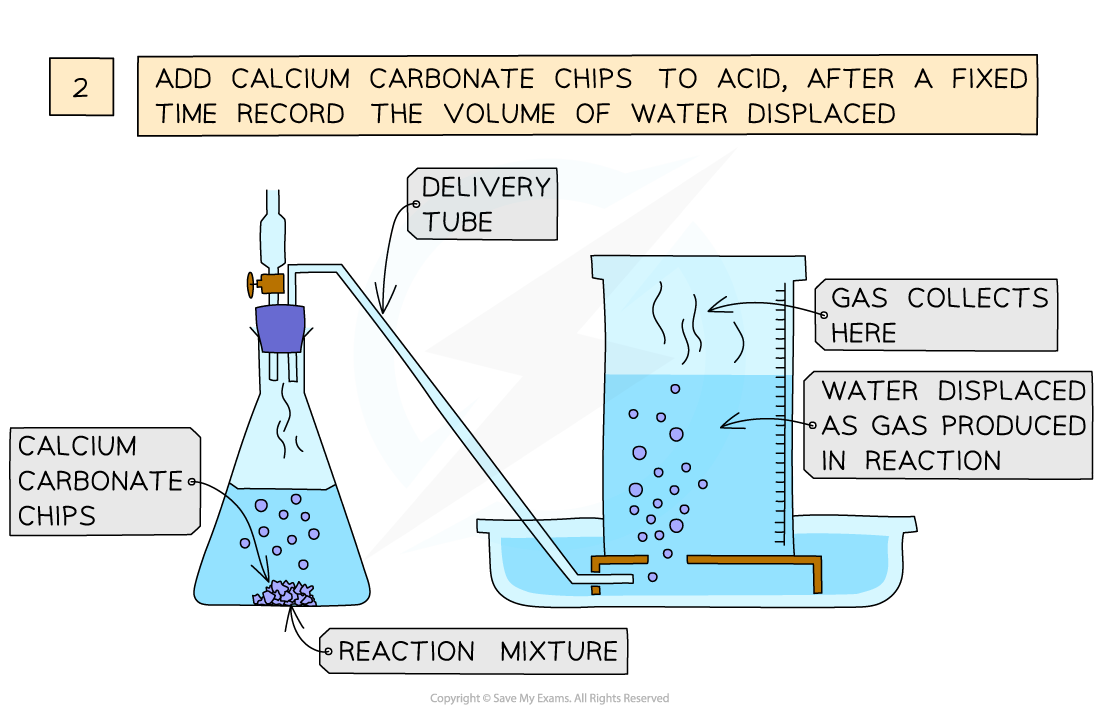
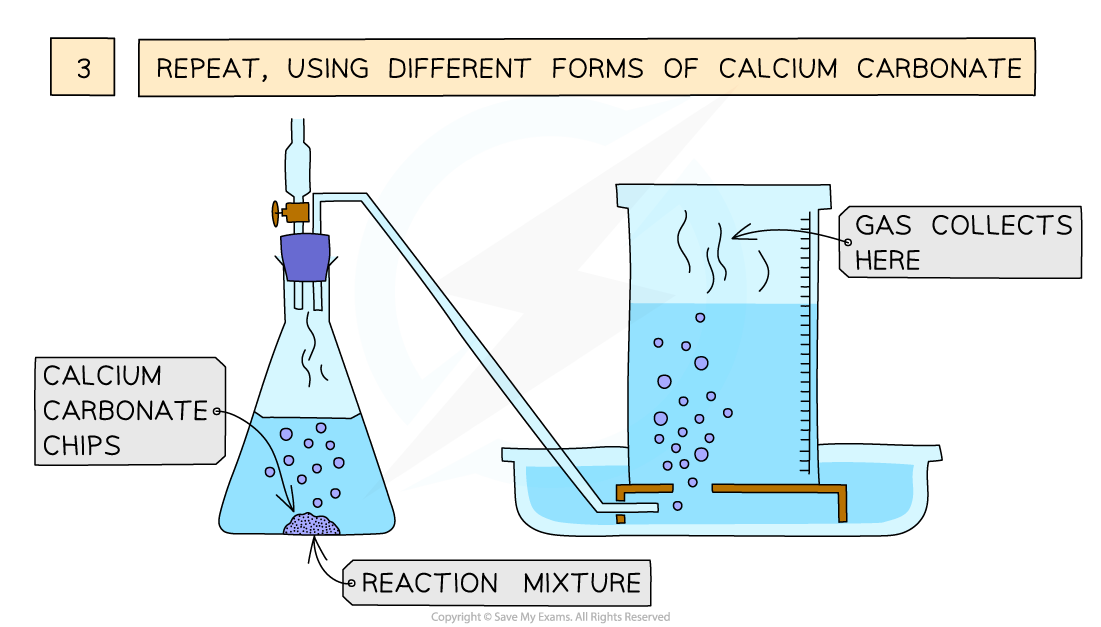
The process of downwards displacement to investigate the effect of the surface area of a solid on the rate of reaction
Method:
- Add dilute hydrochloric acid to the conical flask
- Use a delivery tube to connect this flask to an inverted measuring cylinder upside down in a water trough
- Add calcium carbonate chips into the conical flask and close the bung
- Measure the volume of gas produced in a fixed time using the measuring cylinder
- Repeat with different sizes of calcium carbonate chips
Effect of concentration of a solution on the rate of reaction
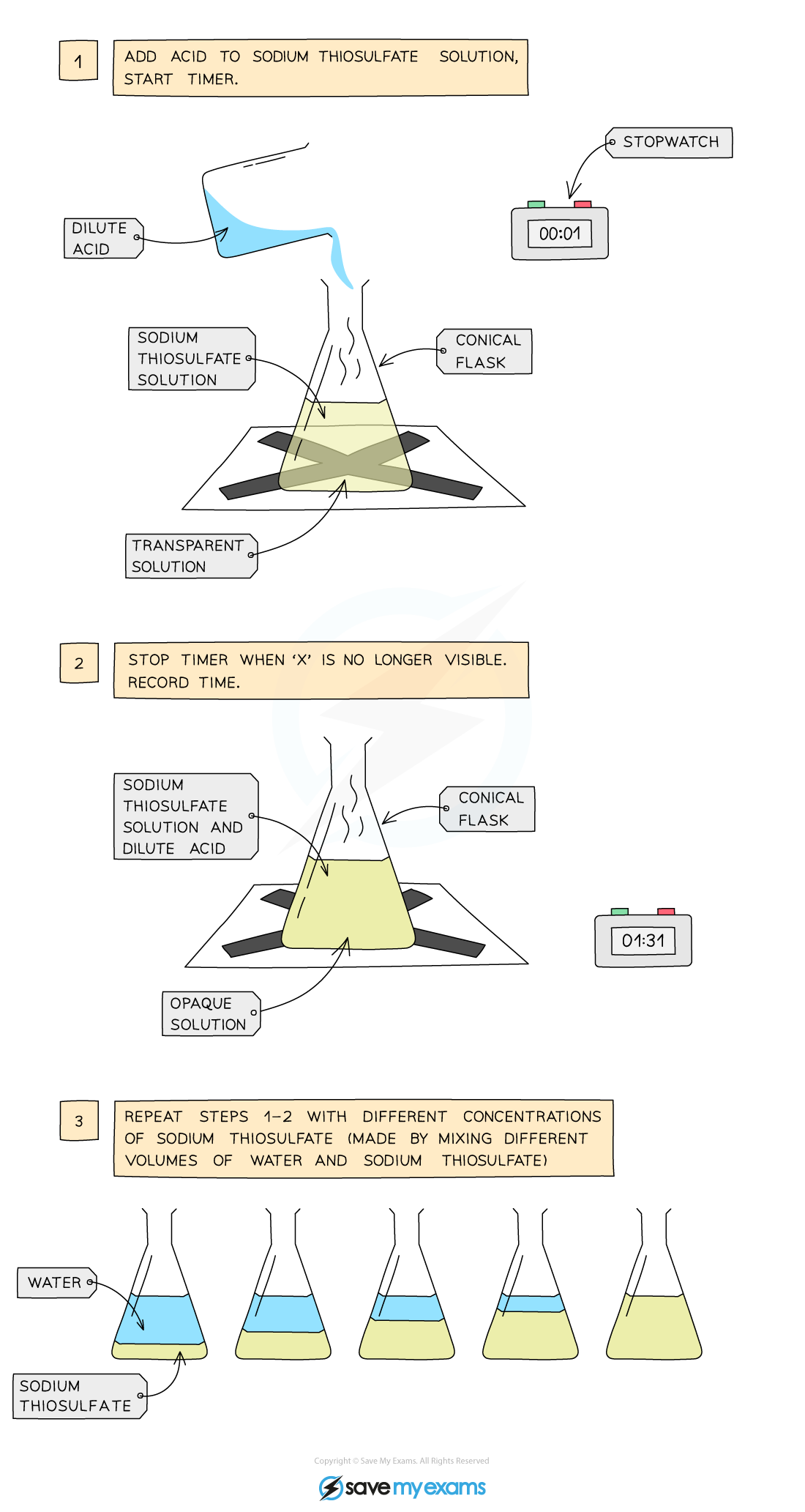
The apparatus needed to investigate the effect of concentration on the rate of reaction
Method:
- Measure 50 cm3 of sodium thiosulfate solution into a flask
- Measure 5 cm3 of dilute hydrochloric acid into a measuring cylinder
- Draw a cross on a piece of paper and put it underneath the flask
- Add the acid into the flask and immediately start the stopwatch
- Look down at the cross from above and stop the stopwatch when the cross can no longer be seen
- Repeat using different concentrations of sodium thiosulfate solution (mix different volumes of sodium thiosulfate solution with water to dilute it)
Result:
- With an increase in the concentration of a solution, the rate of reaction will increase
- This is because there will be more reactant particles in a given volume, allowing more frequent and successful collisions, increasing the rate of reaction
Effect of temperature on the rate of reaction
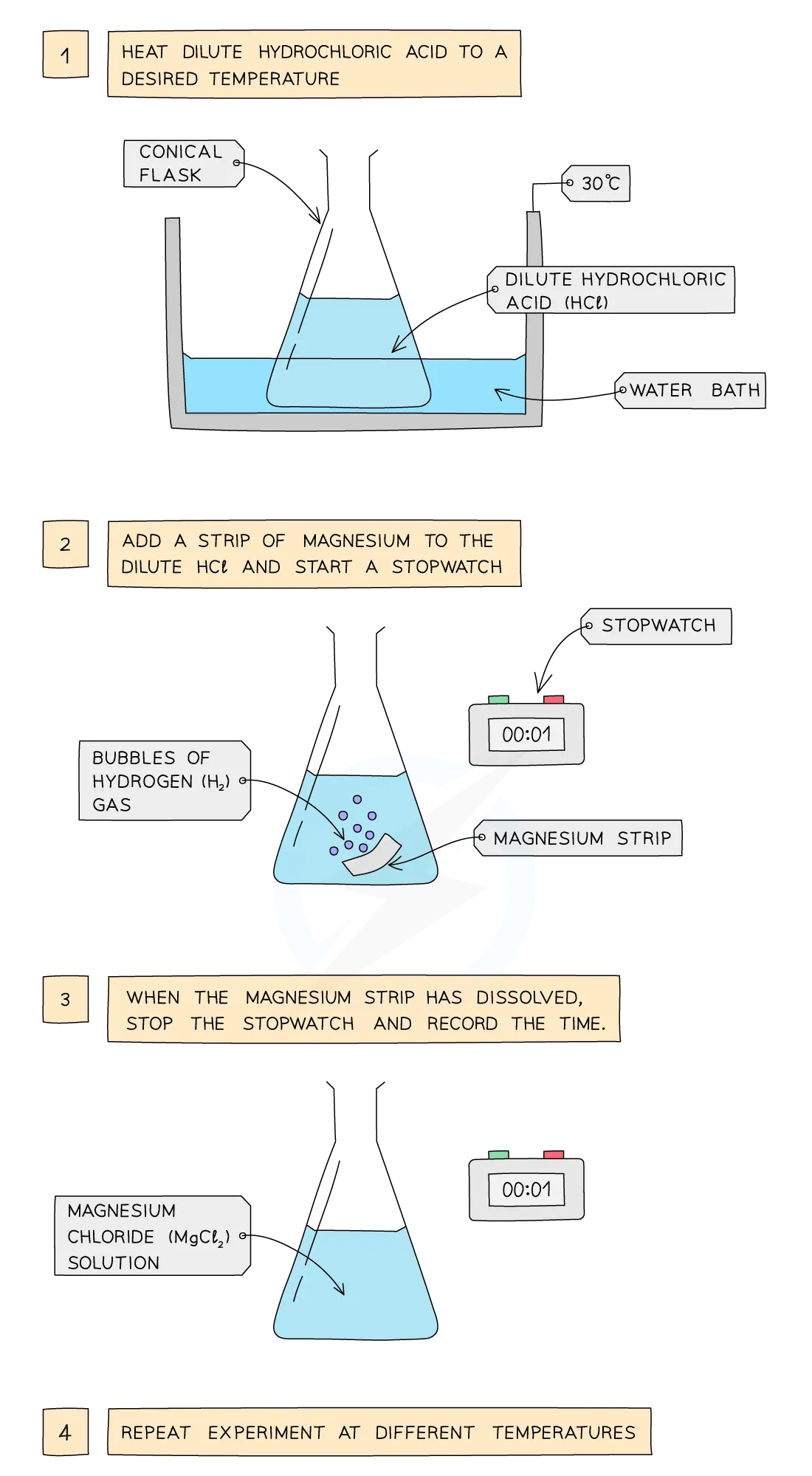
Diagram showing the apparatus needed to investigate the effect of temperature on the rate of reaction
Method:
- Dilute hydrochloric acid is heated to a set temperature using a water bath
- Add the dilute hydrochloric acid into a conical flask
- Add a strip of magnesium and start the stopwatch
- Stop the time when the magnesium fully dissolves
- Repeat at different temperatures and compare results
Result:
- With an increase in the temperature, the rate of reaction will increase
- This is because the particles will have more kinetic energy than the required activation energy, therefore more frequent and successful collisions will occur, increasing the rate of reaction
Effect of a catalyst on the rate of reaction
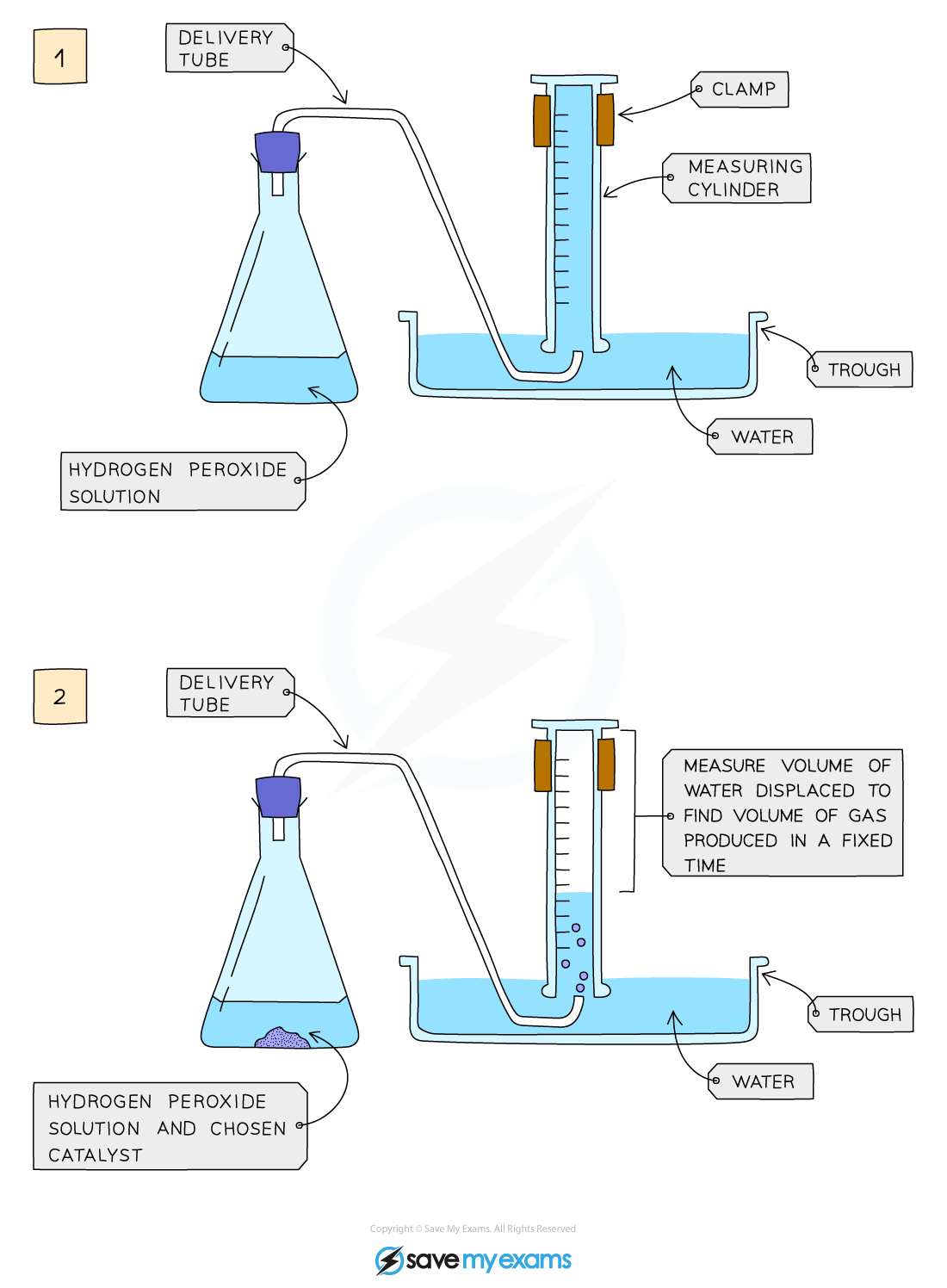
Diagram showing the apparatus needed to investigate the effect of a catalyst on the rate of reaction
Method:
- Add hydrogen peroxide into a conical flask
- Use a delivery tube to connect this flask to a measuring cylinder upside down in water trough
- Add the catalyst manganese(IV) oxide into the conical flask and close the bung
- Measure the volume of gas produced in a fixed time using the measuring cylinder
- Repeat experiment without the catalyst of manganese(IV) oxide and compare results
Factors Affecting Rates
Factors affecting rates of reaction
-
Factors that can affect the rate of a reaction are:
- The concentration of the reactants in solution or the pressure of reacting gases
- The temperature of the reaction
- Surface area of solid reactants
- The presence of a catalyst
-
Changes in these factors directly influence the rate of a reaction
-
It is of economic interest to have a higher rate of reaction as this implies a higher rate of production and hence a more efficient and sustainable process
The effect of increased concentration or pressure
Graph showing the effect of concentration on rate of reaction
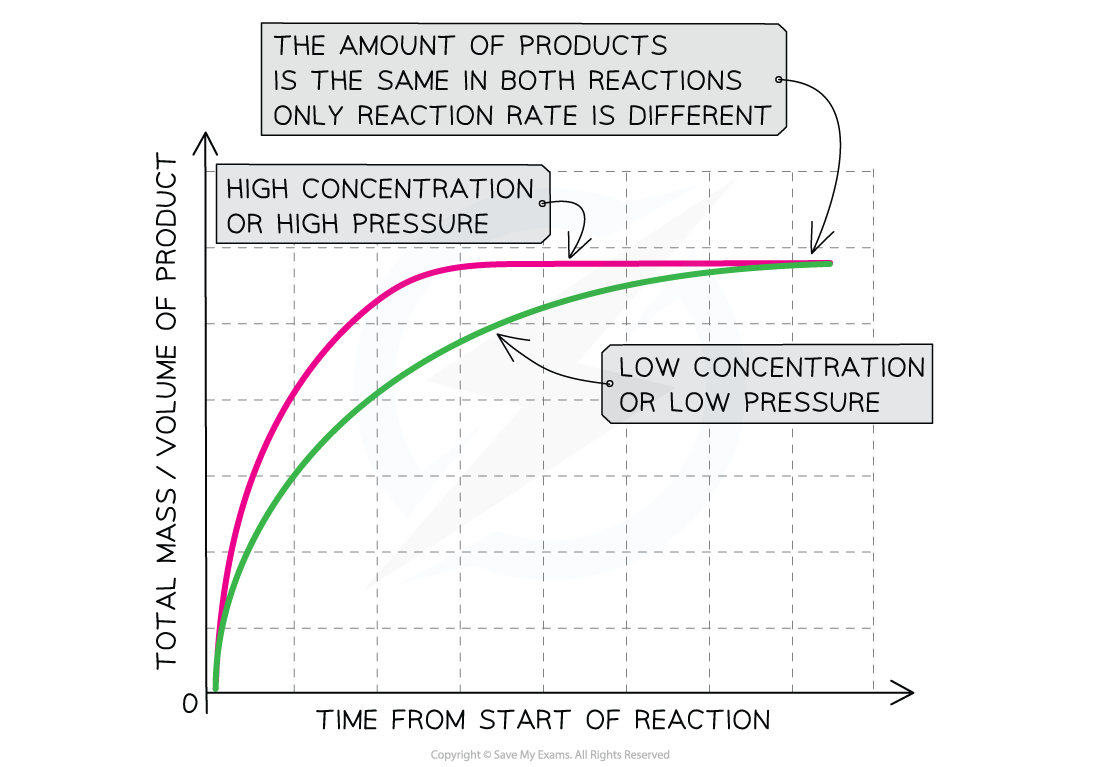
Increasing the concentration of a solution or gas pressure increases the rate of reaction
Explanation:
-
Compared to a reaction with a reactant at a low concentration (or pressure), the line graph for the same reaction at a higher concentration (or pressure):
- Has a steeper gradient at the start
- Becomes horizontal sooner
- Forms the same amount of product
-
This shows that increasing the concentration (or pressure) increases the rate of reaction
The effect of increasing temperature
Graph showing the effect of temperature on rate of reaction
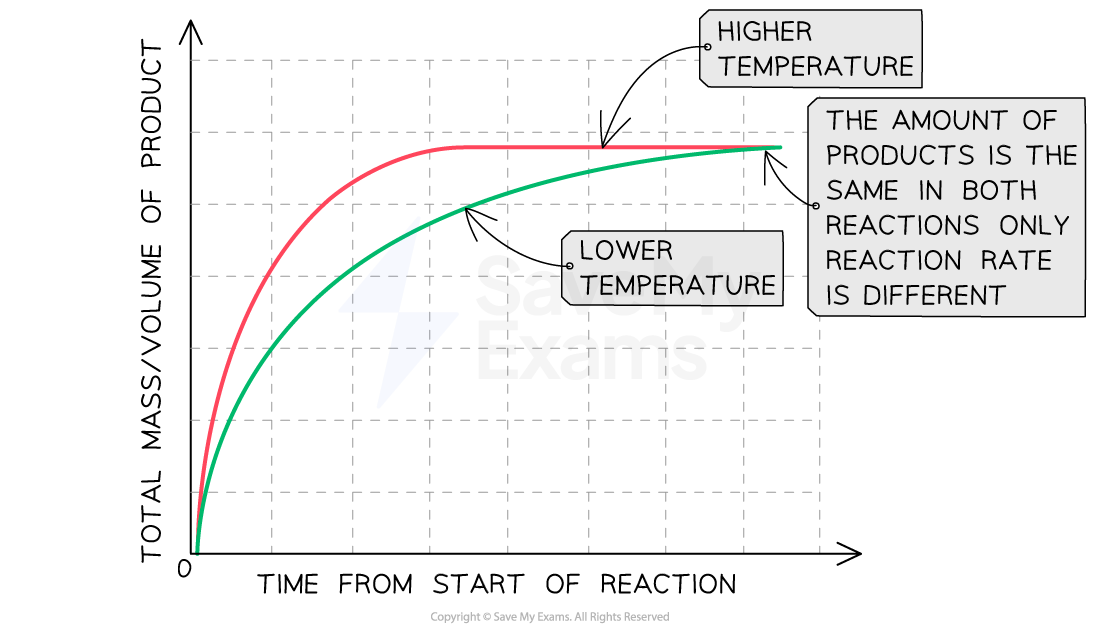
Increasing the temperature increases the rate of reaction
Explanation:
-
Compared to a reaction at a low temperature, the line graph for the same reaction at a higher temperature:
- Has a steeper gradient at the start
- Becomes horizontal sooner
- Forms the same amount of product
-
This shows that increasing the temperature increases the rate of reaction
The effect of increasing surface area
Graph showing the effect of surface area on rate of reaction
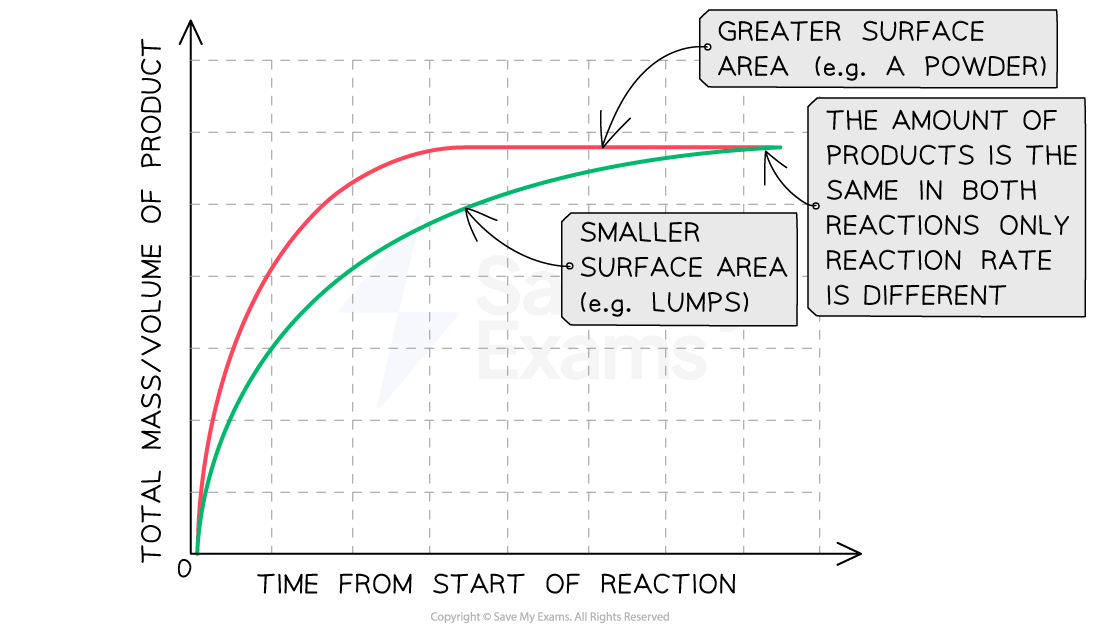
Increasing the surface area increases the rate of reaction
Explanation:
-
Compared to a reaction with lumps of reactant, the line graph for the same reaction with powdered reactant:
- Has a steeper gradient at the start
- Becomes horizontal sooner
- Forms the same amount of product
-
This shows that increasing the surface area increases the rate of reaction
- Increasing surface area can sometimes be described as decreasing solid particle size
Surface area and particle size
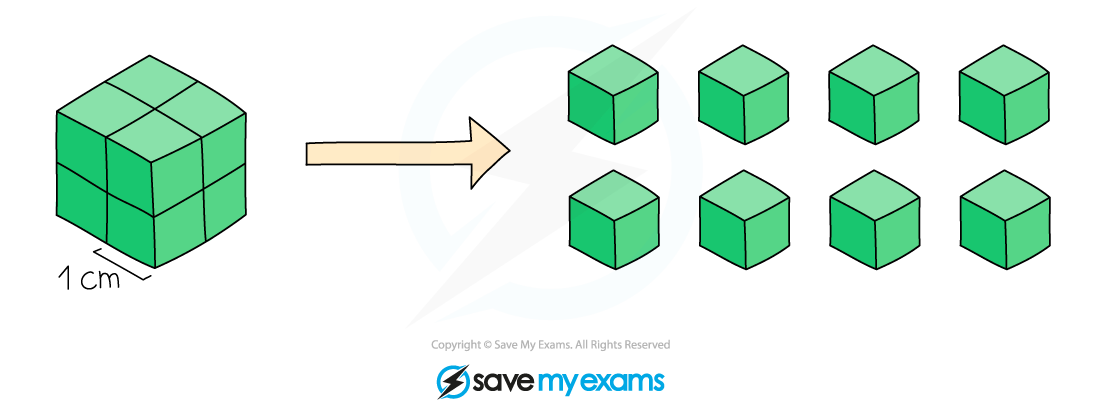
Surface area increases as particle size decreases. A 2 cm3cube has a surface area of 24 cm2and the same cube cut up into 8 cubes has a surface area of 48 cm2
Exam Hint You should be able to recall how changing the concentration, pressure, temperature, and surface area affect the rate of a reaction.
Was this revision note helpful?
Build on this topic