Organic Compounds (Edexcel IGCSE Science)
Representing Organic Compounds
Organic compounds
What is organic chemistry?
- Organic chemistry is the scientific study of the structure, properties, and reactions of organic compounds. Organic compounds are those which contain carbon
- For conventional reasons metal carbonates, carbon dioxide and carbon monoxide are not included in organic compounds
What is a hydrocarbon?
- A compound that contains only hydrogen and carbon atoms
Representing organic molecules
-
Organic compounds can be represented in a number of ways:
- Empirical formulae
- Molecular formulae
- General formulae
- Structural formulae
- Condensed structural formulae
Empirical formulae
The empirical formula shows the simplest possible ratio of the atoms in a molecule
- For example: Hydrogen peroxide is H2O2 but the empirical formula is HO
Molecular formulae
- The molecular formula shows the actual number of atoms in a molecule
Molecular formula of butane
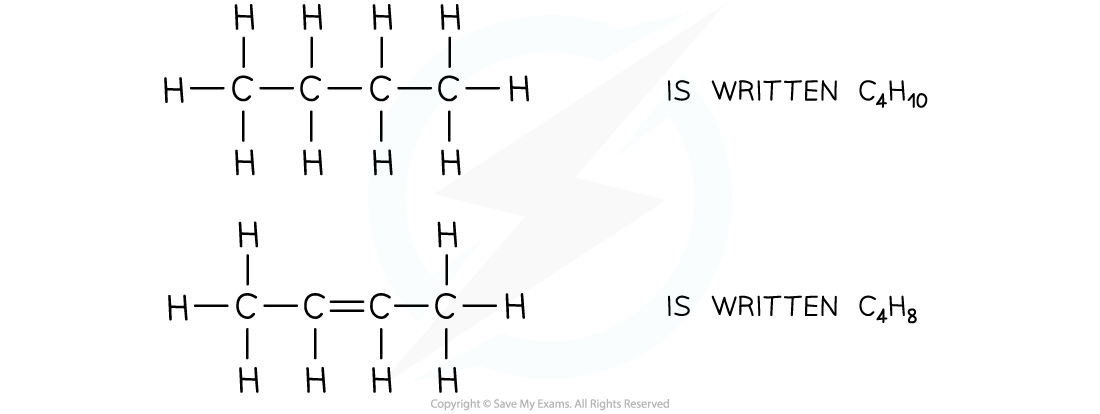
The molecular formula shows the actual number of atoms in a molecule
General formula
-
The general formula shows a ratio of atoms in a family of compounds in terms of 'n' where n is a varying whole number
- For example, the general formula of a molecule that belong to the alkane family is CnH2n+2
Displayed formulae
- The displayed formulae shows the spatial arrangement of all the atoms and bonds in a molecule
- This is also known as the graphical formula
Displayed formula of 2-methylbutane

The displayed formula must show every bond in the molecule
Structural formulae
- In a structural formulae enough information is shown to make the structure clear, but most of the actual covalent bonds are omitted
- Only important bonds are always shown, such as double and triple bonds
- Identical groups can be bracketed together
- Side groups are also shown using brackets
Structural formula of pentane

The structural formula of pentane makes it clear that there are five carbon atoms in the chain and no other functional groups
Exam Hint For defining a hydrocarbon, you must specify that they are compounds which contain hydrogen and carbon atoms only, no other element is present. You may not be asked to name branched chain organic compounds but you will come across them. It is useful to know that the numbers in the names of these compounds refer to the position of the side chains with respect to the main chain.
Organic Terminology
- Three important terms to know in this topic are homologous series,functional group and isomerism
Homologous series
-
This is a series or family of organic compounds that have similar features and chemical properties due to them having the same functional group
-
All members of a homologous series have:
- The same general formula
- Same functional group
- Similar chemical properties
- Gradation in their physical properties
- The difference in the molecular formula between one member and the next is CH2
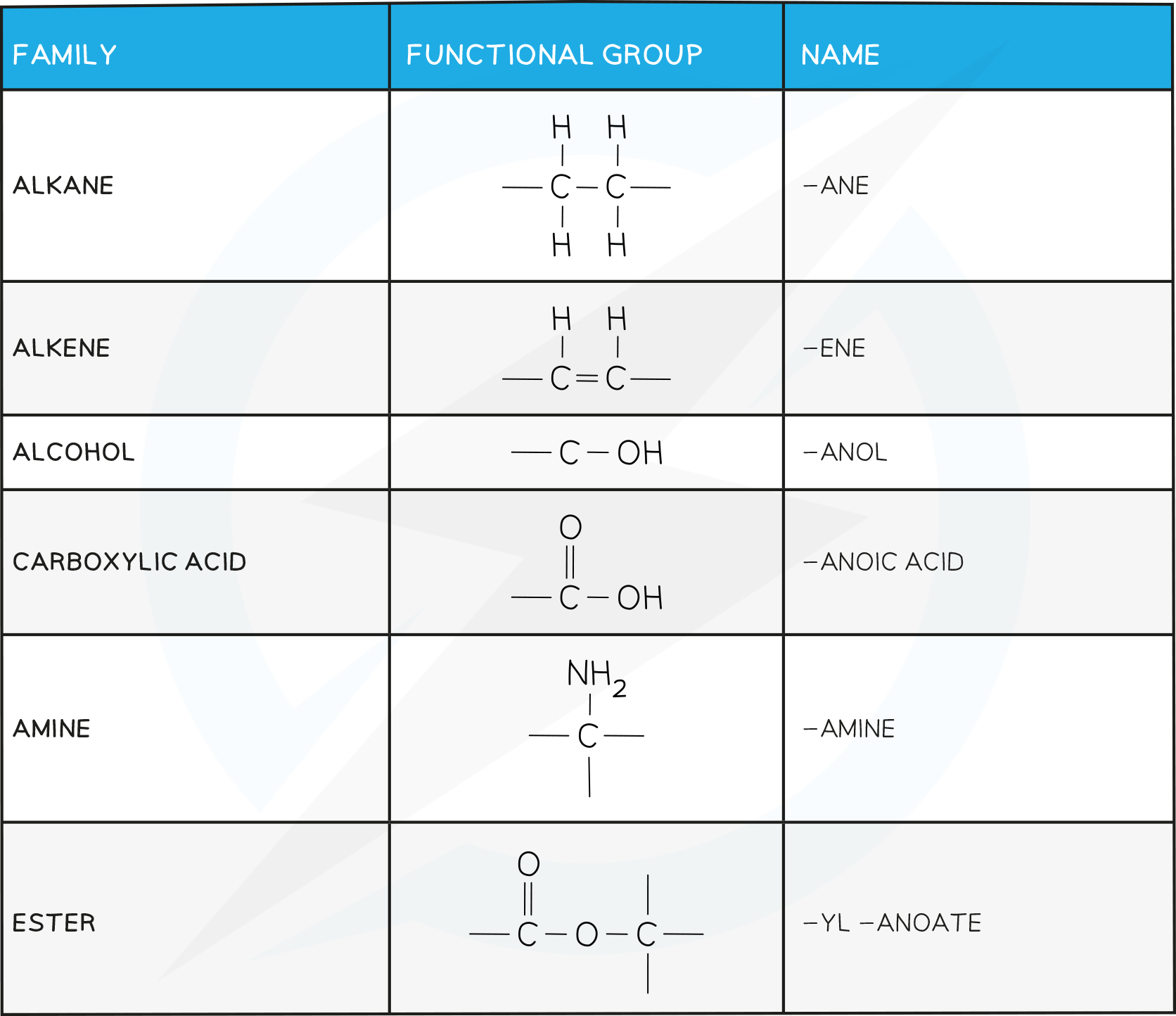
Functional group
- Functional group: A group of atoms bonded in a specific arrangement that influences the properties of the homologous series
- Some examples are shown here
Structures and names of common functional groups
Isomerism
-
Isomers are compounds that have the same molecular formula but different displayed formulae
- E.g. propene and cyclopropane
Isomers of C3H6
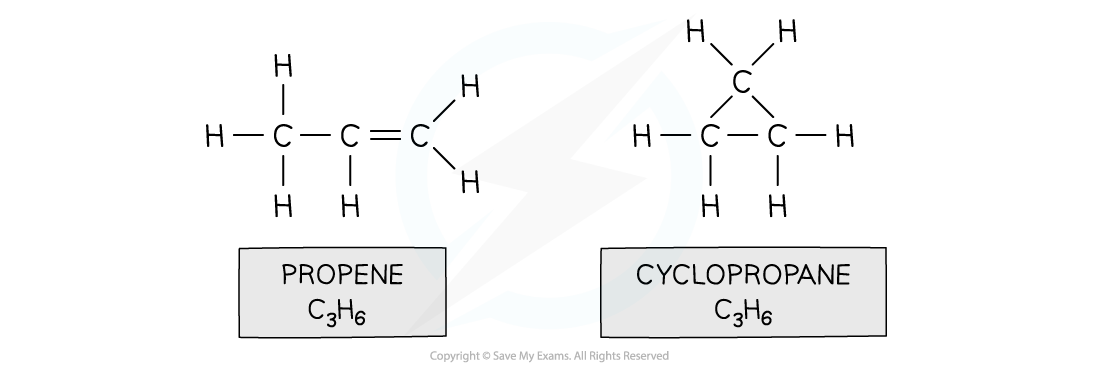
Isomers of C3H6show the same molecular formula but different structures. Isomers can show similar physical and chemical properties or if they have different functional groups, the properties can be different.
Was this revision note helpful?
Build on this topic