Human Nervous System (Edexcel IGCSE Science)
The Human Nervous System: Structure
Spec point —
3.37· understand that the central nervous system consists of the brain and spinal cord and is linked to sense organs by nerves
-
The human nervous system consists of:
- Central nervous system (CNS) – the brain and spinal cord
- Peripheral nervous system (PNS) – all of the nerves that branch out from the CNS to the rest of the body
-
Information is transmitted through the nervous system as electrical impulses – fast-moving electrical signals that pass along special cells called **neurones
-
A** nerve **is a bundle of neurones
-
Nerves extends from the CNS to** all areas of the body including the sense organs, allowing communication between the brain and different parts of the body
-
The CNS acts as the central coordinating centre processing incoming information from sense organs and coordinates the body's response
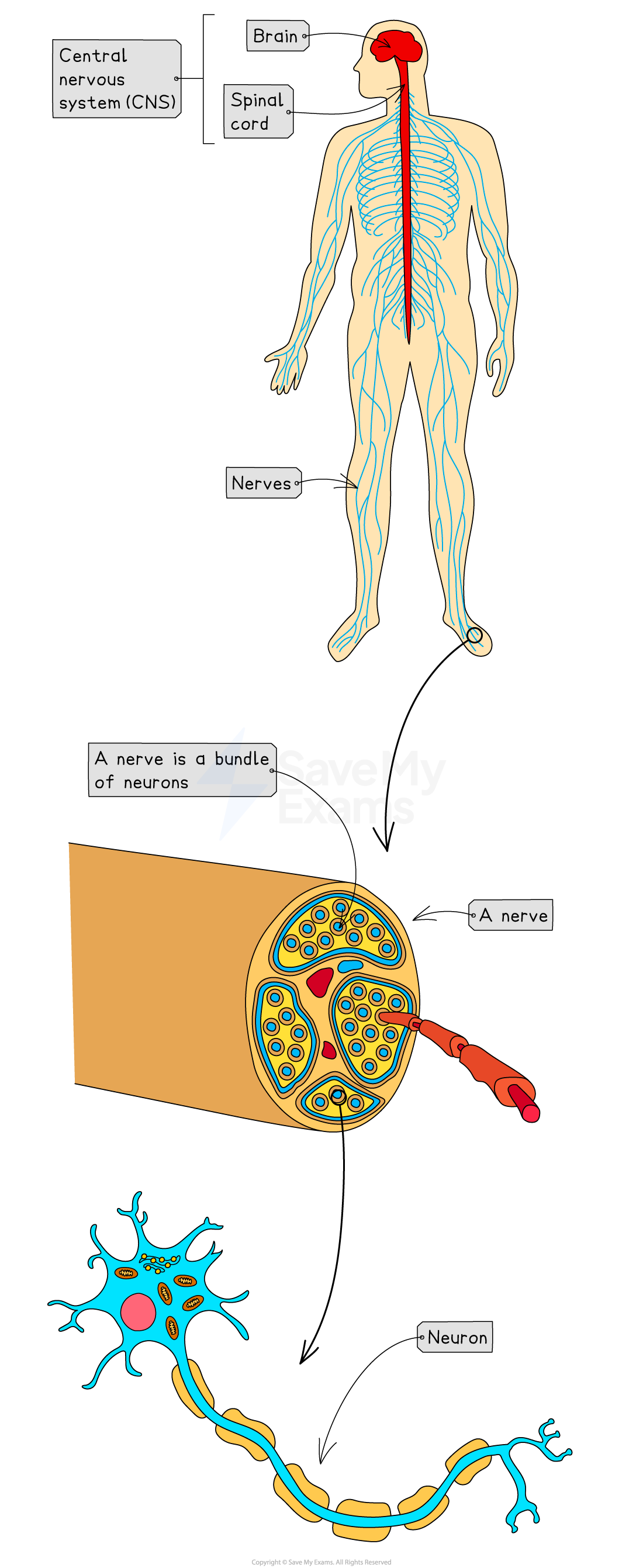
The central nervous system consists of the brain and spinal cord and is linked to sense organs by nerves which are bundles of neurones
The Human Nervous System: Function
Spec point —
3.38· "understand that stimulation of receptors in the sense organs sends electrical impulses along nerves into and out of the central nervous system, resulting in rapid responses"
The Human Nervous System: Function
-
Receptors in sense organs detect stimuli (eg. light, sound, touch, temperature, chemicals)
-
When stimulated, receptors produce electrical impulses
-
These impulses travel along sensory neurones to the CNS
-
The CNS processes the information and sends impulses along motor neurones to effectors (muscles or glands)
-
Effectors carry out a response (eg. muscle contracts or gland secretes
-
This pathway allows rapid, automatic communication within the body
-
In summary:
- Stimulus → receptor → sensory neurone → CNS → motor neurone → effector → response
Was this revision note helpful?
Build on this topic