Antibiotic Resistance (Edexcel IGCSE Science)
Spec point —
4.39· understand how resistance to antibiotics can increase in bacterial populations, and appreciate how such an increase can lead to infections being difficult to control
Antibiotic Resistance
-
Natural selection can give rise to bacterial populations that are resistant to antibiotics
-
Antibiotic resistance can increase in bacterial populations as follows:
- a random mutation can give rise to a new bacterial allele that codes for antibiotic resistance
- when the bacterial population is exposed to an antibiotic any individuals without the resistance allele die, while those with the resistance allele survive
- the surviving bacteria are more likely to reproduce, passing on their resistance alleles to their offspring
- over several generations the frequency of the resistance allele increases, eventually resulting in an antibiotic resistant strain of bacteria
-
Once a bacterial population has developed resistance to a particular antibiotic, it can only be treated with the application of a different antibiotic; in some cases several antibiotics need to be used to treat a resistant infection
-
Antibiotic resistance therefore makes bacterial infections more difficult to control
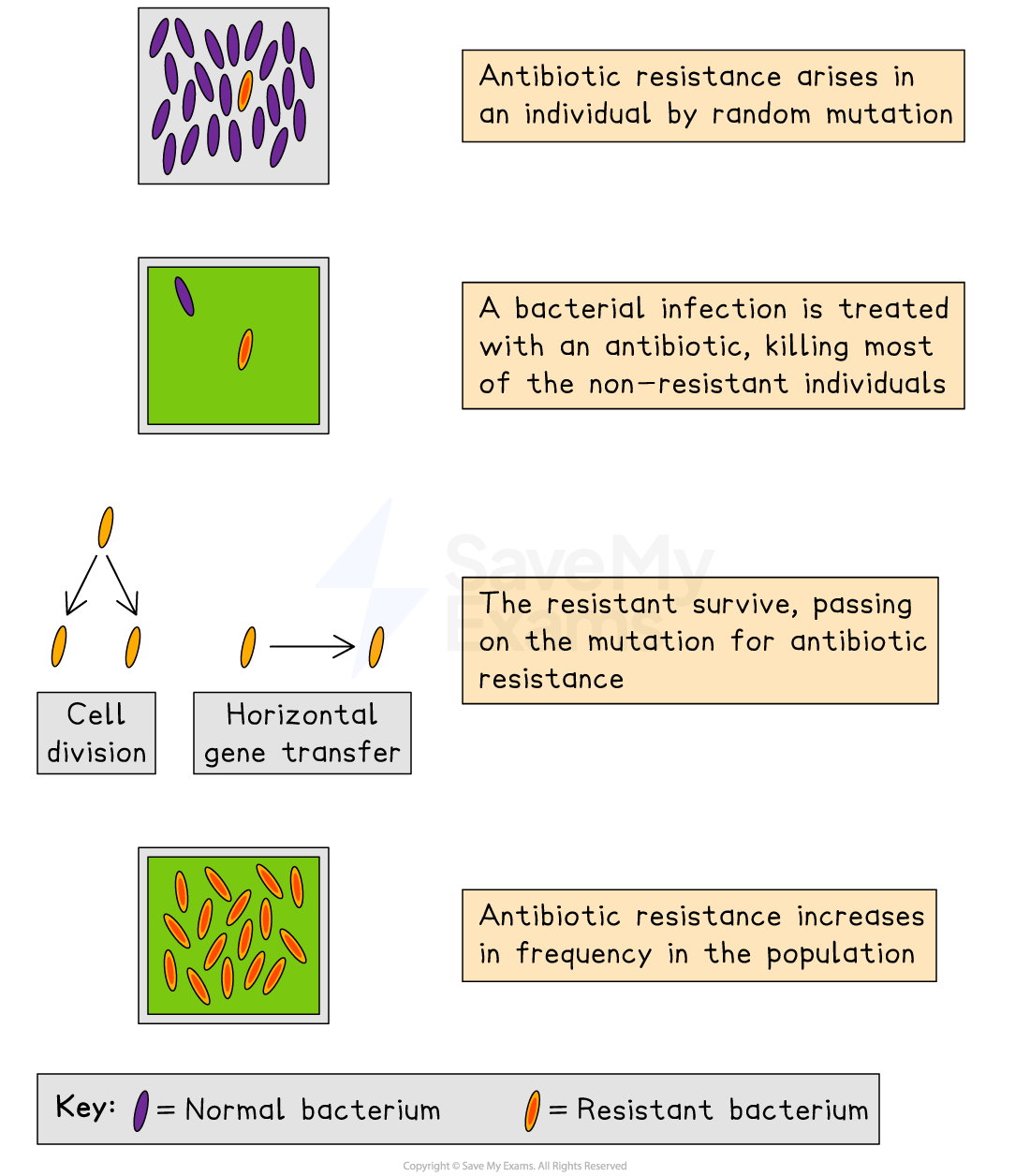
Bacteria can develop resistance to commonly used antibiotics
Exam Hint Remember that antibiotic resistance arises by natural selection, so any description of how antibiotic resistance occurs must include the main steps of natural selection:
- Variation: random mutation gives rise to a resistance allele
- Increased survival: individuals with the resistance allele are more likely to survive
- Increased reproduction: the resistance allele is passed on
- Increased allele frequency: the resistance allele becomes more common in the population
Was this revision note helpful?
Build on this topic