11 markeasy
(a)
Carbon-14 is a radioactive isotope of carbon.
It has the symbol

The number of nucleons in a carbon-14 nucleus is
Choose your answer
6
8
14
20
27 questions · 93 marks · ≈ 2 hours
Carbon-14 is a radioactive isotope of carbon.
It has the symbol
The number of nucleons in a carbon-14 nucleus is
Choose your answer
6
8
14
20
When carbon-14 decays it emits a beta particle.
What is a beta particle?
Choose your answer
An electron
A neutron
A nucleus
A proton
Which of these is the same as an electron?
Choose your answer
Alpha particle
Beta particle
Gamma ray
X-ray
Sodium-24 is a radioactive isotope.
What are isotopes?
Sodium-24 decays by emitting beta particles.
(i) Describe the nature of a beta particle.
(1 mark)
(ii) Name a piece of equipment that can be used to detect beta particles.
(1 mark)
(iii) Describe how a detector can be used with sheets of lead, aluminium and paper to show that a sample of sodium-24 emits beta particles.
(2 marks)
Scientists use the term radiation in different ways.
Sometimes radiation means streams of particles and sometimes radiation means high frequency waves.
Draw a straight line from each description to the type of radiation it describes.
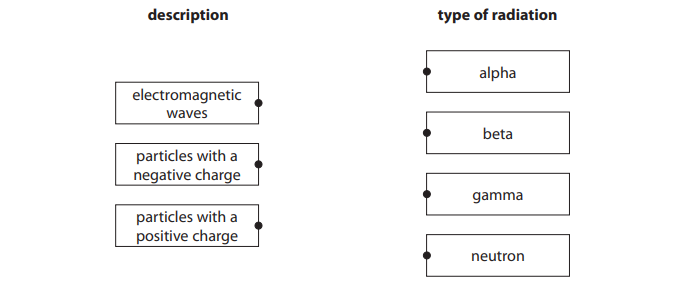
People who work with ionising radiation need to measure the amount of radiation they are exposed to. For many years, a film badge was used to detect the radiation.
State the name of another device that can be used to detect alpha radiation.
The radioactive nuclei in a source emit beta radiation.
What effect does the emission of a beta particle have on a nucleus?
There are different types of ionising radiation.
| Type of ionising radiation | Charge | Emitted by |
|---|---|---|
| alpha particle | unstable nuclei | |
| beta particle | - | unstable nuclei |
| gamma ray | 0 |
Complete the table to show the properties of each type.
A radioactive source contains strontium-90.
A strontium-90 nucleus emits a beta particle.
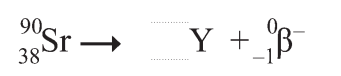
Complete the equation to show how strontium-90 decays.
Radon is a gas produced by some types of rocks.
Radon is a natural source of radioactivity.
What is the name for this radioactivity?
Choose your answer
Chain reaction
Background radiation
Radioactive dating
Radiotherapy
Radon-222 and radon-220 are both isotopes of radon. A nucleus of radon-222 has 86 protons.
How many protons are there in a nucleus of radon-220?
Choose your answer
86
less than 86
more than 86
none
Radon-222 and radon-220 are both isotopes of radon. A nucleus of radon-222 has 136 neutrons.
How many neutrons are there in a nucleus of radon-220?
Choose your answer
86
134
136
220
Vanadium-50 is an isotope of vanadium.
It has the symbol
The number of neutrons in a vanadium-50 nucleus is
Choose your answer
23
27
33
50
Which of these particles has the largest mass?
Choose your answer
Alpha particle
Beta particle
Neutron
Proton
Which of these particles has the largest charge?
Choose your answer
Alpha particle
Beta particle
Neutron
Proton
The maximum range of a beta particle in air is about
Choose your answer
50 mm
50 cm
50 m
50 km
When a nucleus emits a beta particle
Choose your answer
The nucleon number decreases by 1
The nucleon number increases by 1
The proton number decreases by 1
The proton number increases by 1
When an unstable nucleus emits an alpha particle, its atomic (proton) number
Choose your answer
Increases by 1
Stays the same
Decreases by 2
Decreases by 4
Which of these has a mass (nucleon) number of 4?
Choose your answer
Alpha particle
Beta particle
Gamma ray
X-ray
Which of these is the most ionising?
Choose your answer
Alpha particle
Beta particle
Gamma ray
X-ray
When an unstable nucleus emits an alpha particle, its mass (nucleon) number
Choose your answer
Increases by 1
Stays the same
Decreases by 2
Decreases by 4
The atomic (proton) number for iodine-131 is
Choose your answer
0
53
78
131
lodine-131 is a radioactive isotope that emits beta particles.
The equation for this decay is

The mass (nucleon) number for Xe is
Choose your answer
−1
0
53
131
Which of these describes what happens to the strontium-90 nucleus when it emits a beta particle?
Choose your answer
The number of protons stays the same
The number of protons increases
The number of neutrons stays the same
The number of neutrons increases
Tritium is an isotope of hydrogen that decays by emitting beta particles. It is used in some luminous signs.
The symbol for tritium is .
(i) Determine the number of protons and the number of neutrons in a single atom of tritium.
(2 marks)
(ii) Describe three differences between an alpha particle and a beta particle.
(3 marks)
(iii) Suggest why tritium cannot emit alpha particles.
(1 mark)
Tritium is used in this luminous sign.

In this sign
Suggest why this sign is safe to use even though beta particles are ionising and can be dangerous.
A teacher uses this apparatus to demonstrate radioactivity to his students.
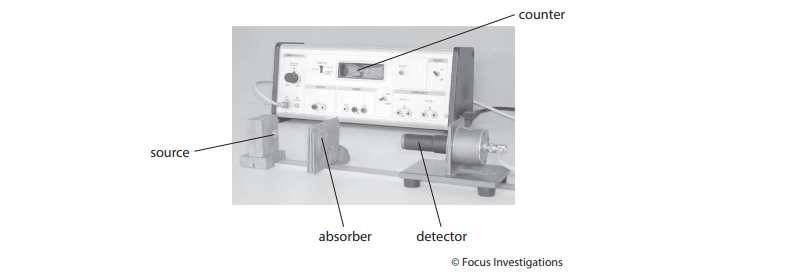
The teacher needs to take some safety precautions.
Put one tick (✓) on each row to show whether the safety precaution is needed or not. Two have been done for you.
| safety precaution | needed | not needed |
|---|---|---|
| not touch the source with bare hands | ✓ | |
| use tongs | ||
| wear gloves | ✓ | |
| wear googles | ||
| students sit at least two metres away | ||
| wear a lead apron | ||
| store source in a lead box |
The teacher uses this method to investigate radioactivity.
The table shows his results.
| Source used | Counts in 30 s for each material | |||||
|---|---|---|---|---|---|---|
| 5 mm of aluminium | 5 mm of lead | 0.2 mm of paper | 5 mm of plastic | 5 mm of stone | 5 mm of wood | |
| barium-133 | 3 843 | 1 989 | not taken | 4 551 | 10 408 | 4 557 |
| strontium-90 | 14 | 15 | 42 770 | 182 | 13 | 331 |
| none | 15 | 15 | 14 | 15 | 14 | 15 |
(i) State why the teacher keeps the distance constant between the source and the detector.
(1 mark)
(ii) Explain why there is a reading when no source is used.
(2 marks)
(i) Explain which of the materials the teacher used is the best absorber of radiation.
(3 marks)
(ii) A student makes this conclusion.
'Stone is the worst absorber of radiation.'
Evaluate this conclusion
(3 marks)
The table describes the nuclei of four atoms.
| uranium-234 | uranium-235 | plutonium-238 | americium-238 |
|---|---|---|---|
(i) Which two nuclei have the same number of protons?
(1 mark)
(ii) Which two nuclei have the same number of nucleons?
(1 mark)
(iii) Which two nuclei have the same number of neutrons?
(1 mark)
All of the nuclei are unstable and have a different half-life.
(i) Explain what is meant by the term unstable.
(1 mark)
(ii) Explain what is meant by the term half-life
(2 marks)
When plutonium decays, it emits an alpha particle and a gamma ray.
(i) Complete the decay equation for plutonium-238.
(4 marks)
(ii) Use information from the table in part (a) to identify element X.
(1 mark)
The nucleus of americium-238 can absorb an electron. When this happens, one of the protons in the nucleus becomes a neutron.
This equation describes the process.
p _ 1 ^ 1 + e _ - 1 ^ 0 -> n _ 0 ^ 1
(i) Describe how this process affects the proton number and the nucleon number of the nucleus that absorbs the electron.
(2 marks)
(ii) Identify the new nucleus formed by this process.
(1 mark)
The table shows the nature of alpha and beta particles.

Explain why alpha particles and beta particles have different penetrating powers.
A doctor uses gamma radiation to produce an image of a person's brain.
A radioactive isotope called technetium-99m is used in this process.
Technetium-99m emits gamma rays and has a short half-life.

Gamma radiation consists of
Choose your answer
Electromagnetic waves
Negatively charged particles
Positively charged particles
Unstable atoms
The table describes the nuclei of four atoms.

Atoms contain electrons.
Which nucleus needs the largest number of electrons to form a neutral atom?
Choose your answer
Uranium-234
Uranium-235
Plutonium-238
Americium-238
Tellurium-120 is an isotope of tellurium.
It has the symbol
The number of protons, neutrons and electrons in a neutral tellurium-120 atom is
Choose your answer
p = 120n = 52e = 120
p = 120n = 68e = 68
p = 52n = 120e = 120
p = 52n = 68e = 52
Compared to a beta particle, an alpha particle
Choose your answer
Causes less ionisation
Has less charge
Has less mass
Has less penetrating power
The grid shows the number of neutrons and the number of protons in some isotopes formed during successive radioactive decays.
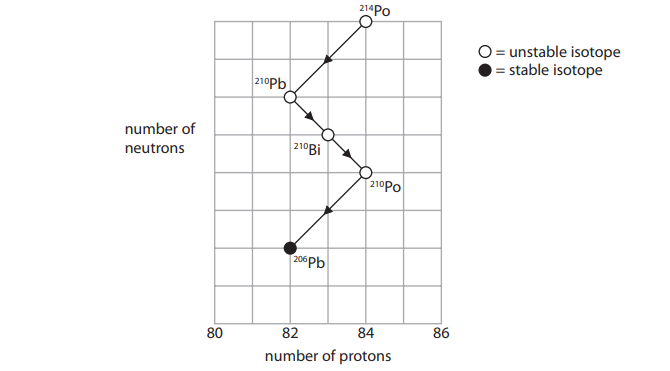
(i) What are isotopes?
(2 marks)
ii) Why are some isotopes described as stable?
(1 mark)
(i) Use the grid in part (a) to calculate the number of neutrons in a nucleus.
(1 mark)
(ii) Describe what happens to the number of protons and the number of neutrons when a nucleus of decays to form .
(2 marks)
(iii) State the type of decay that occurs when decays to form .
(1 mark)
Explain why the mass (nucleon) number and the atomic (proton) number do not change when a gamma ray is emitted from a nucleus.
Alpha particles, beta particles and gamma rays have different properties.
Complete the table by ticking the correct type of radiation for each property. The first one has been done for you.
| Property | Type of radiation | ||
|---|---|---|---|
| alpha particles | beta particles | gamma rays | |
| most ionising | ✓ | ||
| largest mass | |||
| most penetrating | |||
| highest speed | |||
| negatively charged |
The symbol for the structure of an alpha particle is
(i) State the number of neutrons and the number of protons in an alpha particle.
(2 marks)
(ii) Suggest why alpha radiation is more ionising than beta or gamma radiation.
(1 mark)
Scientists use deflection in an electric field to help distinguish between different types of radiation.
The diagram shows a beam containing several types of radiation. This beam travels in a vacuum between two charged plates.
Some of the radiation is deflected upwards, some is deflected downwards, and some are not deflected at all.
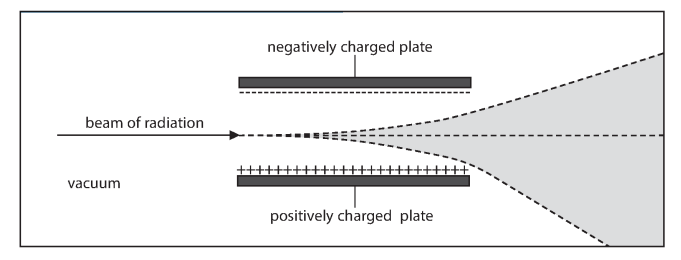
Put one tick in each row to show the correct deflection for each type of radiation.
One has been done for you.
| Type of radiation | Deflected upwards | Deflected downwards | Not deflected |
|---|---|---|---|
| alpha | ✓ | ||
| beta | |||
| gamma | |||
| neutrons | |||
| protons |