Transformers (Edexcel IGCSE Physics)
Guided lessons are live for this note
Work through it step by step — key points, depth layers, a worked example and self-checks.
Spec point —
6.17P· describe the structure of a transformer, and understand that a transformer changes the size of an alternating voltage by having different numbers of turns on the input and output sides (physics only)
Transformers
- A transformer is a device used to change the value of an alternating potential difference or current
- This is achieved using the generator effect
Structure of a transformer
-
A basic transformer consists of:
- A primary coil
- A secondary coil
- An iron core
-
Iron is used because it is easily magnetised
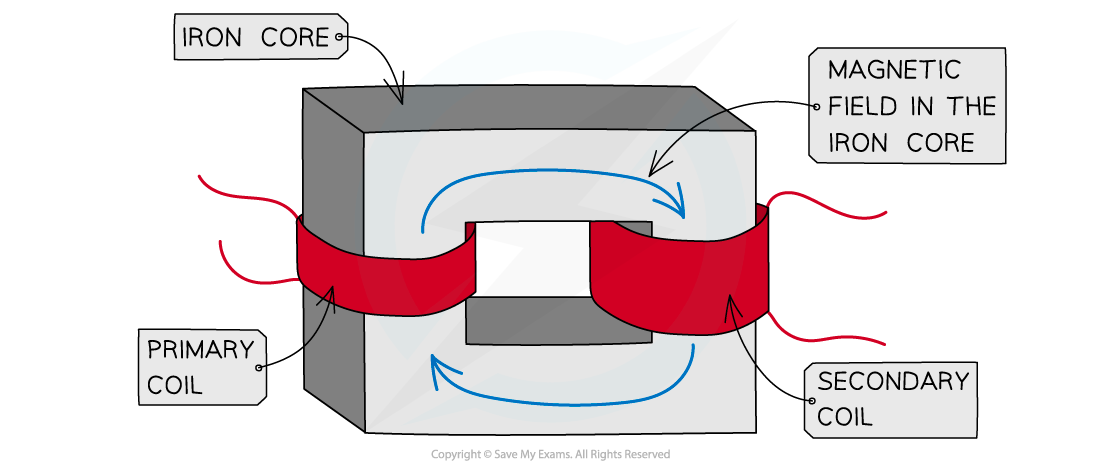
Structure of a transformer
How a transformer works
-
An alternating current is supplied to the primary coil
-
The current is continually changing direction
- This means it will produce a changing magnetic field around the primary coil
-
The iron core is easily magnetised, so the changing magnetic field passes through it
-
As a result, there is now a changing magnetic field inside the secondary coil
- This changing field cuts through the secondary coil and induces a potential difference
-
As the magnetic field is continually changing the potential difference induced will be alternating
- The alternating potential difference will have the same frequency as the alternating current supplied to the primary coil
-
If the secondary coil is part of a complete circuit it will cause an alternating current to flow
Step-up & Step-down transformers
Spec point —
6.18P· explain the use of step-up and step-down transformers in the large-scale generation and transmission of electrical energy (physics only)
-
A transformer can change the size of an alternating voltage
-
They also have a number of other roles, such as:
- To increase the potential difference of electricity before it is transmitted across the national grid
- To lower the high voltage electricity used in power lines to the lower voltages used in houses
- Used in adapters to lower mains voltage to the lower voltages used by many electronic devices
-
A step-up transformer increases the potential difference of a power source.
- A step-up transformer has more turns on the secondary coil than on the primary coil
-
A step-down transformer decreases the potential difference of a power source.
- A step-down transformer has fewer turns on the secondary coil than on the primary coil
Transformers in electricity transmission
-
Electricity is transmitted through power cables at a low current to prevent dissipation of energy
- When current flows in a wire, there is heating in the wire due to resistance
- Therefore, energy is dissipated to the surroundings, this energy is wasted
- The lower the current, the more efficient the energy transfer
What does a step-up transformer do?
-
When electricity is transmitted over large distances, the current in the wires heats them, resulting in energy loss
-
The electrical energy is transferred at high voltages from power stations
-
It is then transferred at lower voltages in each locality for domestic uses
-
The voltage must be stepped up by a step-up transformer
- These are placed after the power station
Why are step-down transformers used?
-
For the domestic use of electricity, the voltage must be much lower
-
This is done by stepping down by the voltage using a step-down transformer
- These are placed before buildings
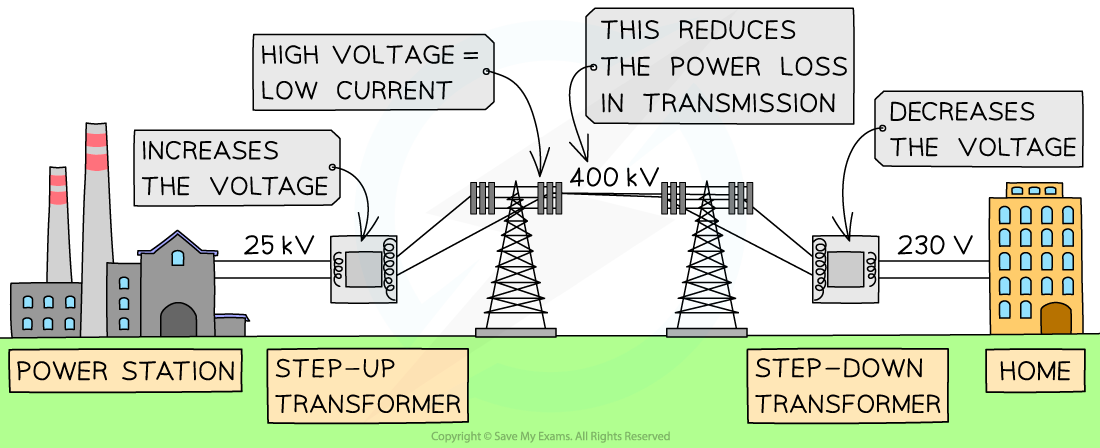
Electricity is transmitted at high voltage, reducing the current and hence power loss in the cables using transformers
Exam Hint Electrical power is equal to voltage × current, or
This means that a low current can be achieved for the same power output by increasing the voltage
A smaller current flowing through the power lines results in less heating in the wire
This reduces the energy loss in the power cables
The key advantages of high-voltage transmission of electricity are:
- the reduced power loss in transmission cables increases the efficiency of energy transfer
- lower currents in cables mean thinner, and therefore, cheaper cables can be used
Was this revision note helpful?
Build on this topic