Core Practical: Investigating Magnetic Fields
3 guided lessons · 27 checks · 6. Magnetism and Electromagnetism → Magnetism and Electromagnetism
Guided lessons for this note
Which concept don't you understand yet?
We'll explain it simply and check your understanding. Pick any lesson — any order works.
0 of 27 checks correct so far
Lesson 1 of 3
Aim and equipment of the field-mapping practical
The investigation maps two field patterns on paper: the field of one permanent bar magnet, and the field in the region between two bar magnets. The kit is deliberately minimal — bar magnets, a plotting compass, paper and a pencil — because the compass itself is the sensor.
What you know already
This practical draws the invisible: a plotting compass, a pencil and a chain of dots turn a bar magnet's field into a visible map. The method steps the compass tail-to-dot, the analysis reads crowding as strength and straightness as uniformity, and the honest error analysis is part of the mark scheme.
Key points of understanding
- The aim is to plot the field patterns for one bar magnet and for the gap between two of them.
- A plotting compass is the sensor: its needle aligns with the local field line direction.
- Paper, pencil and a ruler record each needle direction as a small arrow.
- Two bar magnets and a support setup extend the map to the between-magnet region.
- Every arrow is drawn where the compass sits, so the pattern builds point by point.
Choose a confidence level to continue.
Prefer to read it all at once? Show the full lesson as a page
1.Aim and equipment of the field-mapping practical
The investigation maps two field patterns on paper: the field of one permanent bar magnet, and the field in the region between two bar magnets. The kit is deliberately minimal — bar magnets, a plotting compass, paper and a pencil — because the compass itself is the sensor.
Key points
- The aim is to plot the field patterns for one bar magnet and for the gap between two of them.
- A plotting compass is the sensor: its needle aligns with the local field line direction.
- Paper, pencil and a ruler record each needle direction as a small arrow.
- Two bar magnets and a support setup extend the map to the between-magnet region.
- Every arrow is drawn where the compass sits, so the pattern builds point by point.
First pass
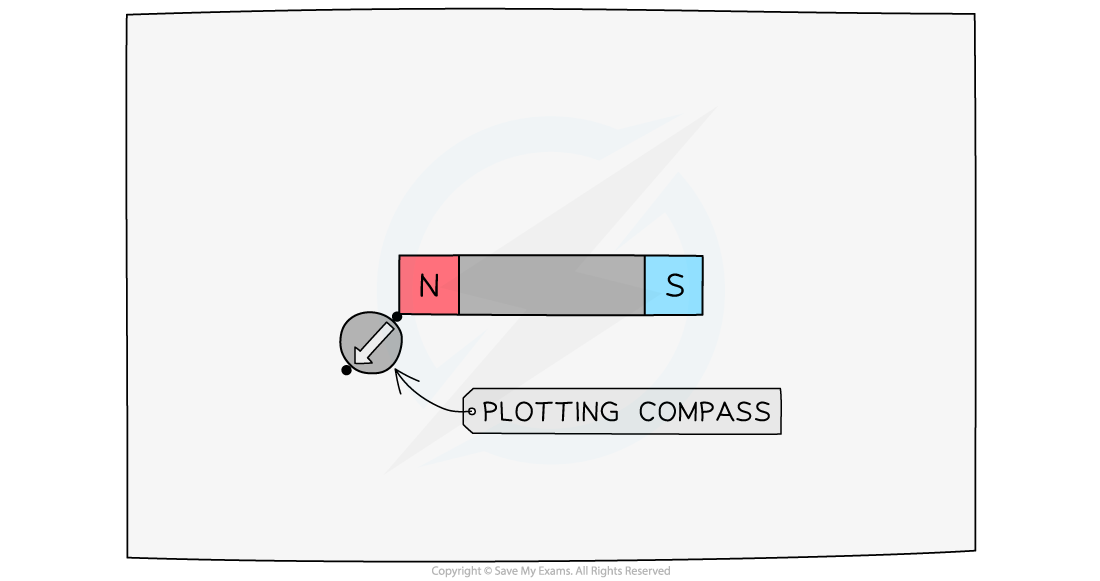
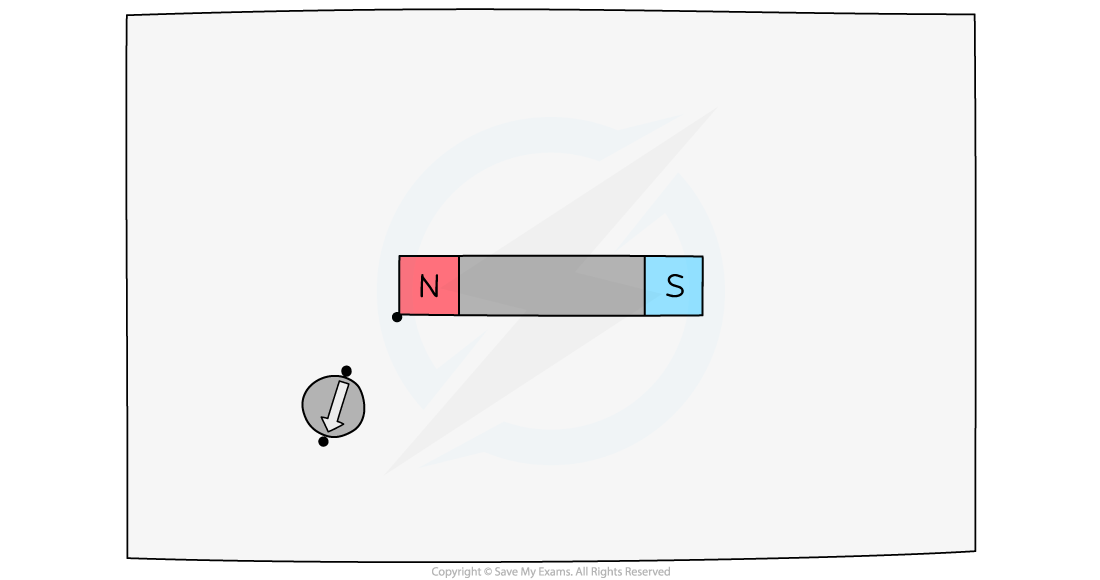
Put a magnet on the paper, place the compass near one pole, and draw a tiny arrow showing where the needle points. Move the compass a little further along the arrow and repeat — the arrows join up into the field lines.
Analogy — It is like mapping a wind field with a tiny weathervane: record its direction at each spot, then connect the spots into streamlines.
Exam pointer — Quote the aim in the question's own terms — the pattern FOR a bar magnet AND between two bar magnets — quoting only one half drops a mark.
Going deeper
The design treats the compass needle as a north-pole test dipole: at each position the needle's north end is pushed along the local field direction, so the marked arrow is a tangent to the field line through that point. Chaining tangent-to-tangent steps reconstructs the full line without ever measuring field strength directly.
Analogy — Each compass reading is one frame of a time-lapse: no single frame shows the path, but playing them in order reveals the whole trajectory.
Exam pointer — If asked why the compass is small, answer: a small needle samples the direction at a point instead of averaging the field across a large area.
Checks
0 of 9 attempted · 0 correct
2.Method: stepping the compass around the magnets
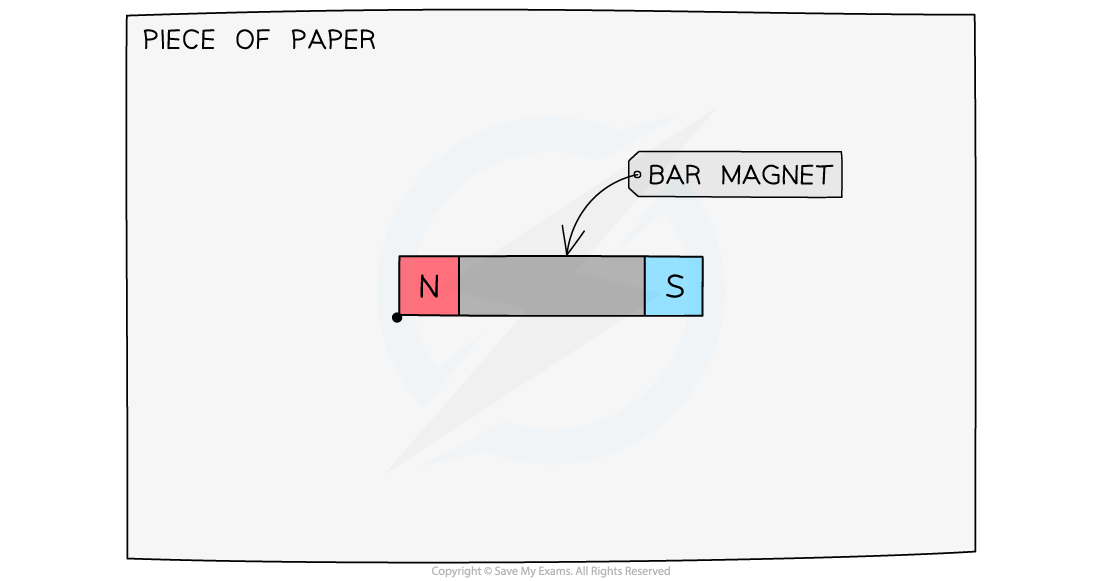
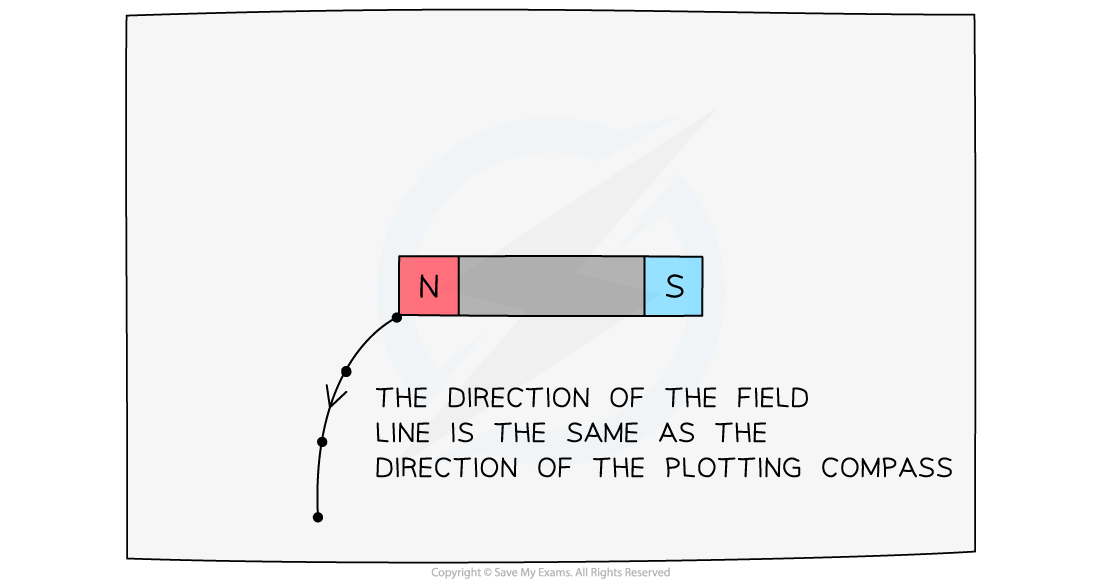
The method is a deliberate walk: place the compass near a pole, mark the needle's two ends with dots, slide the compass so its tail sits on the last dot, and repeat. The dot-chain grows into a field line, and enough chains make the whole pattern.
3.Analysis: reading the mapped patterns
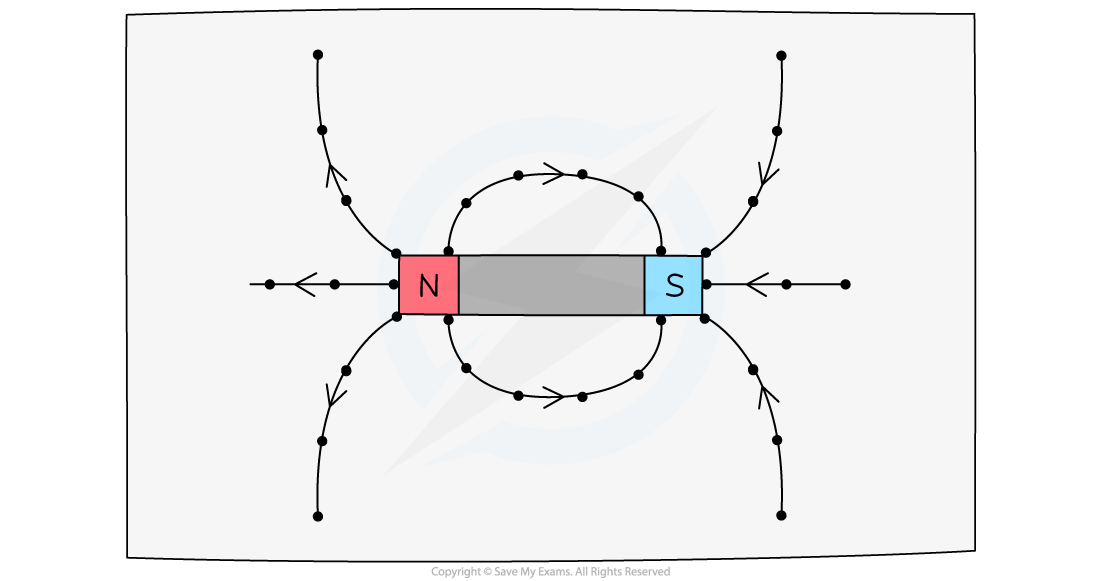
The finished map is read twice: once for direction — arrows leaving north, entering south — and once for strength, where crowded lines mean a strong field. Between two magnets the straight, evenly spaced central lines are the evidence for a uniform field, and the wobbly edge chains are the honest error analysis.
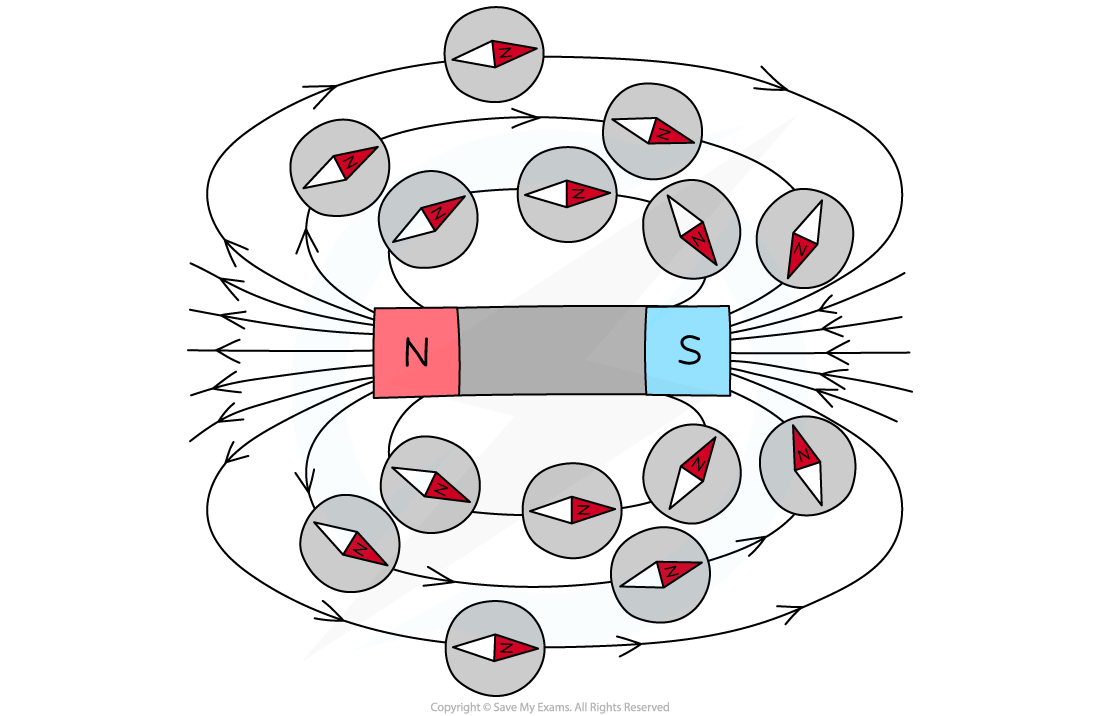
The magnetic field of a bar magnet plotted
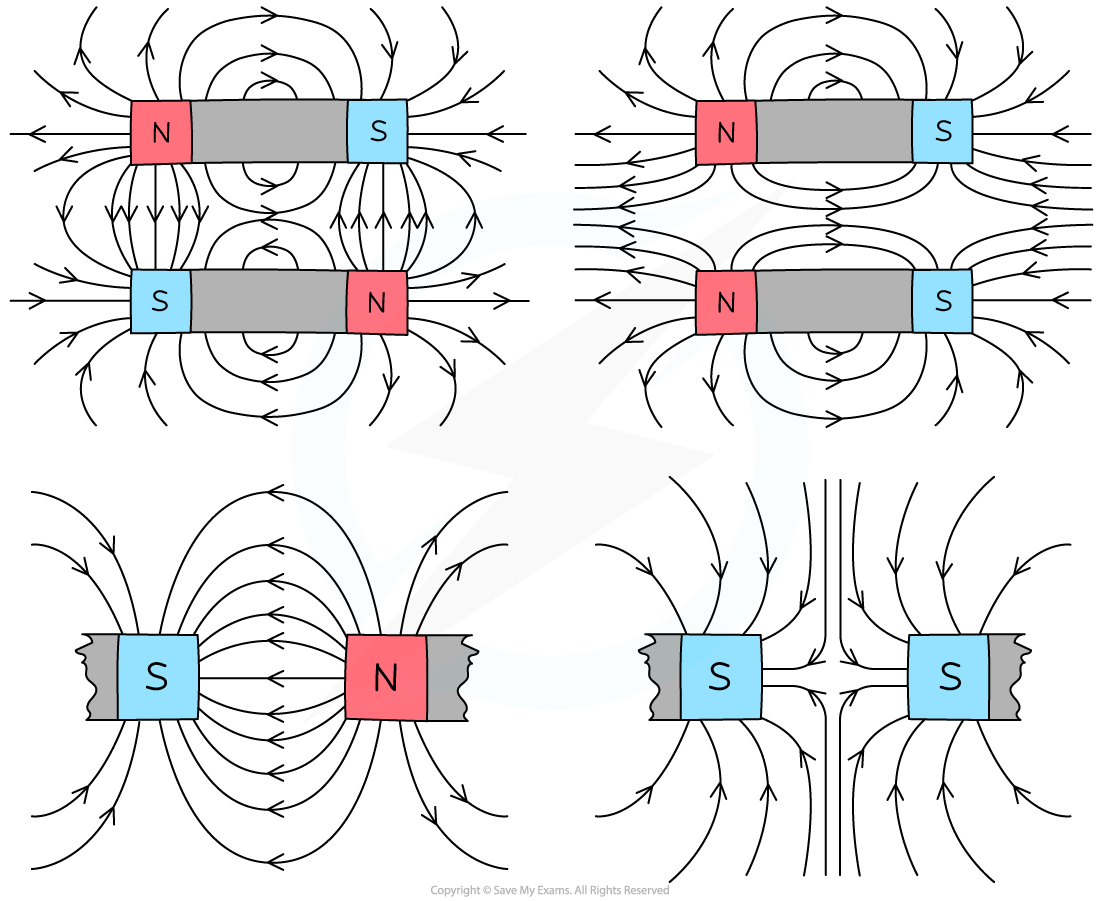
Magnetic field of two bar magnets interacting
Key points
- Arrows on every curve run away from the north pole and into the south pole.
Guided content from the SME authoring corpus — note rn_y9WPd7HxNXd6W7wx, pinned at 6312d659ec0d · promoted SyllabAI/syllabai-resources b3caaaa90c5e