Efficiency
3 guided lessons · 27 checks · 4. Energy Resources and Energy Transfers → Energy Stores & Transfers
Guided lessons for this note
Which concept don't you understand yet?
We'll explain it simply and check your understanding. Pick any lesson — any order works.
0 of 27 checks correct so far
Lesson 1 of 3
Efficiency and the efficiency equation
Efficiency scores an energy transfer: what fraction of the output actually serves the purpose? It is the useful share of the output expressed as a percentage — and conservation of energy pins the total output to the total input, with the wasted share filling the gap.
What you know already
Efficiency turns the conservation law into a score: of all the energy leaving a device, how much served the purpose? This note fixes the equation, works a fan motor from 300 J to 72%, and teaches Sankey diagrams — the arrow picture where widths are joules and efficiency is visible at a glance.
Key points of understanding
- Efficiency scores how much of a transfer is wasted.
- Efficiency = (useful output) ÷ (total output) × 100%.
- High efficiency means most of the transferred energy is useful; low efficiency means most is wasted.
- By conservation of energy, what leaves equals what arrives.
- The output splits into the useful share plus the wasted share.
Choose a confidence level to continue.
Prefer to read it all at once? Show the full lesson as a page
1.Efficiency and the efficiency equation
Efficiency scores an energy transfer: what fraction of the output actually serves the purpose? It is the useful share of the output expressed as a percentage — and conservation of energy pins the total output to the total input, with the wasted share filling the gap.
Key points
- Efficiency scores how much of a transfer is wasted.
- Efficiency = (useful output) ÷ (total output) × 100%.
- High efficiency means most of the transferred energy is useful; low efficiency means most is wasted.
- By conservation of energy, what leaves equals what arrives.
- The output splits into the useful share plus the wasted share.
First pass
Efficiency is a percentage score: useful output over total output, where the total equals the input by conservation and the wasted share fills whatever the useful share leaves.
Analogy — A goalkeeper’s save percentage: saves (useful) divided by all shots faced (total output) — the rest conceded (wasted).
Exam pointer — Write the equation with × 100% for a percentage, or without it for a ratio between 0 and 1 — match the form the question asks for.
Going deeper
The arithmetic chain is fixed: total output = total input (conservation), useful output = total output − wasted, then divide useful by total and scale by 100 for the percentage.
Analogy — A pay slip: gross pay (input) arrives, tax and pension (wasted) are deducted, and take-home (useful) divided by gross is the efficiency.
Exam pointer — Efficiency above 100% is impossible — that claim is a favourite true-or-false check and conservation is the reason.
Checks
0 of 9 attempted · 0 correct
2.Sankey diagrams
A Sankey diagram draws an energy transfer as arrows whose widths are proportional to the energy they carry: one flat input arrow entering, the useful output running straight on, and the wasted output bending away. Because energy is conserved, the widths always recombine to the input width.
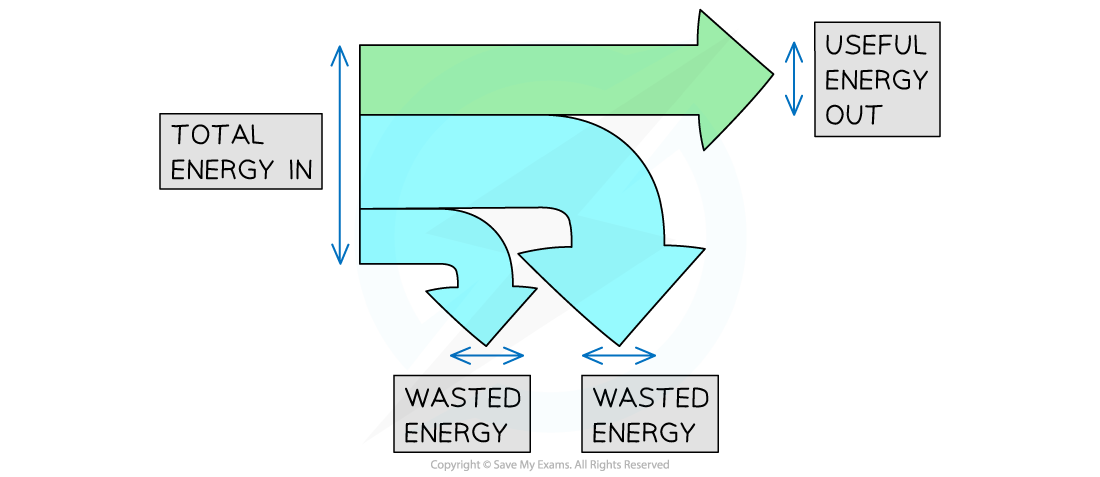
Total energy in, wasted energy and useful energy out shown on a Sankey diagram
Key points
- A Sankey diagram draws an energy transfer as splitting arrows.
- The flat left-hand end is the energy arriving at the system.
- The straight arrow to the right represents the useful energy output.
- The arrows bending away represent the wasted energy.
- Arrow width is proportional to the energy transferred, and total energy in equals total energy out.
First pass
Read a Sankey left to right: input width in, straight arrow = useful output, bent arrows = wasted output, and the widths always sum back to the input because energy is conserved.
Analogy — A river delta: the main channel carries the useful flow onward while side channels bleed away — wider channels mean more water, or here, more joules.
Exam pointer — Widths are PROPORTIONAL, not equal — exam questions test whether you read the arrow widths as energy amounts.
Going deeper
The three parts of the diagram map exactly onto the three quantities of the efficiency equation: input, useful output and wasted output; conservation is the reason the widths close the balance.
Analogy — Splitting a pizza on a plate: the whole pizza arrives (input), the slices guests take are useful, the crumbs on the table are wasted — and nothing left the plate unseen.
Exam pointer — Learn the two splitting-point equations: total in = total out, and total in = useful out + wasted out.
Checks
0 of 9 attempted · 0 correct
3.Sankey diagrams of light bulbs and the lifting motor
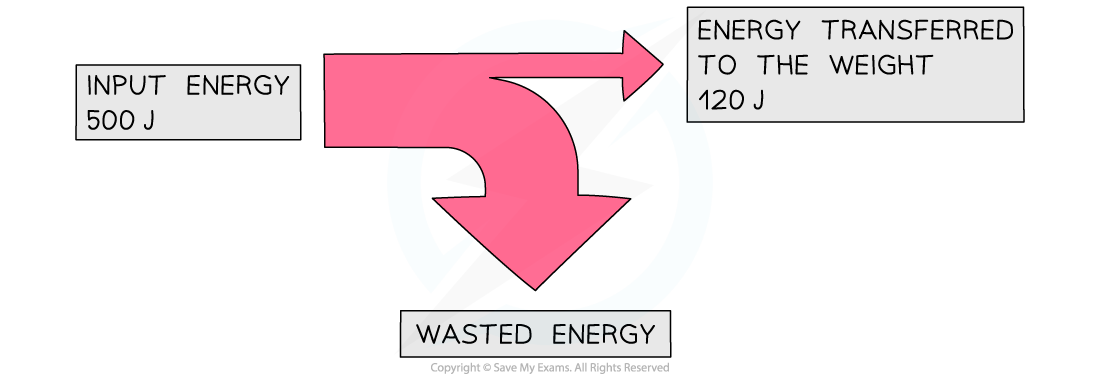
Two bulbs drawing the same input make the efficiency lesson visible: the modern bulb keeps its straight arrow wide while the filament bulb bleeds most of its width into heat. The lifting-motor diagram then shows the arithmetic every Sankey can be reduced to: waste = input − useful.
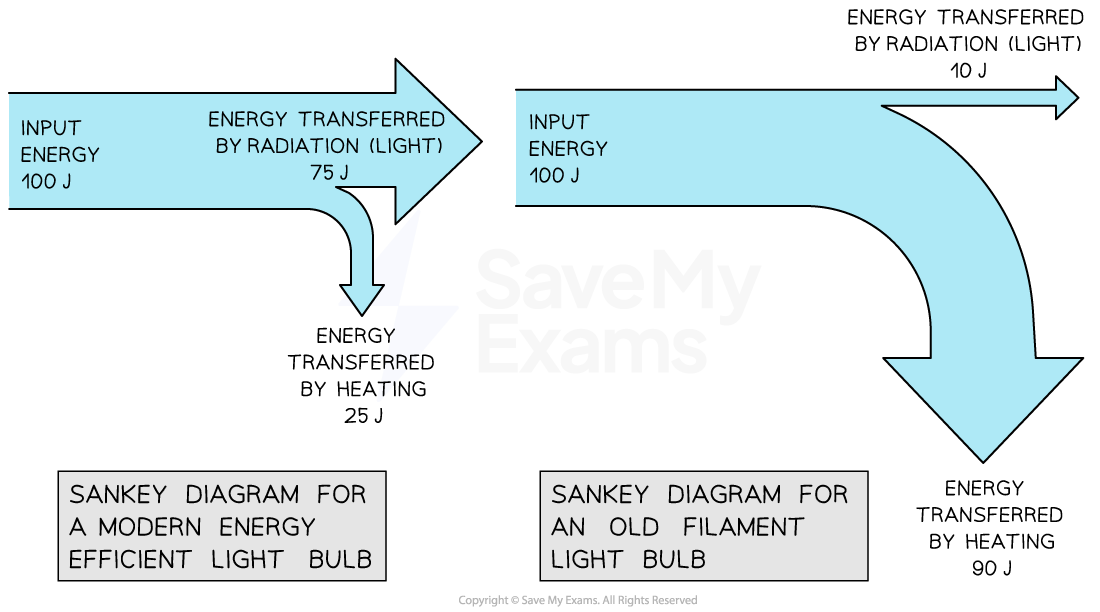
Sankey diagram for modern vs. old filament light bulb
Key points
- A Sankey for a modern efficient bulb looks very different from an old filament bulb’s.
- A more efficient bulb has less wasted energy, shown by a smaller downward heat arrow.
- The of-record motor Sankey shows 500 J in and 120 J out usefully.
- Wasted = total in minus useful out: the motor’s Sankey reads 500 J in and 120 J out usefully, so 380 J is wasted by subtraction.
- The motor’s efficiency is 120 / 500 × 100 = 24%.
First pass
Same input, different split: the efficient bulb’s Sankey keeps most width in the straight useful arrow, the filament bulb’s bends most of it away as heat; the motor example turns the widths into 380 J wasted and 24% efficient.
Analogy — Two funnels of the same mouth: the good one pours almost everything into the bottle, the leaky one dribbles most of it down the outside.
Exam pointer — The Sankey arithmetic move: wasted = total energy in − useful energy out (500 − 120 = 380 J in the of-record example).
Going deeper
Sankey questions end in one of two calculations: read the widths as joules and subtract for waste, or divide useful by total for the percentage; both rest on the widths being proportional.
Analogy — Reading a stained-glass window: the pane widths tell the story without a single number, but a ruler converts them to data when asked.
Exam pointer — Efficiency from a Sankey = useful width ÷ input width × 100; quote the widths in your working.
Checks
0 of 9 attempted · 0 correct
Guided content from the SME authoring corpus — note rn_vctGRbxP4NVz34JT, pinned at 8f834fff738f · promoted SyllabAI/syllabai-resources b3caaaa90c5e