Moments
2 guided lessons · 18 checks · 1. Forces & Motion → Moments
Guided lessons for this note
Which concept don't you understand yet?
We'll explain it simply and check your understanding. Pick any lesson — any order works.
0 of 18 checks correct so far
Lesson 1 of 2
The moment of a force
Push a see-saw and it swings; twist a tap and it turns — forces can spin things as well as shove them. The spinning action a force produces about a fixed turning point is called a moment. This lesson pins down that idea and the two senses of rotation it can take.
What you know already
Forces do more than push objects along in a straight line — they can also make them turn. A stiff door, a spanner and a playground see-saw all rotate about a fixed point when a force acts. This note names that turning effect, shows the clockwise and anticlockwise senses it can take, and builds the equation that measures it.
Key points of understanding
- A moment is the turning effect that a force gives about a pivot.
- Everyday examples include see-saws, spanner handles, doors, cranes, screwdrivers, taps, wheelbarrows and scissors.
- Forces can make an object rotate around a fixed pivot, turning either clockwise or anticlockwise.
- A force applied to one side of a pivot makes the object rotate.
- The direction of turning is judged against the way a clock's hands travel.
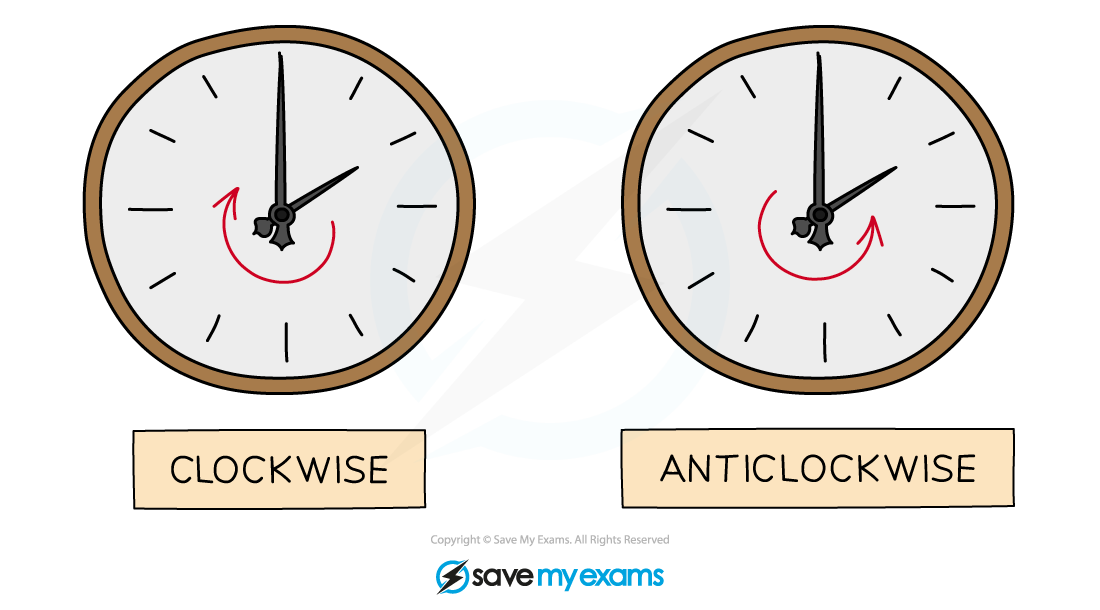
Consider the hands of a clock when deciding if an object will rotate in a clockwise or anti-clockwise direction
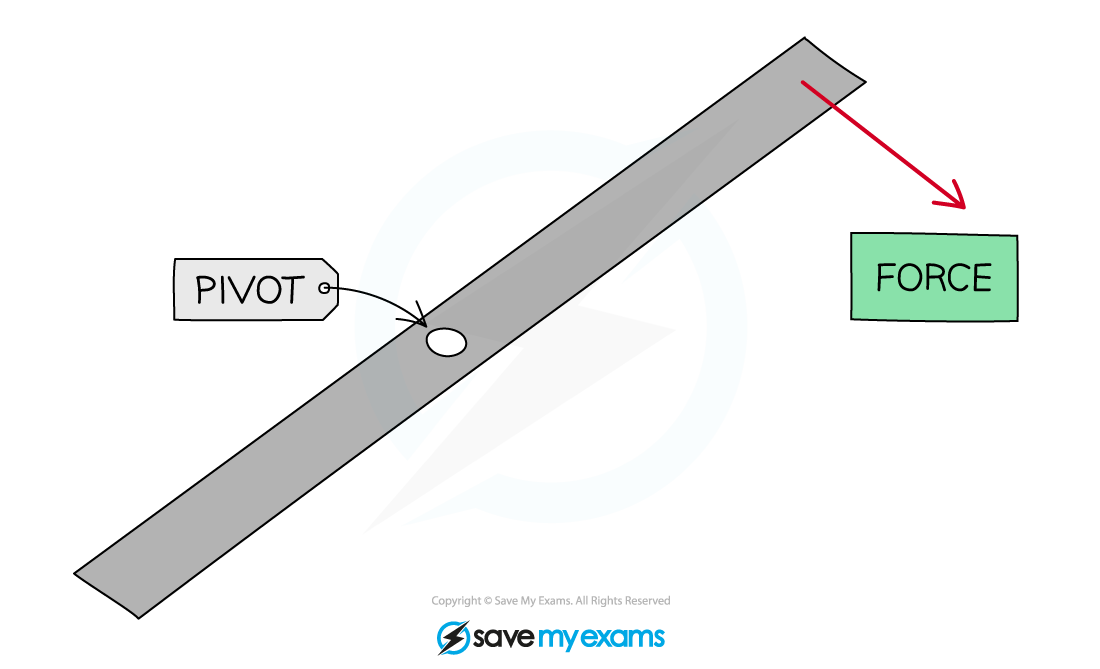
The force applied will cause the object to rotate clockwise about the pivot
Choose a confidence level to continue.
Prefer to read it all at once? Show the full lesson as a page
1.The moment of a force
Push a see-saw and it swings; twist a tap and it turns — forces can spin things as well as shove them. The spinning action a force produces about a fixed turning point is called a moment. This lesson pins down that idea and the two senses of rotation it can take.
Consider the hands of a clock when deciding if an object will rotate in a clockwise or anti-clockwise direction
The force applied will cause the object to rotate clockwise about the pivot
Key points
- A moment is the turning effect that a force gives about a pivot.
- Everyday examples include see-saws, spanner handles, doors, cranes, screwdrivers, taps, wheelbarrows and scissors.
- Forces can make an object rotate around a fixed pivot, turning either clockwise or anticlockwise.
- A force applied to one side of a pivot makes the object rotate.
- The direction of turning is judged against the way a clock's hands travel.
First pass
A moment is the turning effect a force has about a pivot; the spin it produces runs clockwise or anticlockwise.
Analogy — A playground roundabout: where you lean and push decides which way it sweeps around its central post.
Exam pointer — When a question asks for the direction of turning, answer with the exact sense — clockwise or anticlockwise — not a bare 'it rotates'.
Going deeper
The pivot is the fixed point the object swings about; a force pushing on just one side of it sets the whole object rotating in one definite sense.
Analogy — Treat a clock face as the referee: a sweep from the 12 towards the 3 is clockwise, the reverse sweep anticlockwise.
Exam pointer — Even before any calculation, label the sense of rotation on the diagram — examiners expect the clock comparison.
Checks
0 of 9 attempted · 0 correct
2.Calculating moments with M = F × d
Sizing a turning effect takes one multiplication. The moment equals the force multiplied by its perpendicular distance from the pivot — the straight-across gap to that turning point — and it is measured in newton metres. Step back from the hinge and a lighter push opens the same door.
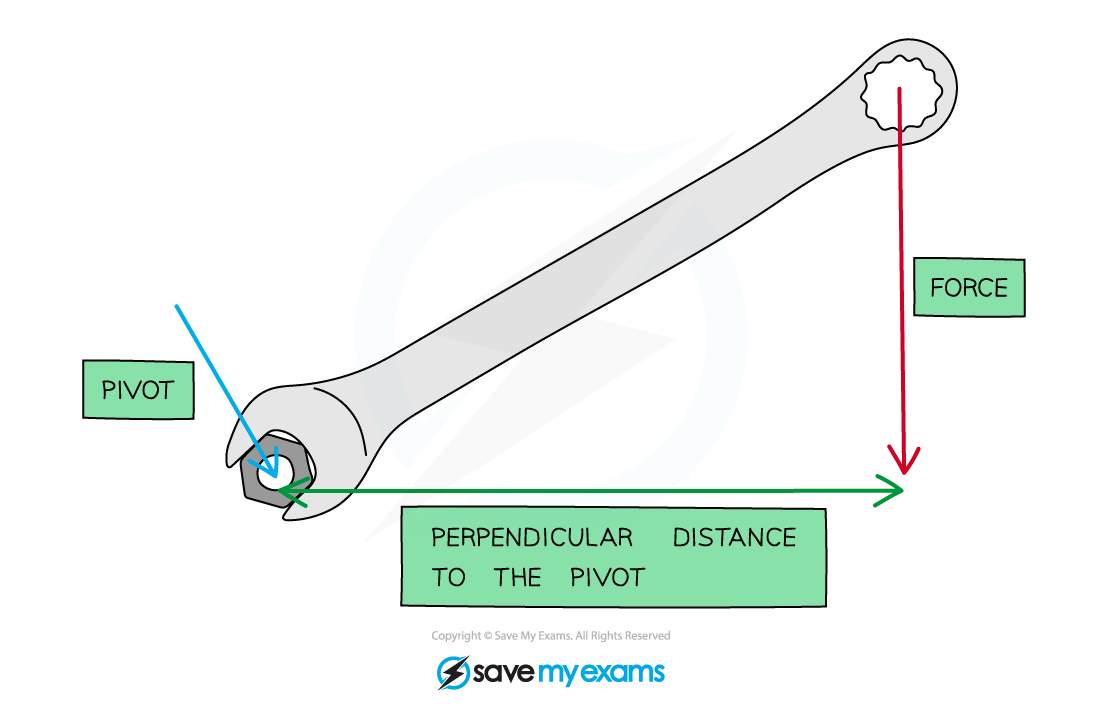
The moment depends on the force and perpendicular distance to the pivot
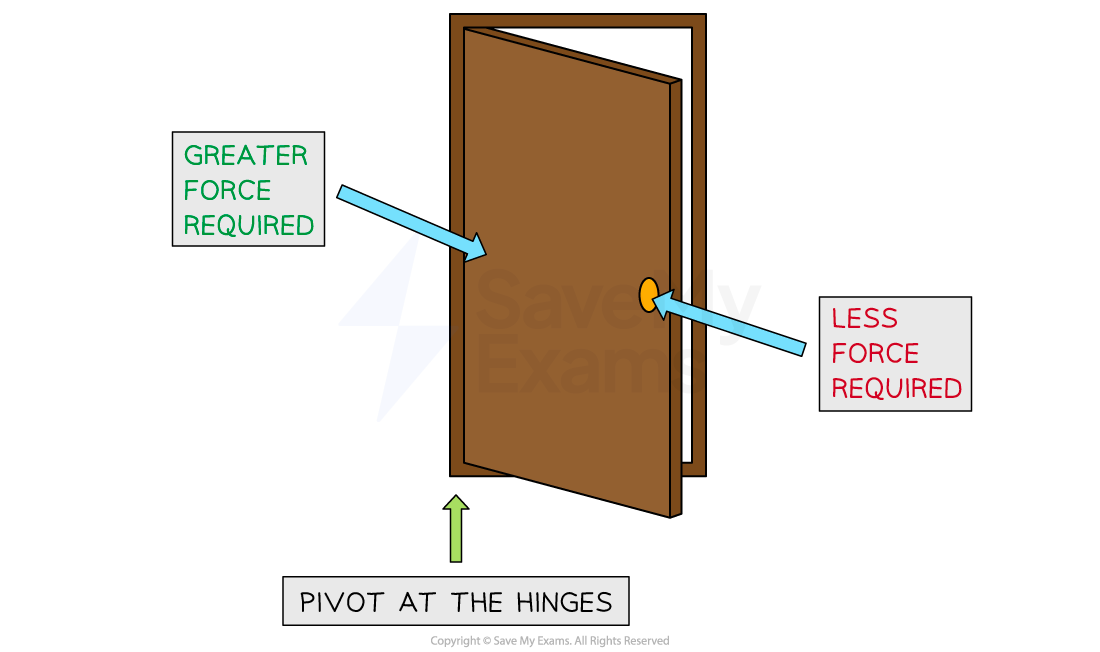
A greater force is required to push open a door next to the hinges than at the door handle
Key points
- The size of a moment is M = F × d: force times perpendicular distance from the pivot.
- M is the moment in newton metres (N m), F the force in newtons (N), and d the perpendicular distance in metres (m).
- The force should act perpendicular to the distance that separates it from the pivot — on a horizontal beam, up or down forces create moments.
- Pushing farther from the pivot needs less force — pushing a door near the hinge is hard, at the handle it is easy.
- Moments may be quoted in newton centimetres when the distance is in centimetres; convert distances to metres unless the question names a unit.
First pass
Multiply the force by its perpendicular distance from the pivot and you have the moment: M = F × d.
Analogy — A longer spanner arm is a force multiplier: the same hand grip swings a stiffer nut because the extra reach does part of the work.
Exam pointer — Watch the units: force in newtons and distance in metres give a moment in newton metres (N m).
Going deeper
M = F × d runs both ways: divide the moment by the distance to recover the force, or by the force to recover the distance.
Analogy — Reach is a discount on effort: every extra metre from the pivot buys the same turn for fewer newtons.
Exam pointer — If the question gives centimetres and names no unit for the answer, convert the distance to metres before multiplying — newton metres is the default.
Checks
0 of 9 attempted · 0 correct
Guided content from the SME authoring corpus — note rn_jzQZQcPRQkJvdYwJ, pinned at 0cea83a78102 · promoted SyllabAI/syllabai-resources b3caaaa90c5e