Unbalanced Forces
2 guided lessons · 18 checks · 1. Forces & Motion → Forces, Movement & Changing Shape
Guided lessons for this note
Which concept don't you understand yet?
We'll explain it simply and check your understanding. Pick any lesson — any order works.
0 of 18 checks correct so far
Lesson 1 of 2
Balanced and unbalanced forces
Forces on one object combine along each line into a single resultant. When that resultant is zero the forces are balanced and nothing about the motion changes; when a surplus survives, the forces are unbalanced and the object must accelerate. This lesson fixes both words with the two standard scenes.
What you know already
A book on a desk and a tug-of-war rope tell one story in two halves: sometimes the forces cancel, sometimes they leave a surplus. This note names the two cases, then turns the surplus into the most used equation in mechanics — force equals mass times acceleration.
Key points of understanding
- Balanced forces cancel completely, so the resultant force on the body is zero.
- A book on a desk shows the standard balance: its weight downward against the desk's upward push.
- Unbalanced forces leave a resultant, and that resultant causes the object to accelerate.
- The acceleration may show as speeding up, slowing down, or changing direction.
- A tug-of-war with 80 N against 100 N leaves a 20 N resultant towards the stronger side.
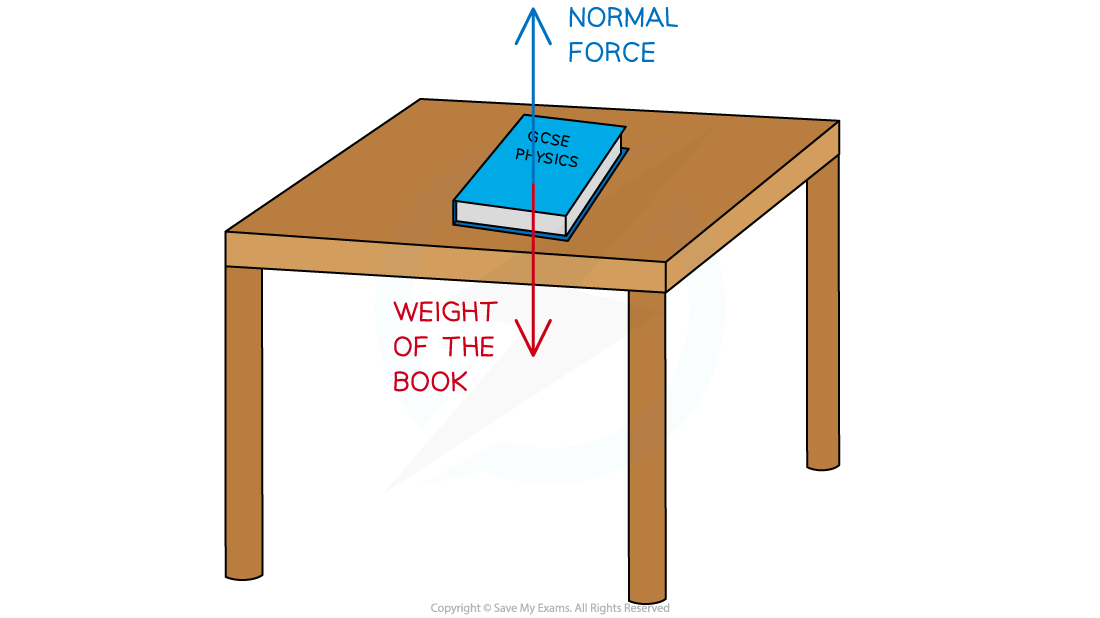
A book resting on a table is an example of balanced forces
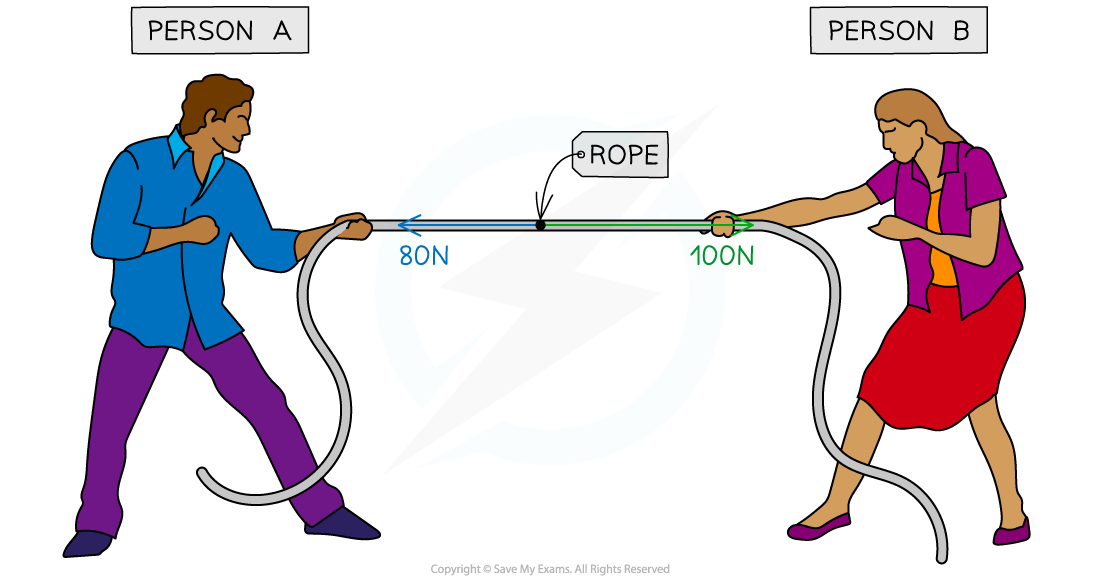
A tug-of-war is an example of when forces can become unbalanced
Choose a confidence level to continue.
Prefer to read it all at once? Show the full lesson as a page
1.Balanced and unbalanced forces
Forces on one object combine along each line into a single resultant. When that resultant is zero the forces are balanced and nothing about the motion changes; when a surplus survives, the forces are unbalanced and the object must accelerate. This lesson fixes both words with the two standard scenes.
A book resting on a table is an example of balanced forces
A tug-of-war is an example of when forces can become unbalanced
Key points
- Balanced forces cancel completely, so the resultant force on the body is zero.
- A book on a desk shows the standard balance: its weight downward against the desk's upward push.
- Unbalanced forces leave a resultant, and that resultant causes the object to accelerate.
- The acceleration may show as speeding up, slowing down, or changing direction.
- A tug-of-war with 80 N against 100 N leaves a 20 N resultant towards the stronger side.
First pass
Cancel completely — balanced, nothing changes. Leave a surplus — unbalanced, and the surplus accelerates the object.
Analogy — Two shopkeepers haggling over one till: equal pulls hold the till still; the stronger pull walks away with it.
Exam pointer — 'Balanced' questions want the phrase 'resultant force is zero' — not merely 'the forces are equal'.
Going deeper
Balance is a statement about the resultant, not about stillness: a balanced object keeps whatever velocity it had, while any non-zero resultant rewrites that velocity.
Analogy — A barge in steady current: matched tow ropes hold its heading; one extra metre of rope on a side swings it — velocity responds to the surplus, not to the pull.
Exam pointer — Direction of the acceleration follows the resultant's direction — state both when a question asks for the motion.
Checks
0 of 9 attempted · 0 correct
2.The relationship F = m × a
One equation runs this whole note: the resultant force equals the mass times the acceleration. This lesson fixes the equation, its units, and the proportionality habits it rewards — doubling force doubles acceleration, doubling mass halves it — then applies all three in worked numbers.
Key points
- The relationship is force = mass × acceleration, written F = m × a, also known as Newton's second law.
- F is the resultant force in newtons, m the mass in kilograms, a the acceleration in metres per second squared.
- For a fixed mass, doubling the resultant force doubles the acceleration.
- For a fixed force, doubling the mass halves the acceleration.
- A negative F value records a force acting opposite to the motion — a decelerating force.
First pass
Push harder on the same mass and it speeds up faster; push the same on a heavier mass and it speeds up more slowly.
Analogy — Supermarket trolleys: an empty trolley leaps away at the same shove; the half-full one needs double the shove for the same getaway.
Exam pointer — Always check the units before substituting: kilograms and metres per second squared feed newtons directly.
Going deeper
F = m × a is a proportionality law, not just a formula: a scales with F for fixed m and with 1/m for fixed F — the two habits behind most rearrangement questions.
Analogy — It behaves like a see-saw: force and mass at the ends, acceleration the tilt — load one end double and the tilt answers in kind.
Exam pointer — When a question hands you a negative force, say why: the minus sign marks a force opposing the motion, exactly the crash-test deceleration case.
Checks
0 of 9 attempted · 0 correct
Guided content from the SME authoring corpus — note rn_gDy2qTkY26r5sMtd, pinned at bfae99778094 · promoted SyllabAI/syllabai-resources b3caaaa90c5e