The Pressure Law
1 guided lesson · 9 checks · 5. Solids, Liquids and Gases → Ideal Gases
Guided lessons for this note
Which concept don't you understand yet?
We'll explain it simply and check your understanding. Pick any lesson — any order works.
0 of 9 checks correct so far
Lesson 1 of 1
The pressure law and its use
One law, one condition set, one trap: for a fixed mass at constant volume, pressure is proportional to kelvin temperature, so p1/T1 = p2/T2. The trap is Celsius — converting to kelvin is not optional, it is the law's grammar.
What you know already
For a sealed, rigid container of gas, pressure and kelvin temperature rise and fall together in strict proportion: p1/T1 = p2/T2. This note puts the law to work on a bicycle tyre and a hot cylinder, with the kelvin conversion done before any substitution — the law's one non-negotiable.
Key points of understanding
- The pressure law states p1/T1 = p2/T2 — with the sample sealed and the volume rigid, pressure divided by kelvin temperature stays constant.
- Pressure and kelvin temperature are directly proportional at constant volume.
- Temperatures must be converted to kelvin before any substitution into the law.
- Rearranged, p2 = p1 × T2/T1 gives the new pressure after a temperature change.
- A graph of pressure against kelvin temperature is a straight line through the origin.
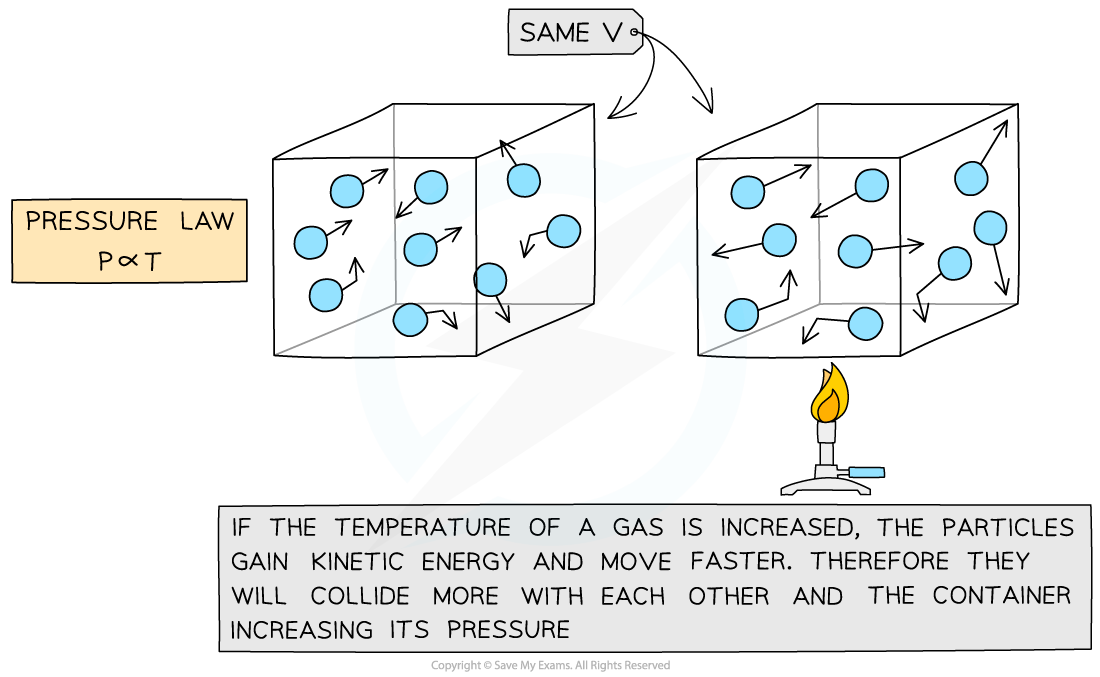
Pressure and temperature are proportional. Doubling temperature also doubles the pressure for a gas in a fixed volume.
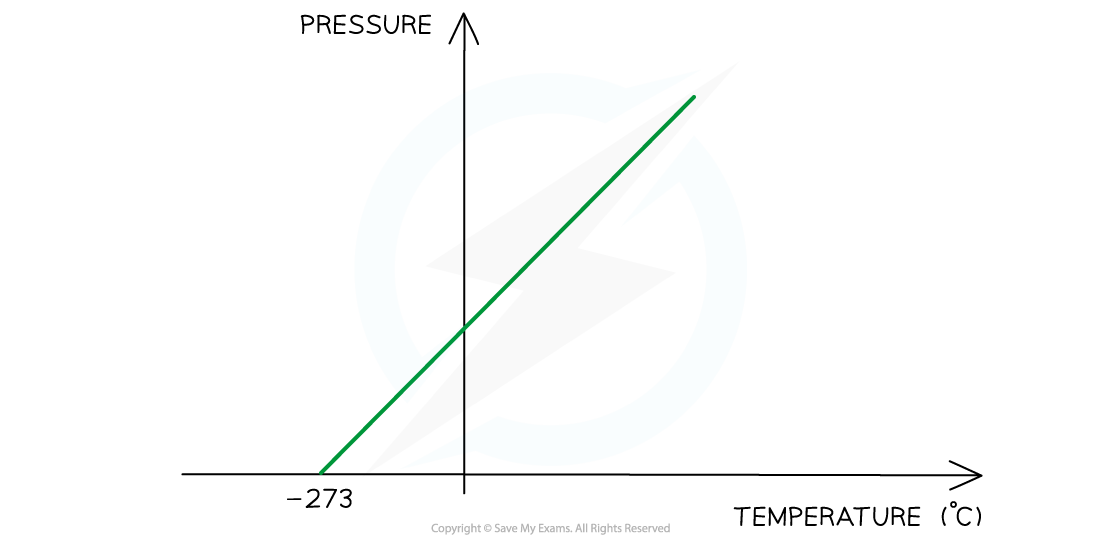
Pressure law graph representing temperature (in °C) directly proportional to the volume
Choose a confidence level to continue.
Prefer to read it all at once? Show the full lesson as a page
1.The pressure law and its use
One law, one condition set, one trap: for a fixed mass at constant volume, pressure is proportional to kelvin temperature, so p1/T1 = p2/T2. The trap is Celsius — converting to kelvin is not optional, it is the law's grammar.
Pressure and temperature are proportional. Doubling temperature also doubles the pressure for a gas in a fixed volume.
Pressure law graph representing temperature (in °C) directly proportional to the volume
Key points
- The pressure law states p1/T1 = p2/T2 — with the sample sealed and the volume rigid, pressure divided by kelvin temperature stays constant.
Guided content from the SME authoring corpus — note rn_VrW4vQKk2VCQ2sQd, pinned at 8788fc85a2c1 · promoted SyllabAI/syllabai-resources b3caaaa90c5e