Core Practical: Using an Oscilloscope
1 guided lesson · 9 checks · 3. Waves → Sound
Guided lessons for this note
Which concept don't you understand yet?
We'll explain it simply and check your understanding. Pick any lesson — any order works.
0 of 9 checks correct so far
Lesson 1 of 1
Finding frequency from the time base
A tuning fork hands you a sound of pure, known-shape frequency. Display it on an oscilloscope, count the divisions spanned by one complete cycle, convert with the time-base scale to get the time period, and the frequency follows from f = 1/T — then repeat for forks of different frequency.
What you know already
This core practical turns the oscilloscope from a display into a measuring instrument. A tuning fork supplies a pure note, the time base supplies the ruler, and one counted cycle plus f = 1/T supplies the frequency — repeated across forks to map period against frequency.
Key points of understanding
- The independent variable is the frequency of the tuning fork used and the dependent variable is the measured time period.
- The microphone detects the fork’s note and the oscilloscope displays the wave electronically.
- The time base is adjusted until multiple complete waves fit on the screen.
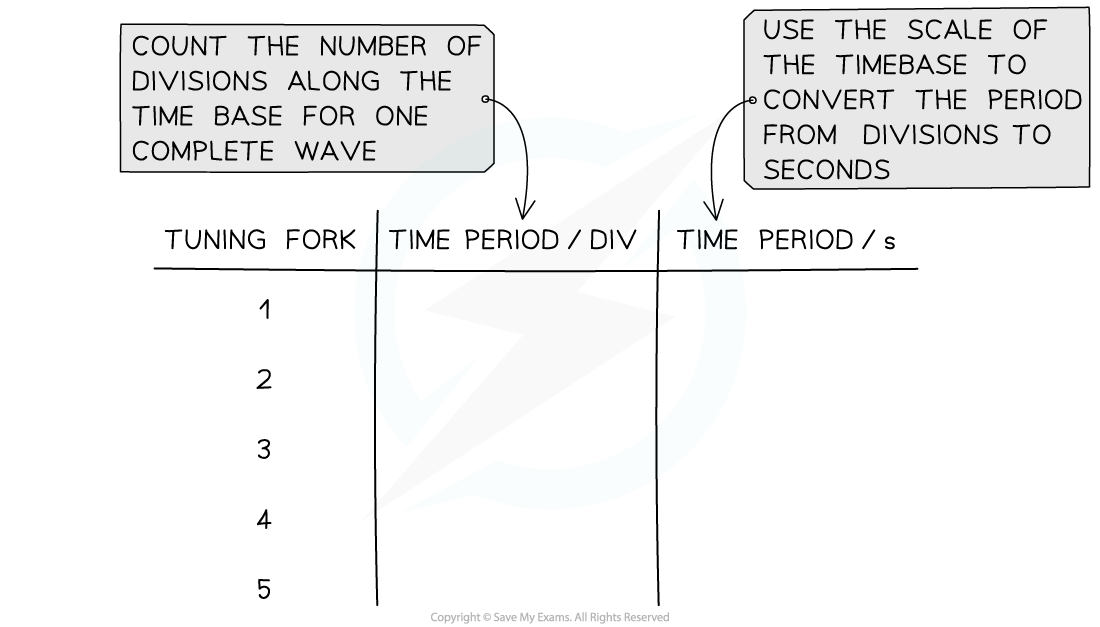
- One complete cycle is measured in divisions and converted to seconds with the time-base scale.
- Frequency is calculated from f = 1/T and the measurement is repeated for a variety of forks.
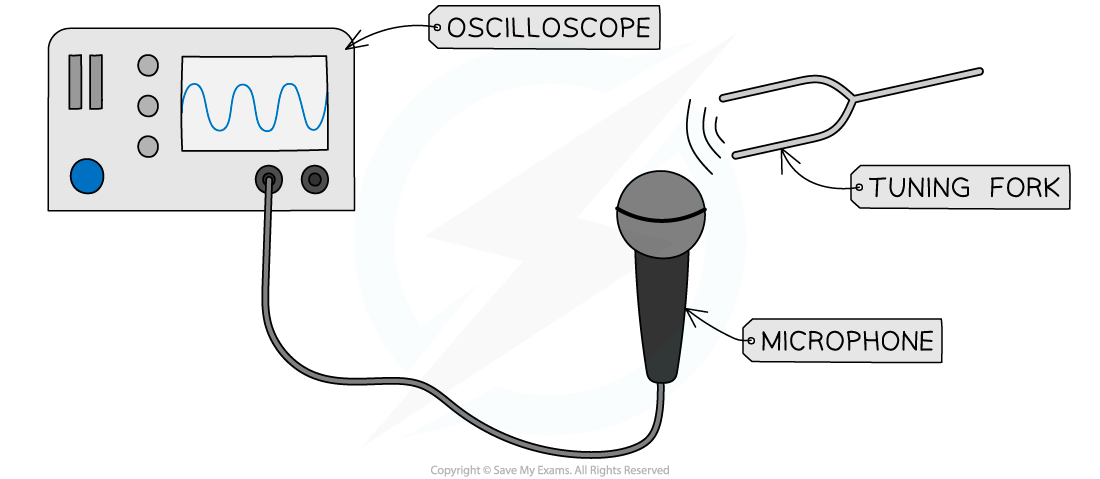
Measuring the frequency of a sound wave using an oscilloscope
Choose a confidence level to continue.
Prefer to read it all at once? Show the full lesson as a page
1.Finding frequency from the time base
A tuning fork hands you a sound of pure, known-shape frequency. Display it on an oscilloscope, count the divisions spanned by one complete cycle, convert with the time-base scale to get the time period, and the frequency follows from f = 1/T — then repeat for forks of different frequency.
Measuring the frequency of a sound wave using an oscilloscope
Key points
- The independent variable is the frequency of the tuning fork used and the dependent variable is the measured time period.
Guided content from the SME authoring corpus — note rn_P8xWkdTw6SrvWYJx, pinned at 8f834fff738f · promoted SyllabAI/syllabai-resources b3caaaa90c5e