AC & DC
2 guided lessons · 18 checks · 2. Electricity → Electrical Power & Mains Electricity
Guided lessons for this note
Which concept don't you understand yet?
We'll explain it simply and check your understanding. Pick any lesson — any order works.
0 of 18 checks correct so far
Lesson 1 of 2
Direct current from cells & batteries
A battery pushes charge the same way all the time: its positive and negative terminals never swap, so the current flows steadily one way around the circuit. That is direct current, and every cell or battery you have wired into a circuit produces it.
What you know already
Two kinds of current power the world: the steady one-way flow from a battery, and the back-and-forth flow from the mains. This note defines direct and alternating current, contrasts their terminals, and pins down the UK mains figures — alternating current at 50 Hz and about 230 V — alongside the oscilloscope traces that tell them apart.
Key points of understanding
- Direct current flows steadily one way round the circuit, positive to negative.
- A d.c. supply keeps fixed positive and negative terminals.
- Cells and batteries are the everyday sources of direct current.
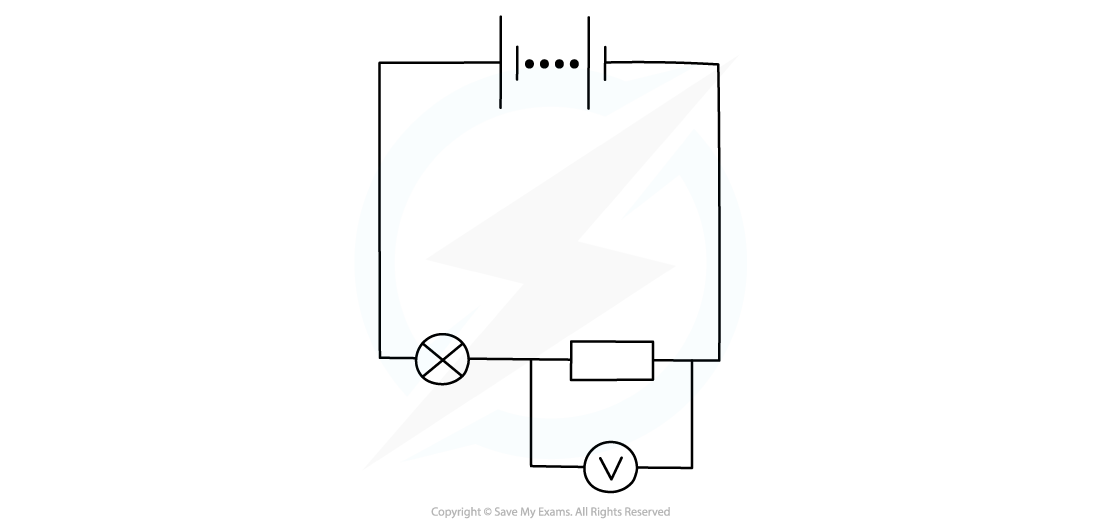
Circuits powered by cells or batteries use a d.c. supply
Choose a confidence level to continue.
Prefer to read it all at once? Show the full lesson as a page
1.Direct current from cells & batteries
A battery pushes charge the same way all the time: its positive and negative terminals never swap, so the current flows steadily one way around the circuit. That is direct current, and every cell or battery you have wired into a circuit produces it.
Circuits powered by cells or batteries use a d.c. supply
Key points
- Direct current flows steadily one way round the circuit, positive to negative.
- A d.c. supply keeps fixed positive and negative terminals.
- Cells and batteries are the everyday sources of direct current.
First pass
Direct current goes one way only, from the positive terminal to the negative.
Analogy — A one-way escalator: everyone moves in the same direction, all the time.
Exam pointer — All the circuits you have built so far are d.c. — the calculations you know already apply unchanged.
Going deeper
The fixed polarity of the terminals is what fixes the direction: the current follows the potential difference, and that never reverses.
Analogy — A river bed that only ever slopes one way — the water has no choice of direction.
Exam pointer — If asked for a source, say cells or batteries, not 'the plug'.
Checks
0 of 9 attempted · 0 correct
2.Alternating current & the UK mains
The mains behaves differently: its two terminals keep trading polarity, so the current sweeps back and forth instead of holding one direction. That is alternating current. The frequency counts the sweeps each second — 50 of them in UK sockets — and the voltage sits near 230 V.
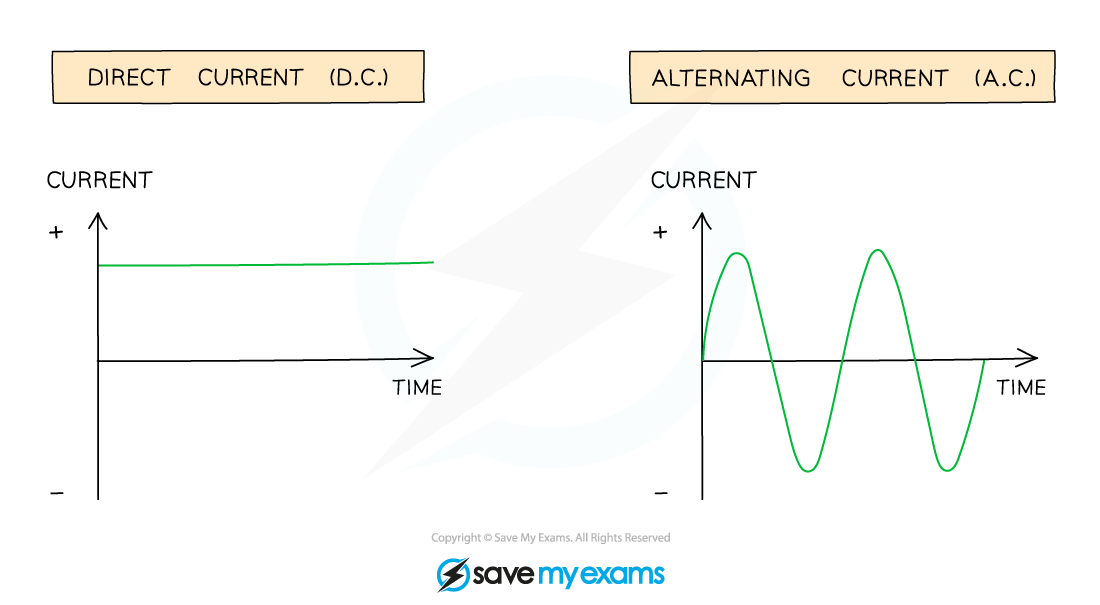
Two graphs showing the variation of current with time for alternating current and direct current
Key points
- Alternating current changes direction continuously, moving back and forth.
- An a.c. supply has two identical terminals whose polarity keeps swapping.
- The frequency counts the back-and-forth direction changes each second.
- UK mains delivers alternating current at 50 Hz and about 230 V.
- Generators at power stations produce the mains alternating current.
First pass
Alternating current keeps reversing direction; UK mains does this 50 times a second at about 230 V.
Analogy — A pendulum versus a one-way slide: the pendulum sweeps both ways, the slide only down.
Exam pointer — Learn the two mains numbers as a pair — 50 Hz and 230 V — questions rarely ask for one without the other.
Going deeper
Because the terminals swap polarity continuously, neither is 'the positive one'; each is positive half the time and negative the other half.
Analogy — Two children on a see-saw taking turns being 'up' — neither holds the title for long.
Exam pointer — Sketch the two oscilloscope traces: a flat line for d.c., an oscillating wave for a.c.
Checks
0 of 9 attempted · 0 correct
Guided content from the SME authoring corpus — note rn_NgxJhPpm5Zs7kFSz, pinned at 502107a3fcac · promoted SyllabAI/syllabai-resources b3caaaa90c5e