Specific Heat Capacity
2 guided lessons · 18 checks · 5. Solids, Liquids and Gases → Changes of State
Guided lessons for this note
Which concept don't you understand yet?
We'll explain it simply and check your understanding. Pick any lesson — any order works.
0 of 18 checks correct so far
Lesson 1 of 2
Defining specific heat capacity
Specific heat capacity is the price, in joules, of lifting one kilogram of a substance by one degree Celsius. High-capacity substances are slow to warm and slow to cool; low-capacity substances sprint through both.
What you know already
Different substances are differently stubborn about warming: water soaks up four thousand joules per kilogram per degree, metals far less. This note defines specific heat capacity, contrasts the high-capacity and low-capacity worlds, and drills the ΔQ = mcΔT calculation to a two-significant-figure finish.
Key points of understanding
- Specific heat capacity is the energy needed to warm 1 kg of a substance by 1 °C.
- Its unit is joules per kilogram per degree Celsius, written J/kg °C.
- Water has a high specific heat capacity, so it warms up and cools down slowly.
- Substances with a low specific heat capacity heat up and cool down quickly for the same energy.
- The temperature change for a given energy input depends on the mass and the material heated.
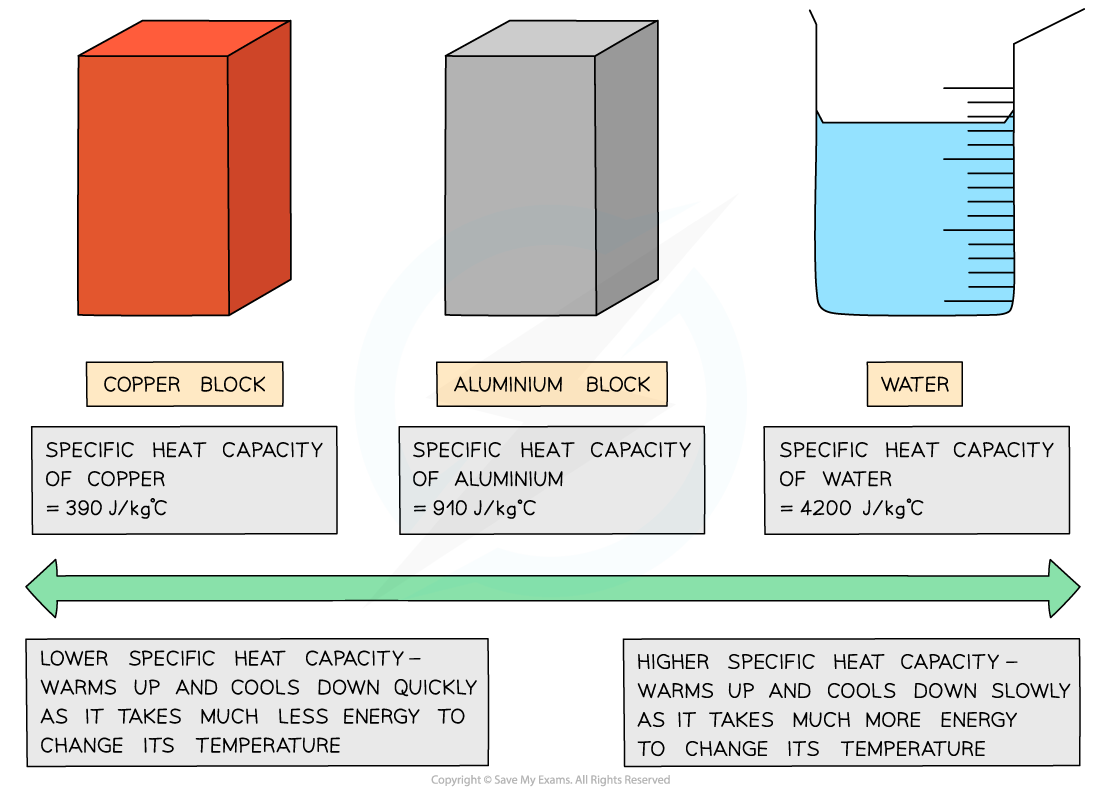
Low vs high specific heat capacity
Choose a confidence level to continue.
Prefer to read it all at once? Show the full lesson as a page
1.Defining specific heat capacity
Specific heat capacity is the price, in joules, of lifting one kilogram of a substance by one degree Celsius. High-capacity substances are slow to warm and slow to cool; low-capacity substances sprint through both.
Low vs high specific heat capacity
Key points
- Specific heat capacity is the energy needed to warm 1 kg of a substance by 1 °C.
- Its unit is joules per kilogram per degree Celsius, written J/kg °C.
- Water has a high specific heat capacity, so it warms up and cools down slowly.
- Substances with a low specific heat capacity heat up and cool down quickly for the same energy.
Guided content from the SME authoring corpus — note rn_H8r8FssR6Q3Ks7pc, pinned at 8788fc85a2c1 · promoted SyllabAI/syllabai-resources b3caaaa90c5e