Density
3 guided lessons · 27 checks · 5. Solids, Liquids and Gases → Density & Pressure
Guided lessons for this note
Which concept don't you understand yet?
We'll explain it simply and check your understanding. Pick any lesson — any order works.
0 of 27 checks correct so far
Lesson 1 of 3
The density equation
Density prices a material: how much mass is packed into each cube of its volume. The equation divides mass by volume, the triangle rearranges it, and the units follow whatever units the two inputs arrive in.
What you know already
A feather bag and a metal bag can share a size yet differ wildly in heft. These lessons define density, build the density equation and its triangle, compare materials state by state, and unlock the volume formulae the calculation needs first.
Key points of understanding
- Density is how much mass a material packs into each unit of its volume.
- ρ = m ÷ V, with density in kilograms per metre cubed, mass in kilograms and volume in metres cubed.
- A formula triangle covering ρ, m or V reproduces every rearrangement of the equation.
- Grams with centimetres cubed give grams per centimetre cubed; kilograms with metres cubed give kilograms per metre cubed.
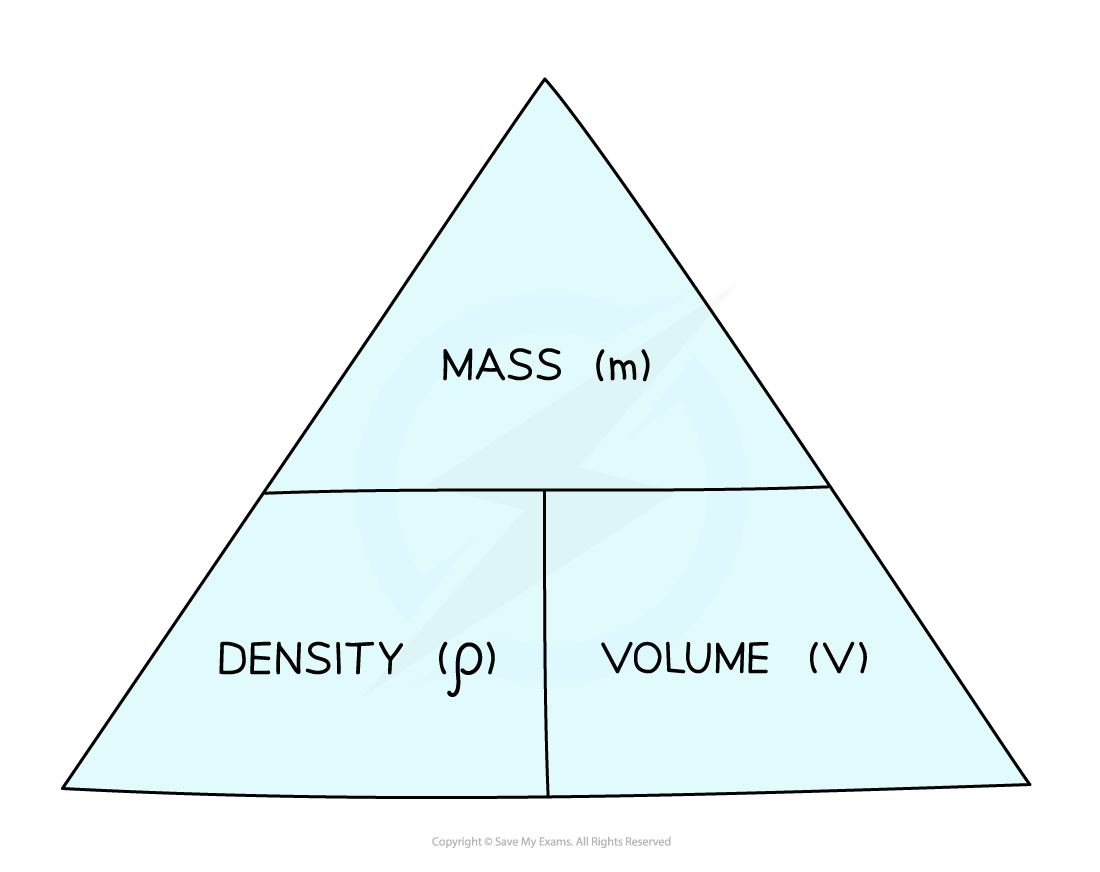
To use a formula triangle, simply cover up the quantity you wish calculate and the structure of the equation is revealed
Choose a confidence level to continue.
Prefer to read it all at once? Show the full lesson as a page
1.The density equation
Density prices a material: how much mass is packed into each cube of its volume. The equation divides mass by volume, the triangle rearranges it, and the units follow whatever units the two inputs arrive in.
To use a formula triangle, simply cover up the quantity you wish calculate and the structure of the equation is revealed
Key points
- Density is how much mass a material packs into each unit of its volume.
- ρ = m ÷ V, with density in kilograms per metre cubed, mass in kilograms and volume in metres cubed.
- A formula triangle covering ρ, m or V reproduces every rearrangement of the equation.
- Grams with centimetres cubed give grams per centimetre cubed; kilograms with metres cubed give kilograms per metre cubed.
First pass
Weigh it, measure the space it fills, divide the first by the second. Hide the symbol you want on the triangle and the other two show you whether to multiply or divide.
Analogy — A crowd count: people (mass) spread through a hall (volume) — a cramped hall has a dense crowd, an empty one does not.
Exam pointer — State the unit with the answer and match it to the input units — mixing grams with metres cubed is the classic unit slip.
Going deeper
The density equation ρ = m/V divides the mass of a sample by the volume it occupies, so equal masses in smaller volumes are denser. The unit follows the inputs: grams and centimetres cubed yield grams per centimetre cubed, kilograms and metres cubed yield kilograms per metre cubed, and the triangle encodes all three rearrangements.
Analogy — A population density map: the same city spread over a larger county reads as a lower figure — area here plays volume's role.
Exam pointer — Convert lengths to metres and masses to kilograms before dividing whenever the question wants kg/m³ — quote the unit to bank the mark.
Checks
0 of 9 attempted · 0 correct
2.Density across states and materials
The same substance changes its density with its state: packed particles make dense solids and liquids, while spread-out particles thin gases out. Material choice matters just as much — equal sizes, wildly different hefts.
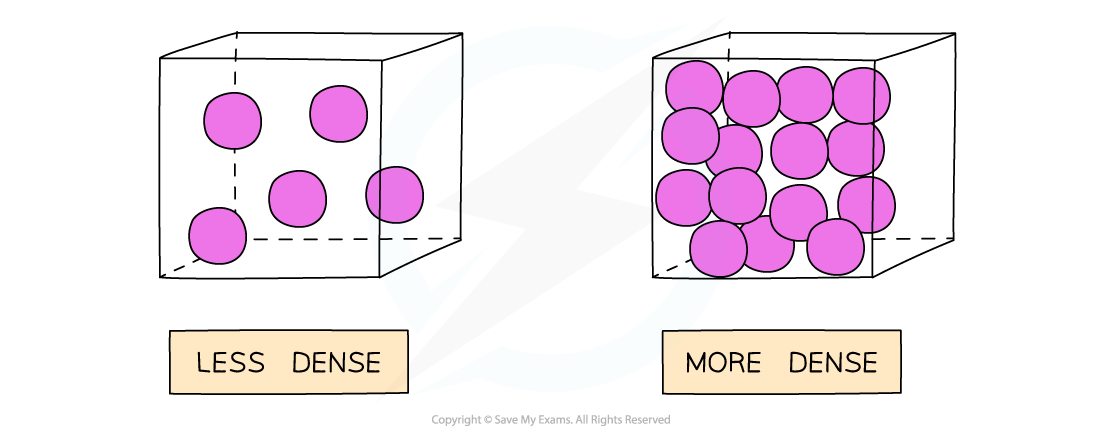
A gas is less dense than the same substance in liquid or solid form
Key points
- Objects made from low-density materials carry low masses; equal-sized objects of high-density materials carry high masses.
- A bag of feathers is far lighter than the same bag filled with metal.
- Gases are generally less dense than solids because their particles sit far apart.
- The same substance is denser in solid or liquid form than as a gas.
First pass
Squeeze the same atoms closer together and the density climbs: solid tight, liquid close, gas sparse. Swap the material instead and the atom's own heft sets the scale — feathers float, lead sinks.
Analogy — Three classrooms: packed full (solid), half full (liquid), one pupil per corridor (gas) — same school, very different crowding.
Exam pointer — Comparisons must fix everything but one variable — equal volumes for material comparisons, equal substance for state comparisons.
Going deeper
Density tracks particle spacing: a substance's solid and liquid states pack particles closely, so both out-dense the gas state where the same mass disperses through far more volume. Across materials at equal volume, the heavier-particle, tighter-packed material wins the density contest outright.
Analogy — Packing for three trips: folded tight (solid), loosely rolled (liquid), scattered across the whole suitcase (gas) — same belongings, three bulks.
Exam pointer — When a question compares states, answer with particle spacing and the mass-over-volume consequence, not with 'gases are light', which explains nothing.
Checks
0 of 9 attempted · 0 correct
3.Finding volume first
Density questions often hide the volume inside the object's shape. Out come the geometry formulae — cubes, cuboids, cylinders and spheres — and only after the volume is rebuilt can the density equation divide.
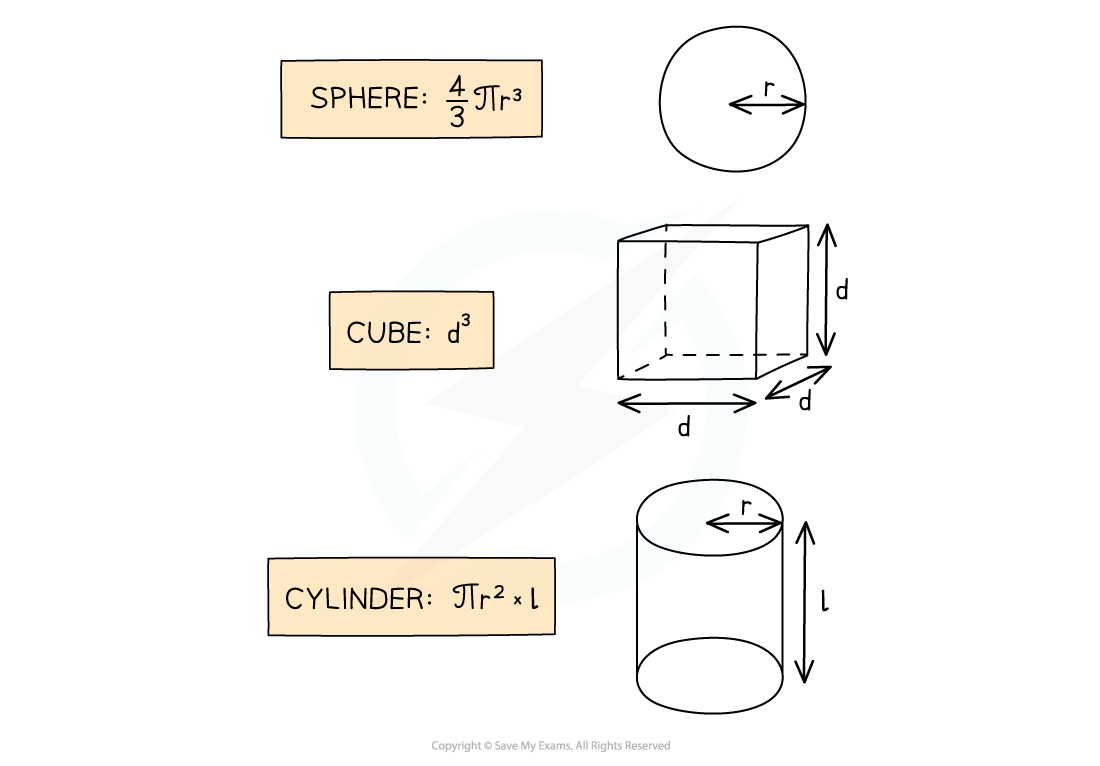
Volumes of common 3D shapes
Key points
- An object's volume is not always stated and must be calculated from its shape first.
- Each regular shape carries its own volume formula — cube, cuboid, cylinder and sphere among them.
- Once the volume is known, the density equation divides mass by volume as usual.
- Lengths must enter the volume formulae in metres so the density lands in kilograms per metre cubed.
First pass
Measure the edges, apply the shape's own formula, then divide the mass by what you get. The geometry is the servant: it exists to feed the density equation a volume.
Analogy — A recipe: the shape's formula is the measuring jug step — only after pouring the volume can you cook the density.
Exam pointer — Write the volume formula explicitly before substituting — examiners award the method mark even where arithmetic slips.
Going deeper
Volume reconstruction precedes density calculation whenever the volume is not given directly: the object's shape selects the formula, the lengths are multiplied through in metres, and the resulting volume in metres cubed feeds ρ = m/V. Errors in the geometry propagate straight into the density, which is why the formula must be stated.
Analogy — A two-stage rocket: the geometry stage lifts off first, and only its burnout hands the mass-over-volume stage its payload.
Exam pointer — State the shape formula, convert lengths to metres, then divide — and carry the units through the volume step, not just the final answer.
Checks
0 of 9 attempted · 0 correct
Guided content from the SME authoring corpus — note rn_9SWwrq7BZFhXQbsT, pinned at c40b8b284935 · promoted SyllabAI/syllabai-resources b3caaaa90c5e