Solids, Liquids & Gases
2 guided lessons · 18 checks · 5. Solids, Liquids and Gases → Changes of State
Guided lessons for this note
Which concept don't you understand yet?
We'll explain it simply and check your understanding. Pick any lesson — any order works.
0 of 18 checks correct so far
Lesson 1 of 2
Particle arrangements in solids and liquids
Solids and liquids both keep their particles touching, but only the solid locks them into a fixed pattern. That single difference explains why a solid keeps its own shape while a liquid borrows the shape of whatever holds it.
What you know already
Every material sits in one of three states, and the difference between them is purely how its particles are packed and how freely they move. This note prices the three arrangements — fixed lattice, sliding neighbours, free flight — and the shape-and-volume behaviour each arrangement forces on the bulk substance.
Key points of understanding
- Solid particles are packed in a regular, fixed arrangement and only vibrate about fixed positions.
- Liquid particles stay in contact but are arranged irregularly and can slide past one another.
- A solid keeps both its own shape and a fixed volume because its particles cannot change positions.
- A liquid has a fixed volume but takes the shape of the bottom of its container because its particles can flow.
Choose a confidence level to continue.
Prefer to read it all at once? Show the full lesson as a page
1.Particle arrangements in solids and liquids
Solids and liquids both keep their particles touching, but only the solid locks them into a fixed pattern. That single difference explains why a solid keeps its own shape while a liquid borrows the shape of whatever holds it.
Key points
- Solid particles are packed in a regular, fixed arrangement and only vibrate about fixed positions.
- Liquid particles stay in contact but are arranged irregularly and can slide past one another.
- A solid keeps both its own shape and a fixed volume because its particles cannot change positions.
- A liquid has a fixed volume but takes the shape of the bottom of its container because its particles can flow.
First pass
In a solid every particle has a locked seat and just trembles in place; in a liquid the neighbours touch but jostle past each other, so the material pours yet will not compress much.
Analogy — A sold-out theatre: in the solid film everyone stays in their assigned seat, while in the liquid version the crowd shuffles around the aisles but nobody leaves the row they were born in.
Exam pointer — Two marks live apart: state the arrangement (regular vs irregular, touching or not) and then the motion (vibrate about fixed points vs move past each other).
Going deeper
The solid lattice is regular and close-packed, so each particle oscillates around one site and the macroscopic shape is self-held. In a liquid the packing is irregular with near-neighbours still in contact; bonds constantly break and reform, allowing flow while density stays close to the solid's.
Analogy — Magnetic balls in a tray: snap them into a crystal and each ball buzzes on its spot; warm the grip slightly and they roll over one another while never leaving the tray floor.
Exam pointer — When comparing states, always tie a particle property to the bulk property — sliding particles cause flow, fixed particles cause a shape that survives tipping the container out.
Checks
0 of 9 attempted · 0 correct
2.The gas state and the three-state summary
Gases complete the picture: particles break contact entirely and fly between collisions. Comparing all three states side by side turns the particle model into a one-glance summary of shape and volume behaviour.
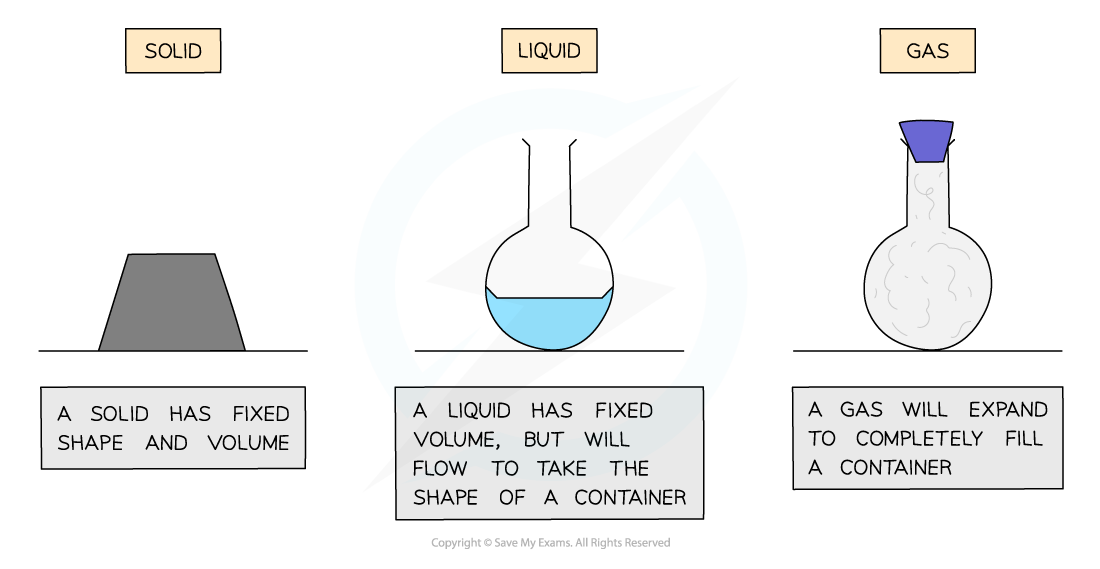
Diagram showing the three states of matter in terms of shape and volume
Key points
- Gas particles are well separated with no regular arrangement and move quickly in random directions.
- Collisions between gas particles, and between particles and the container walls, are frequent in the model.
- A gas has neither a fixed shape nor a fixed volume and expands to fill whatever space it is given.
- Shape and volume across the three states follow directly from particle arrangement and freedom of motion.
First pass
Gas particles are spread far apart and race about at random, bumping into each other and the walls. That is why a gas spreads out to fill any box you put it in and can be squeezed into a smaller one.
Analogy — A room full of bouncy balls released at once: they ricochet off each other and the walls until the swarm occupies every corner of the room.
Exam pointer — State the two gas behaviours together — rapid random motion and negligible forces between particles except at collisions — because questions usually want both.
Going deeper
In the gas state separations are large compared with the particle size, interactions are negligible between collisions, and motion is rapid, random and straight-line until the next impact. Macroscopically this yields both variable shape and variable volume, with pressure emerging from wall collisions.
Analogy — Squash balls sealed in a glass jar and shaken hard: each ball travels freely until it clips another or rebounds off the glass, and the swarm presses outward on every wall at once.
Exam pointer — If asked why a gas fills its container, quote the random straight-line motion between collisions rather than vague 'particles move' — the direction randomness is the mark-winning detail.
Checks
0 of 9 attempted · 0 correct
Guided content from the SME authoring corpus — note rn_7kByTFpXspTbVrWf, pinned at 8788fc85a2c1 · promoted SyllabAI/syllabai-resources b3caaaa90c5e