Core Practical: Investigating Thermal Energy
3 guided lessons · 27 checks · 4. Energy Resources and Energy Transfers → Energy Stores & Transfers
Guided lessons for this note
Which concept don't you understand yet?
We'll explain it simply and check your understanding. Pick any lesson — any order works.
0 of 27 checks correct so far
Lesson 1 of 3
Experiment 1: conduction in four metals
Four metal strips meet at a heated centre, each carrying a ball bearing stuck on with wax at the same distance out. The wax lets go in conduction-speed order: the first bearing to drop hangs on the best conductor, and the falling order ranks copper, aluminium, brass and iron.
What you know already
Three experiments, three transfer routes. Metal strips and dropping ball bearings rank conductors; a purple dye trail films a convection current in water; four differently painted flasks turn surface finish into cooling curves. Together they put conduction, convection and radiation on the bench.
Key points of understanding
- The aim is to rank four different metals by how quickly they conduct heat along their length.
- The independent variable is the type of metal; the dependent variable is the rate of conduction.
- Control variables include the size and thickness of the strips, the amount of wax and identical ball bearings.
- Ball bearings are attached with wax; when conducted heat melts the wax, the bearing drops, and the drop time is recorded.
- The first bearing to fall marks the best thermal conductor; the observed order is copper, then aluminium, then brass, then iron.
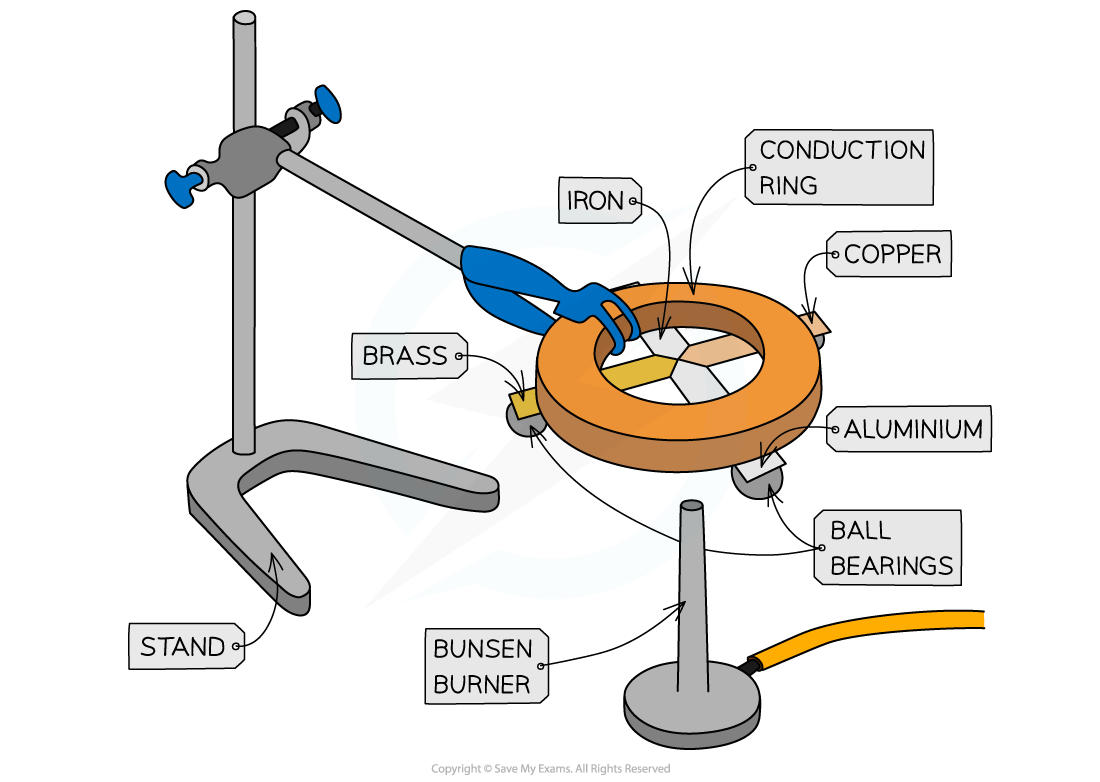
The above apparatus consists of 4 different metal strips of equal width and length arranged around an insulated circle
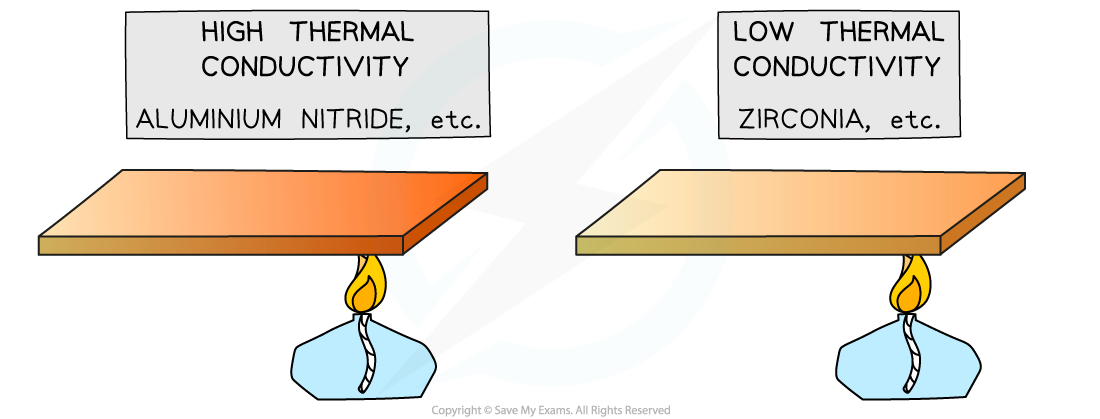
Examples of materials with high and low thermal conductivity
Choose a confidence level to continue.
Prefer to read it all at once? Show the full lesson as a page
1.Experiment 1: conduction in four metals
Four metal strips meet at a heated centre, each carrying a ball bearing stuck on with wax at the same distance out. The wax lets go in conduction-speed order: the first bearing to drop hangs on the best conductor, and the falling order ranks copper, aluminium, brass and iron.
The above apparatus consists of 4 different metal strips of equal width and length arranged around an insulated circle
Examples of materials with high and low thermal conductivity
Key points
- The aim is to rank four different metals by how quickly they conduct heat along their length.
- The independent variable is the type of metal; the dependent variable is the rate of conduction.
- Control variables include the size and thickness of the strips, the amount of wax and identical ball bearings.
- Ball bearings are attached with wax; when conducted heat melts the wax, the bearing drops, and the drop time is recorded.
- The first bearing to fall marks the best thermal conductor; the observed order is copper, then aluminium, then brass, then iron.
First pass
Heat the shared centre of four metal strips, time how long each strip’s wax takes to release its ball bearing, and read the conductivity ranking straight off the falling order.
Analogy — Four runners handed a relay baton at the same instant: the finishing order is the conducting order.
Exam pointer — Controls earn marks: equal strip size and thickness, equal wax, identical bearings — otherwise the comparison is unfair.
Going deeper
Better conductors push heat along their length sooner, so their wax reaches melting temperature first; repetition and averaging steady the timing.
Analogy — A row of candle wicks of different materials lit from a shared flame: some carry the flame to their far end before the others.
Exam pointer — Quote the expected order if asked: copper (fastest) > aluminium > brass > iron (slowest).
Checks
0 of 9 attempted · 0 correct
2.Experiment 2: convection in water
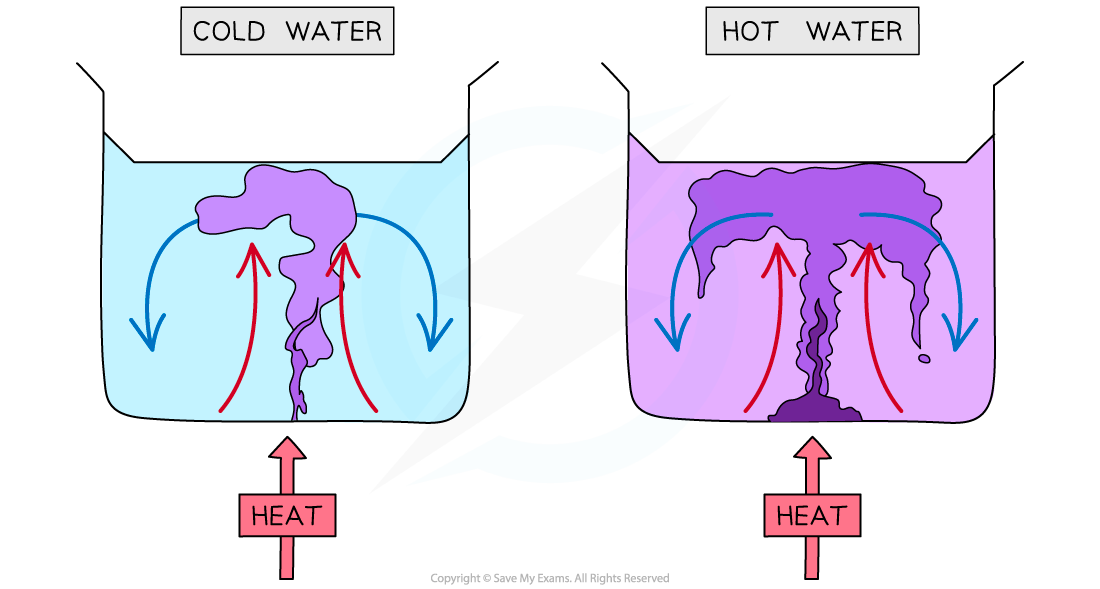
A crystal of potassium permanganate drops into water and bleeds purple. Warm the water gently right below it and the purple trail becomes a movie of the convection current: rising above the flame, spreading, cooling, sinking and circling back — in cold water and warm water alike, at different speeds.
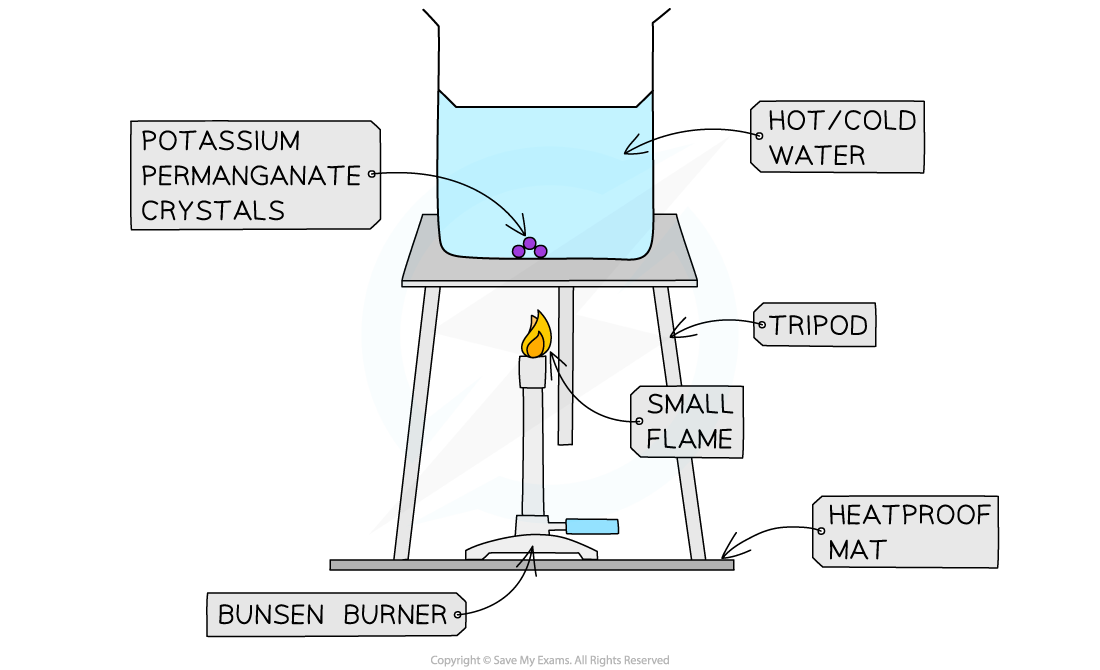
Apparatus used to investigate potassium permanganate crystals undergoing convection in water
Key points
- The aim is to investigate the rate of convection using potassium permanganate crystals in two temperatures of water.
- The independent variable is the temperature of the water; the dependent variable is the rate of convection.
- Controls include the amount of water, the size of the Bunsen flame and the size of the crystal.
- The crystal is dropped carefully into the centre of the beaker of water and the beaker is heated gently below it.
- The purple trail traces the convection current, and the trail’s speed shows the rate of convection in each water temperature.
First pass
The dye rides the current: warm water rises above the flame carrying the purple trail, cools, sinks at the edges and returns, and the loop runs faster in warmer water.
Analogy — Ink dropped into a lazy river bend: the ink is passive, the flow draws the picture, and the flow’s speed is the story.
Exam pointer — The crystal is the MARKER, not the mover — say the water’s motion carries it, or you lose the mechanism mark.
Going deeper
Controls keep the current’s shape comparable: same water volume, same flame, same crystal size — so the only real difference is the water’s starting temperature and hence the convection rate.
Analogy — Two identical go-kart tracks with different starting speeds: the tracks must match before you compare the laps.
Exam pointer — Careful handling earns marks: forceps for the crystal, gentle heating, not-too-full beaker — quote them as method points.
Checks
0 of 9 attempted · 0 correct
3.Experiment 3: radiation from different surfaces
Four identical flasks — black, dull grey, white and silver — filled with the same hot water at the same starting temperature, then timed with thermometers. The black flask cools fastest, the silver slowest, and the temperature-time curves put the emit-and-absorb law of surfaces on the page.
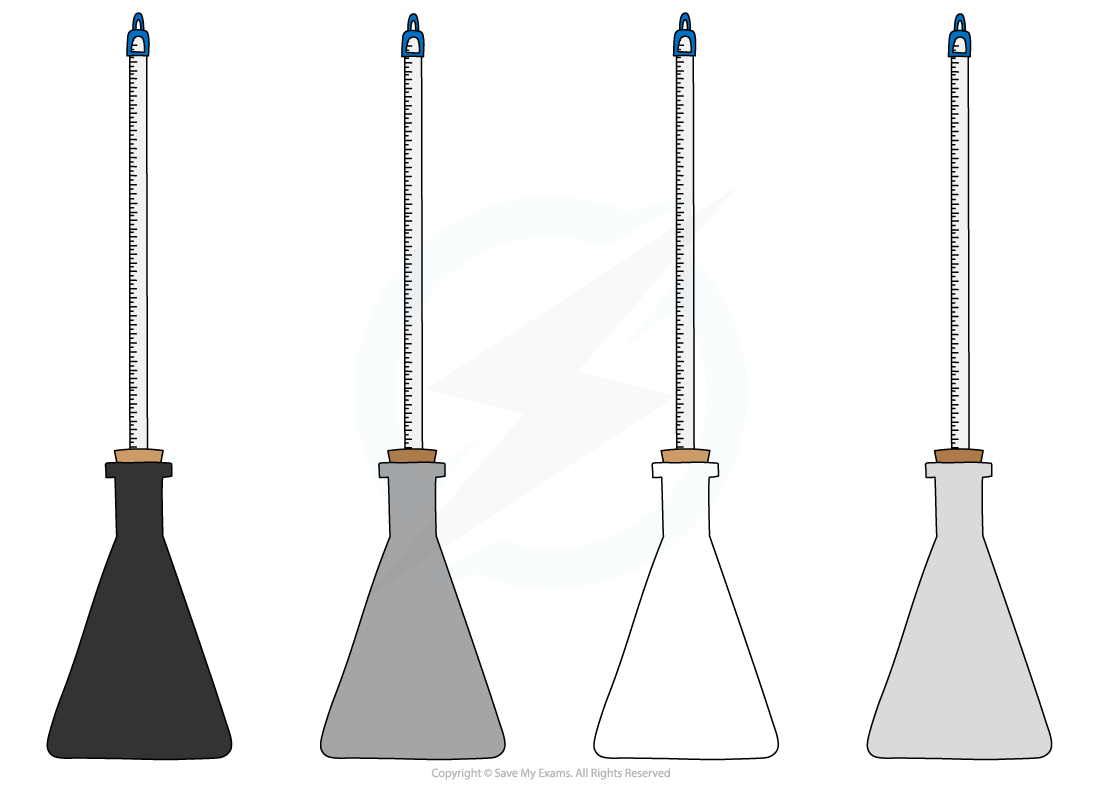
Different coloured beakers for investigating infrared radiation apparatus
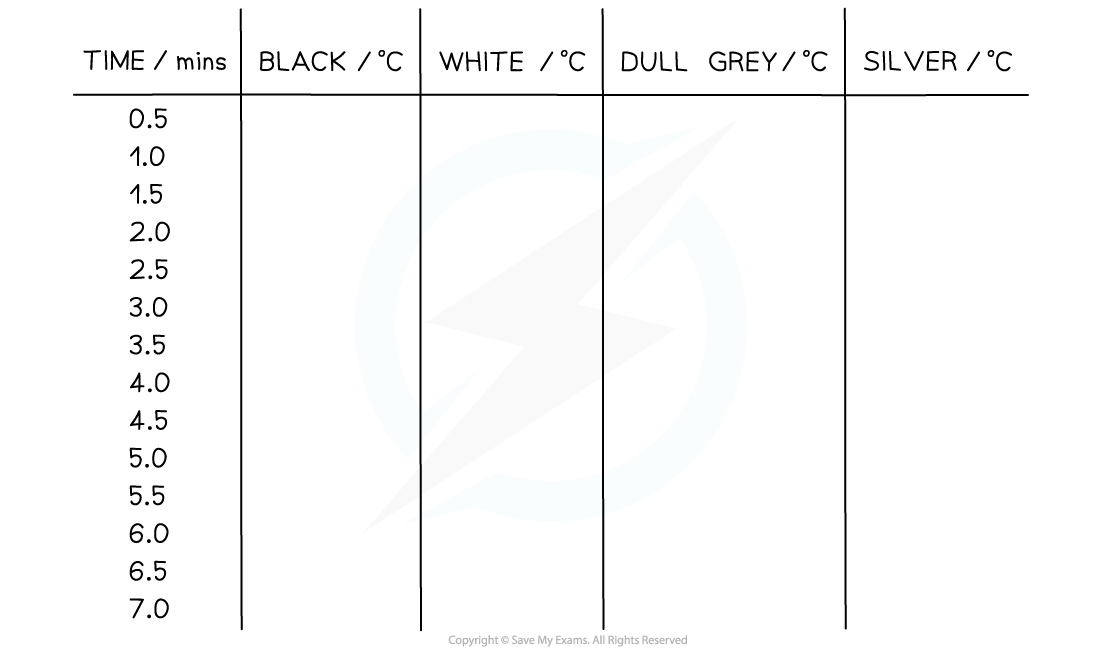
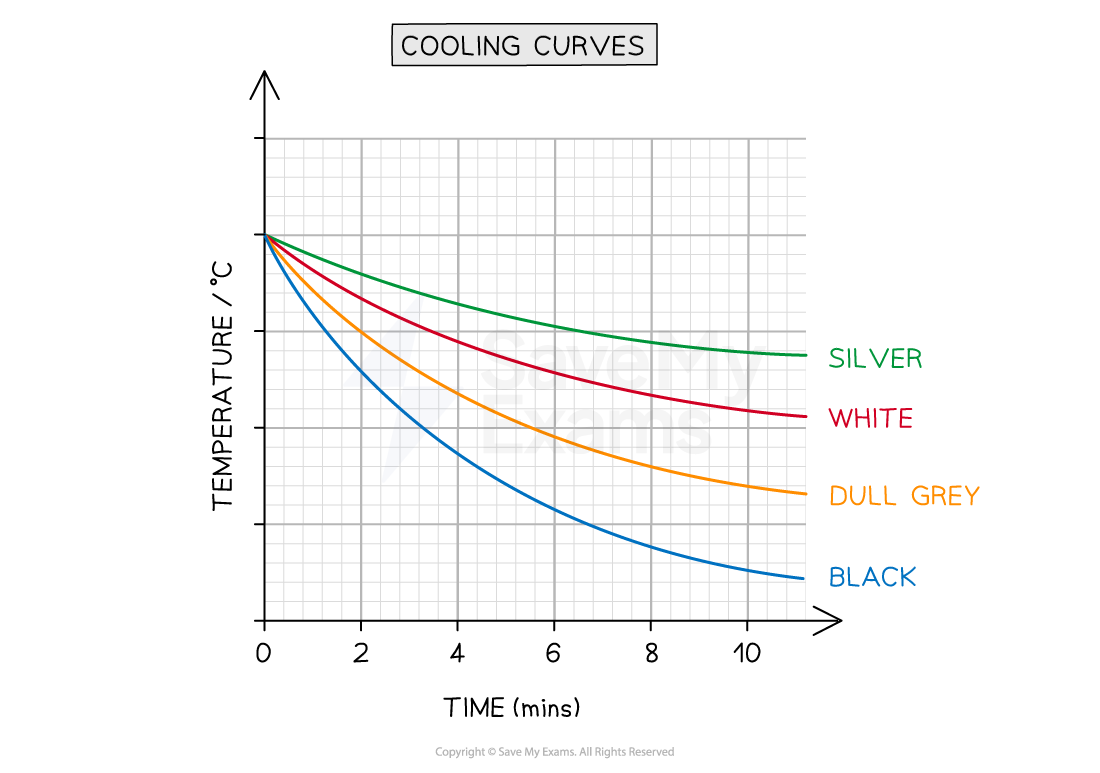
Example graph of the expected results for the different coloured beakers
Key points
- The aim is to test how a surface’s nature sets how much infrared it absorbs and radiates.
- The independent variable is the colour of the flask; the dependent variable is the temperature of the water.
- Controls keep the flasks identical apart from their finish, with equal hot water, one shared starting temperature and one shared timing interval.
- Temperatures are recorded at regular intervals, for example every 30 seconds for 10 minutes.
- The black flask cools fastest and the silver flask slowest, matching the emit-and-absorb ranking of surfaces.
First pass
Same water, same start, four finishes: the cooling curves order themselves black first, then grey, then white, then silver last — the emission ranking drawn in temperature.
Analogy — Four identical mugs of tea in winter, one painted black, one wrapped in foil: the paint job decides who cools first.
Exam pointer — Quote the control set — identical flasks except colour, same volumes, same start temperature, same intervals — before quoting the ranking.
Going deeper
The cooling rate is the emission rate made visible: steeper early drop for black, flattest for silver; the evaluation adds heatproof mats, thermometer resolution of 1 °C and repeat runs.
Analogy — Four runners of the same fitness on different shoes: the shoes — like the surfaces — set who crosses the line first.
Exam pointer — Safety and evaluation: hot water scalds, mats protect the bench, and repeats average out reading scatter at ±1 °C resolution.
Checks
0 of 9 attempted · 0 correct
Guided content from the SME authoring corpus — note rn_6wZc5RHQn4qftvc8, pinned at 8f834fff738f · promoted SyllabAI/syllabai-resources b3caaaa90c5e