Resistance
1 guided lesson · 9 checks · 2. Electricity → Current, Potential Difference & Resistance
Guided lessons for this note
Which concept don't you understand yet?
We'll explain it simply and check your understanding. Pick any lesson — any order works.
0 of 9 checks correct so far
Lesson 1 of 1
Calculating current, resistance & potential difference
Squeeze a garden hose and the flow drops; leave it open and the flow soars. Resistance does to charge exactly what your hand does to the water. This lesson defines the ohm, sets the see-saw between resistance and current, and assembles the equation V = I × R that ties all three quantities together.
What you know already
Every component, even a plain copper wire, pushes back a little against the current trying to pass through it. That push-back is resistance. This note defines the ohm, shows how resistance throttles the current at a fixed voltage, and assembles the equation linking voltage, current and resistance that solves most simple circuits.
Key points of understanding
- Resistance describes how strongly a component opposes the flow of current through it.
- Resistance is measured in ohm units (Ω); one ohm lets one volt drive one amp through a component.
- For a fixed voltage, a higher resistance means a smaller current, and a lower resistance means a larger one.
- The three quantities are linked by V = I × R.
- Copper wiring has a very low resistance, which is why it counts as a good conductor.
- In exam circuits the wires, ammeters and cells are taken to have zero resistance.
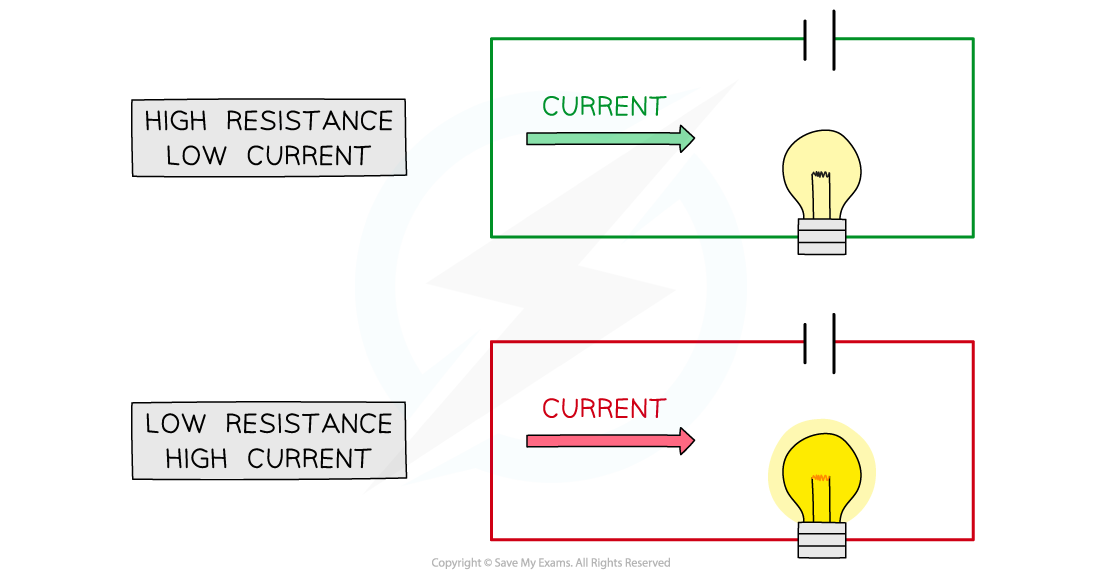
A greater resistance means there is a lower current and vice versa
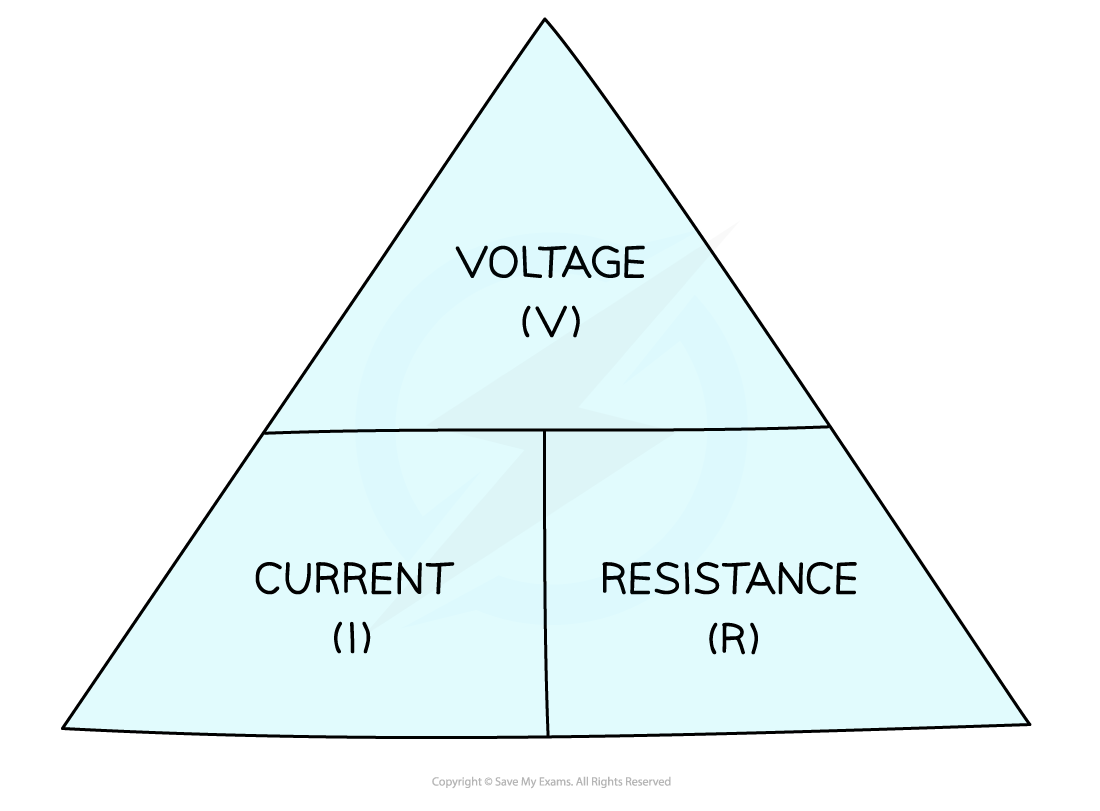
Formula triangle for the voltage, current and resistance equation
Choose a confidence level to continue.
Prefer to read it all at once? Show the full lesson as a page
1.Calculating current, resistance & potential difference
Squeeze a garden hose and the flow drops; leave it open and the flow soars. Resistance does to charge exactly what your hand does to the water. This lesson defines the ohm, sets the see-saw between resistance and current, and assembles the equation V = I × R that ties all three quantities together.
A greater resistance means there is a lower current and vice versa
Formula triangle for the voltage, current and resistance equation
Key points
- Resistance describes how strongly a component opposes the flow of current through it.
Guided content from the SME authoring corpus — note rn_64pQyK4tm9P9rdKN, pinned at 275f3b535d78 · promoted SyllabAI/syllabai-resources b3caaaa90c5e