Gravitational Potential Energy
2 guided lessons · 18 checks · 4. Energy Resources and Energy Transfers → Work, Power & Energy Resources
Guided lessons for this note
Which concept don't you understand yet?
We'll explain it simply and check your understanding. Pick any lesson — any order works.
0 of 18 checks correct so far
Lesson 1 of 2
The GPE store and its equation
An object lifted in a gravitational field carries energy because of where it is, not because of what it is doing. The gravitational potential store holds that energy, and multiplying mass by gravitational field strength by height prices it in joules.
What you know already
Height is a place where energy can be parked. These lessons define the gravitational store, build the GPE equation piece by piece, and show how the strength of gravity — from the Moon to the gas giants — changes what the same lifted height is worth.
Key points of understanding
- Gravitational potential energy is the energy an object has because of its height in a gravitational field.
- Lifting an object transfers energy into its gravitational store; a falling object transfers energy out of it.
- GPE = m × g × h, with mass in kilograms, gravitational field strength in newtons per kilogram and height in metres.
- The energy in the gravitational store grows in direct proportion to each of mass, field strength and height.
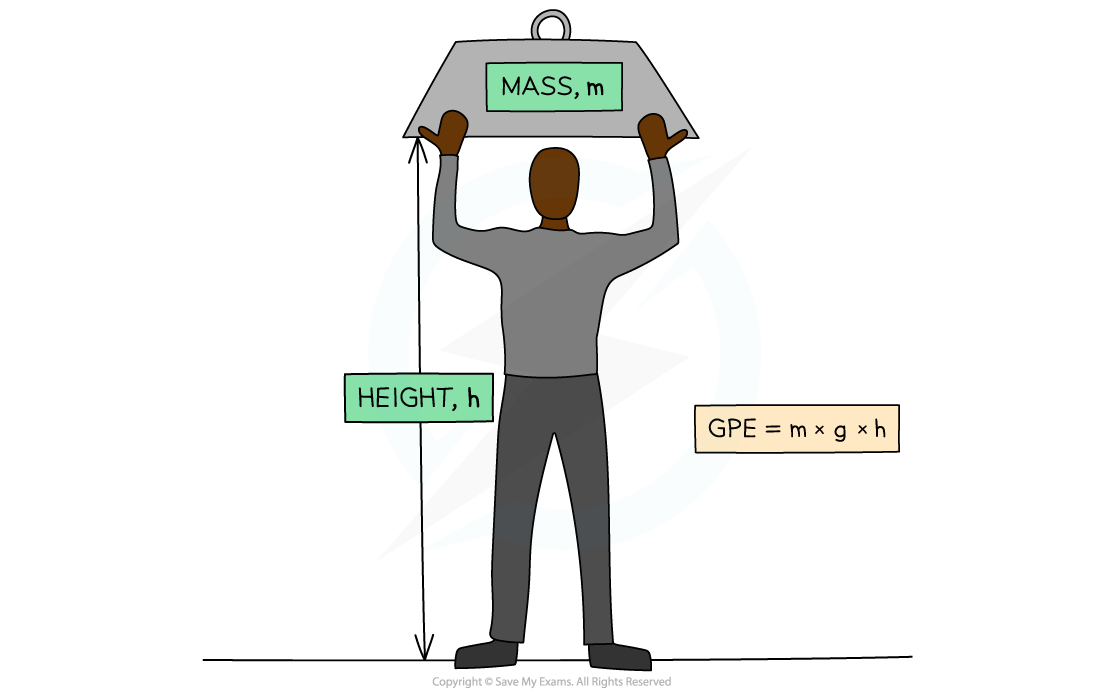
Energy is transferred to the mass's gravitational store as it is lifted above the ground
Choose a confidence level to continue.
Prefer to read it all at once? Show the full lesson as a page
1.The GPE store and its equation
An object lifted in a gravitational field carries energy because of where it is, not because of what it is doing. The gravitational potential store holds that energy, and multiplying mass by gravitational field strength by height prices it in joules.
Energy is transferred to the mass's gravitational store as it is lifted above the ground
Key points
- Gravitational potential energy is the energy an object has because of its height in a gravitational field.
- Lifting an object transfers energy into its gravitational store; a falling object transfers energy out of it.
- GPE = m × g × h, with mass in kilograms, gravitational field strength in newtons per kilogram and height in metres.
- The energy in the gravitational store grows in direct proportion to each of mass, field strength and height.
First pass
Raise something and you bank energy in its height; drop it and the bank pays out. The bill is mass times field strength times height — treble any one input and the stored energy trebles with it.
Analogy — A car park on a hill: the more cars (mass), the steeper the ramp (field strength) and the higher the level (height), the more fuel is stored in the climb.
Exam pointer — Keep the three inputs' units straight — kilograms, newtons per kilogram, metres — and the answer comes out in joules without conversion drama.
Going deeper
The gravitational store's contents are priced by GPE = mgh: each input multiplies the others, so the store responds proportionally to mass, to field strength and to height alike. Lifting deposits energy mechanically; descending releases it to other stores.
Analogy — Water pumped to a header tank: every extra metre of head, litre of water or strength of the pump's feed raises the energy held ready by the same factor.
Exam pointer — State the proportionality explicitly when a question doubles one input — examiners want 'the store doubles' with the reason, not just the number.
Checks
0 of 9 attempted · 0 correct
2.Gravitational field strength
The same lifted mass is worth different energy on different worlds, because gravitational field strength g varies. Around ten newtons per kilogram on Earth, weaker on the Moon and stronger on the gas giants, g scales every GPE calculation.
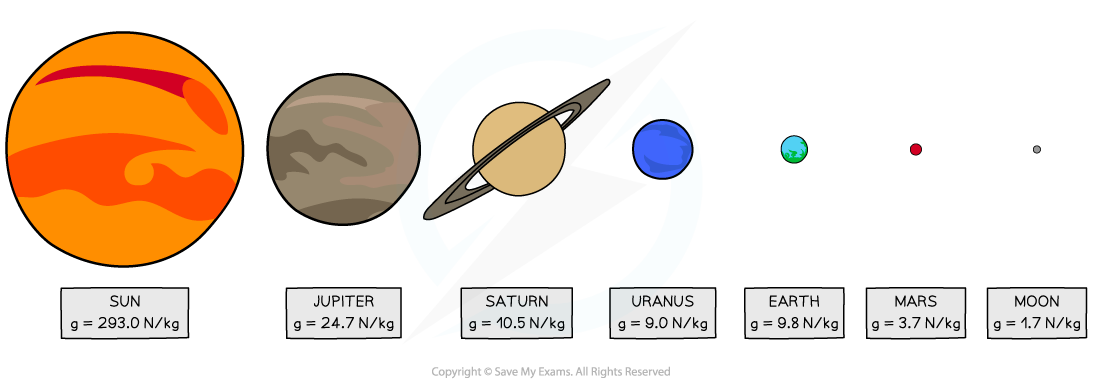
Some values for g on the different objects in the Solar System
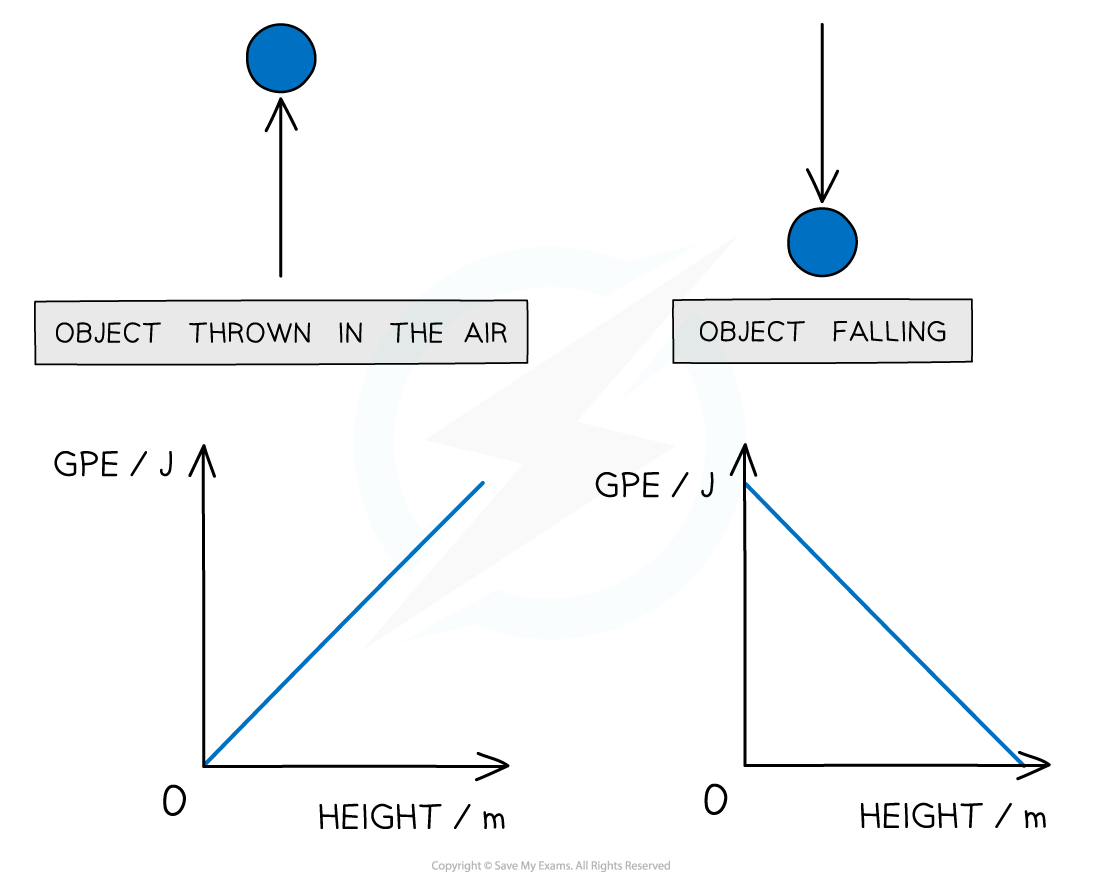
Graphs showing the linear relationship between GPE and height
Key points
- Gravitational field strength g is about 10 N/kg on Earth and multiplies mass inside the GPE equation.
- The Moon's weaker field makes lifting a given mass easier there than on Earth.
- Gas giants such as Jupiter and Saturn have stronger fields than Earth, so lifting is harder there.
- GPE rises in a straight line with height, so equal upward steps add equal amounts of energy.
First pass
g is the exchange rate between height and energy. Earth pays roughly ten joules per kilogram per metre; the Moon pays less, the gas giants more. Plot store contents against height and the line is straight — level steps, equal deposits.
Analogy — Currency conversion for height: the same suitcase of mass converts to more stored energy where gravity's exchange rate (g) is stronger.
Exam pointer — You will always be given g in the question or on the equation sheet — quote it with its unit, N/kg, in your working.
Going deeper
Gravitational field strength enters the store equation as a multiplier with the unit newton per kilogram: about 10 on Earth, lower on the Moon, higher on Jupiter and Saturn. Because m and g are fixed for a given lifted object on a given world, the store grows linearly with height.
Analogy — A pay rate: mass is the hours worked, g is the hourly rate set by each world, and height is the hours logged — doubling the hours doubles the pay, whatever the rate.
Exam pointer — When a question switches world, swap g first and recompute; never carry Earth's rate into a Moon or Jupiter calculation.
Checks
0 of 9 attempted · 0 correct
From the revision note
Diagrams on this note's page that are not tied to a specific lesson.
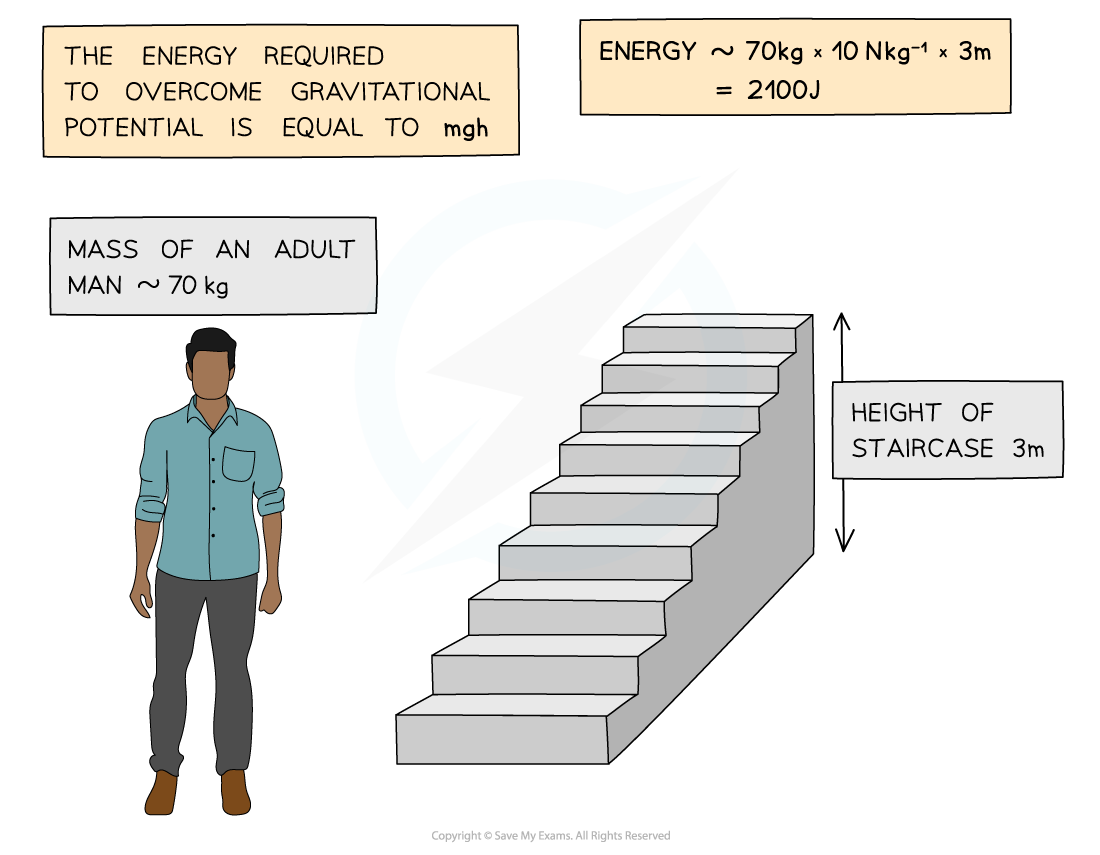
Exam Hint
Guided content from the SME authoring corpus — note rn_5VwtXpGcdNVHV2tm, pinned at c40b8b284935 · promoted SyllabAI/syllabai-resources b3caaaa90c5e