Parallel Vectors & Unit Vectors (Edexcel IGCSE Maths)
Parallel Vectors
Spec point —
8D
How can I tell if two vectors are parallel?
-
Two vectors are parallel if one is a scalar multiple of the other
-
This means that all components of the vector have been multiplied by a common constant (scalar)
-
For example, and are scalar multiples
- The numbers in the first vector have each been multiplied by 2 to get the numbers in the second vector
-
-
Multiplying the components of a vector by a positive scalar changes the magnitude of the vector but not the direction
- For example, is double the length of but in the same direction
-
Multiplying the components of a vector by a negative scalar reverses the direction
-
You can factorise a vector to help spot if two vectors are parallel
-
-
- They are scalar multiples of the same vector so they are parallel
-
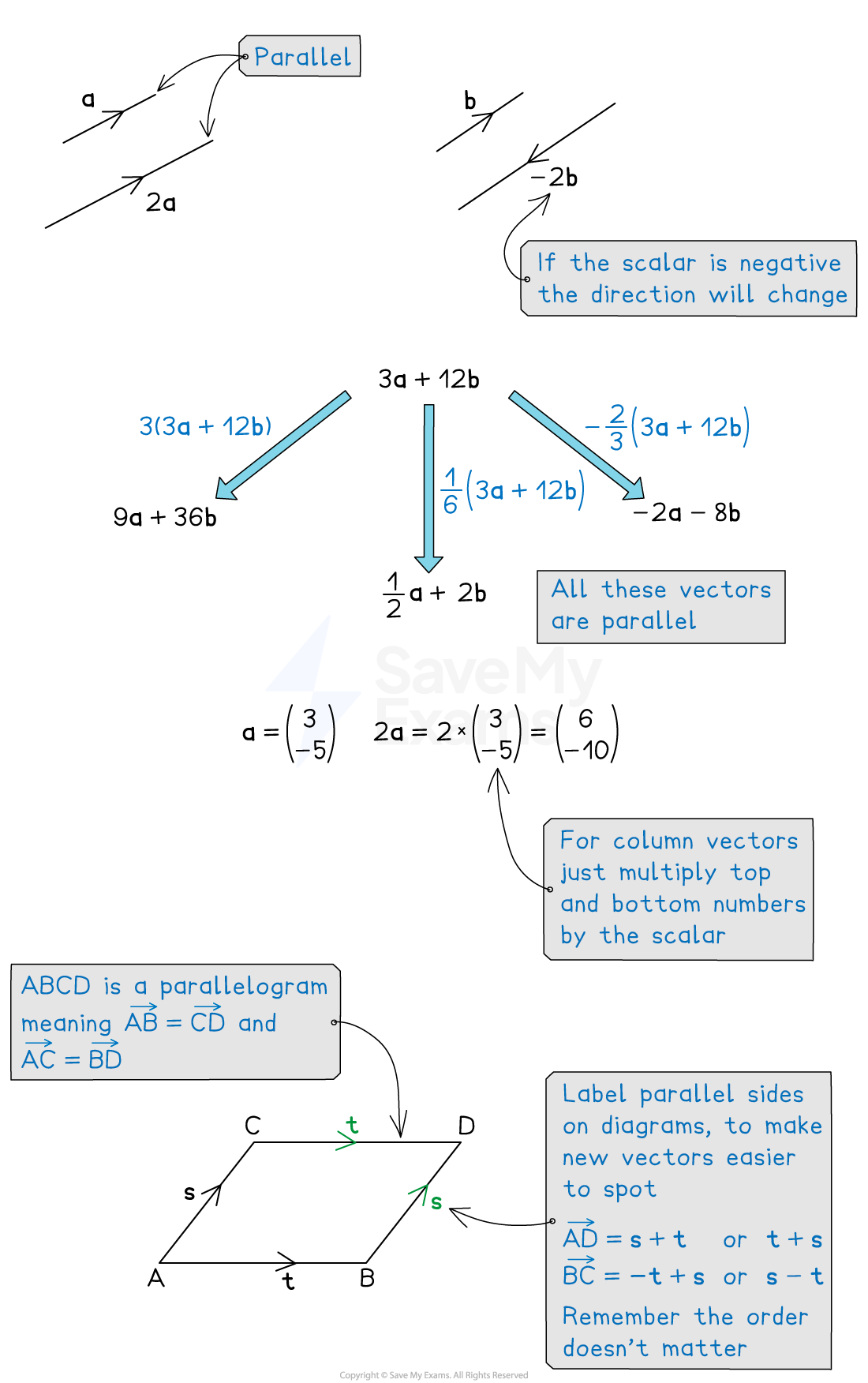
Examples of parallel vectors
Exam Hint If you are told that two vectors ( and ) are parallel, then it can be helpful to define a scalar to form an equation .
Worked Example Show that the vectors and are parallel.
Answer:
Method 1
Show that one vector is a multiple of the other
Final answer: , so the two vectors are parallel
Method 2
Show that both vectors are multiples of another vector
Final answer: andare both scalar multiples of, so they are parallel to each other
Unit vectors
Spec point —
8D
What is a unit vector?
-
A unit vector is a vector with a modulus(length) of 1
-
To find a unit vector that is in the same direction as the vector
- divide the components of the vector by the modulus of the vector
- I.e. is a unit vector in the direction of vector
-
For example, a unit vector in the direction is
Worked Example Find a unit vector in the same direction as .
Answer:
Find the modulus of the vector
Divide each of the vector components by the modulus
Was this revision note helpful?