12 markseasy
Express 15 centimetres as a percentage of 3 metres.
%
28 questions · 100 marks · ≈ 2 hours
Express 15 centimetres as a percentage of 3 metres.
%
A
B
The diagram shows shape A and shape B.
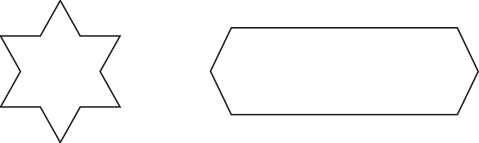
Write down,
the number of lines of symmetry of shape A,
A
B
The diagram shows shape A and shape B.
Write down,
the order of rotational symmetry of shape B.
The bearing of ship P from ship Q is 057°
Find the bearing of ship Q from ship P.
°
B =
3
5
3
3
−
−
Calculate 3A + 2B
Without using a calculator and showing all your working, evaluate
2 1
4 × 2 2
3
Give your answer in its simplest form.
Given that y = 7x2 − 3
x
find d
y
d
x
d
y
x =
d
Here are the first 4 terms of a sequence.
4096 −1024 256 −64
Write down the next 2 terms of the sequence.
,
Explain how you found your answer.
Ying has 4 black counters and 3 white counters.
There is a number on each counter.
The mean of the numbers on the black counters is 11.5
The mean of the numbers on the white counters is 9
Calculate the mean, to 3 significant figures, of the numbers on all 7 counters.
Find the largest integer value of x such that 17 − 2x ≥ 4(x – 5)
Show clear algebraic working.
A regular polygon has n sides.
Each interior angle of the regular polygon is 135° greater than each exterior angle of
the polygon.
Find the value of n.
n =
A piece of ribbon 9 metres long is cut into 3 parts in the ratios 3 : 5 : 7 by length.
Calculate the length, in metres, of the longest piece.
m
Write 9.6 × 10⁻⁷ as an ordinary number.
Calculate 2 4
.
10
×
199
9 6
.
10
×
7
−
Give your answer in standard form.
Without using a calculator and showing all your working, express
in the form where is an integer.
Solve the equation
5x2 = 7 − 9x
Give your solutions to 3 significant figures.
Show your working clearly.
A
D
B
C
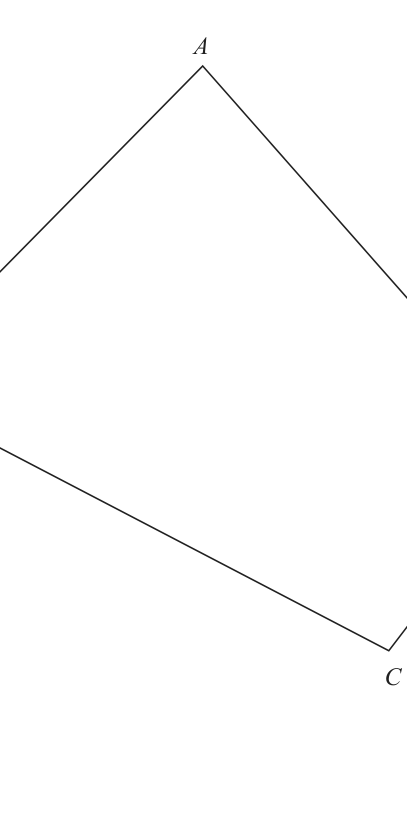
The diagram shows quadrilateral ABCD.
The point P lies inside the quadrilateral, such that P is 5.5 cm from C and equidistant
from AD and AB.
Using ruler and compasses only and showing all your construction lines, show the point
P on the diagram.
t varies inversely as the square of a where a > 0
t = 14 when a = 5
Calculate the value of a when t = 224
a =
The diagram shows two similar jugs.
The height of jug A is 20 cm and the height of jug B is 6 cm.
Given that volume of jug A − volume of jug B = 1459.5 cm³, calculate the volume, in cm³, of jug B.
E = {positive integers from 1 to 15 inclusive}
A = {multiples of 3}
B = {even numbers}
Find A ∪ B
Find A ∩ B
Find n([A ∩ B]′)
The set C has 8 elements and B ∩ C = ∅
Write down the elements of set C.
Solve the simultaneous equations
10x + 2y = 17
15x − 3y = 39
x =
, y =
The coordinates of point A are (7, 2) and the coordinates of point B are (−5, y).
→ is 13
The modulus of the vector AB
Calculate the possible values of y.
y =
The straight line joining the points with coordinates (−a, −22) and (3a, 38)
has equation y = mx + a
Calculate the value of a and the value of m.
a =
m =
A
Diagram NOT
accurately drawn
D
C
B
E
In the diagram ACE and BCD are straight lines such that the point C is the midpoint of BD.
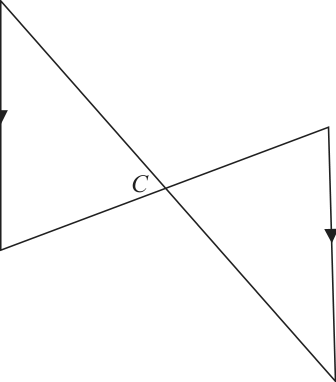
AB is parallel to DE.
Prove that the triangles ABC and EDC are congruent.
A right circular cone has a curved surface area of 136 cm²
The radius of the base of the cone is 8 cm
The volume of the cone is k cm³
Find the value of k.
k =
Solve 3
1
−
−
=
2
9
5
5
x
x
x
−
2
Show clear algebraic working.
x =
There are 20 counters in a bag.
There are 7 red counters.
The rest of the counters are green or white.
Bernard takes at random 2 counters from the bag.
The probability that Bernard will take 2 white counters is 1
19
Calculate the probability that Bernard will take 1 green counter and 1 white counter.
The table below gives information about the lengths of time that 50 people have been
waiting for a train.
Find the modal class.
The table below gives information about the lengths of time that 50 people have been
waiting for a train.
Find the class interval that contains the median waiting time.
The table below gives information about the lengths of time that 50 people have been
waiting for a train.
Calculate an estimate for the mean waiting time.
minutes
B
(2x − 5) cm
30°
(x + 5) cm
A
C
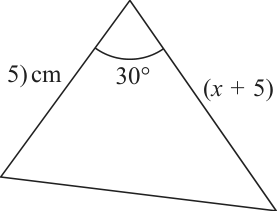
The diagram shows ABC in which
AB = (2x − 5) cm BC = (x + 5) cm Ð ABC = 30°
The area of ABC is 15.75 cm²
Calculate the length, in cm to 3 significant figures, of AC.
cm
Factorise fully 15x3 y − 20x2 y2
2
Simplify fully (
27
)
x
6
3
18
x
3
Given that (x − 2) is a factor of 2x3 + 3x2 + kx − 6
find the value of k.
k =