Differentiation (Edexcel IGCSE Maths)
Spec point —
3.4C
Differentiation
What is a gradient function?
-
Recall that the equation of a curve gives the y-coordinate of a point when you substitute in its x-coordinate
-
For example,
- Substitute in to get
- The point lies on the curve
-
-
A gradient function gives the gradient of the curve at a point when you substitute in its x-coordinate
-
A gradient function is written as
- pronounced "dy by dx"
- This refers to the change in y over change in x
-
For example, the gradient function
- Substitute in to get
- The gradient at the point where is 7
-
-
The gradient function can also be called the derivative or derived function
What is differentiation and how does it work?
-
Differentiation is an algebraic method that changes the equation of a curve, , into a gradient function,
-
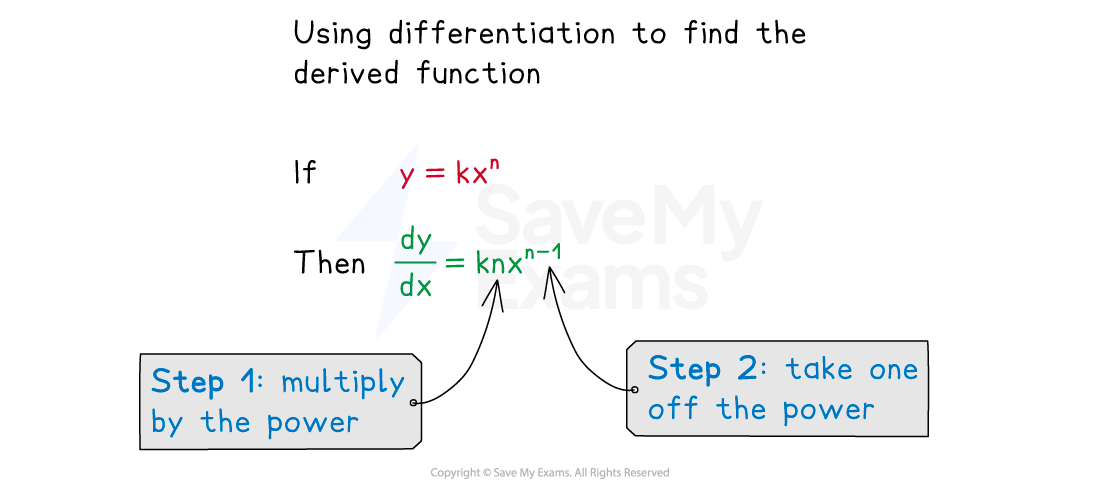
To differentiate a power of , bring down the power and reduce the power by 1
- Differentiating gives
- Differentiating gives
- Differentiating gives
-
Any number that is already in front of is multiplied by the power that was brought down
- Differentiating gives
- Differentiating gives
- Differentiating gives
-
Be careful with two special cases:
-
Differentiating gives
- The disappears leaving just a number
- For example, differentiates to
- This makes sense, the gradient of the straight line is 2
-
Differentiating just a number (a constant term), , gives
- Numbers disappear!
- For example, differentiates to
- This makes sense, the gradient of the horizontal line is zero
-
How do I differentiate negative powers of x?
-
The same rules apply to negative powers, becomes
-
Be careful: subtracting 1 from a negative power creates a larger negative number!
- E.g. becomes
-
-
You may need to use index laws to convert algebraic fractions into negative powers (and vice versa)
-
For example
- so
- so
- so
-
How do I differentiate sums and differences of terms?
-
The equation of a curve may include a number of different terms
-
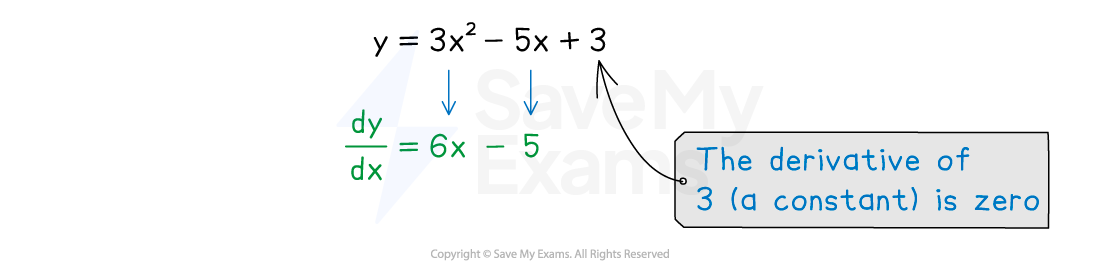
You can differentiate each term individually
- Differentiating gives
- Differentiating gives
-
-
Remember the two special cases of:
-
differentiating to just
-
and constant terms, , differentiating to zero
- E.g. differentiating gives
-
-
You may need to separate an algebraic fraction
-
E.g. becomes
- Using negative indices gives
- This can be differentiated:
- This simplifies to
-
How do I find the gradient of a curve using the gradient function?
-
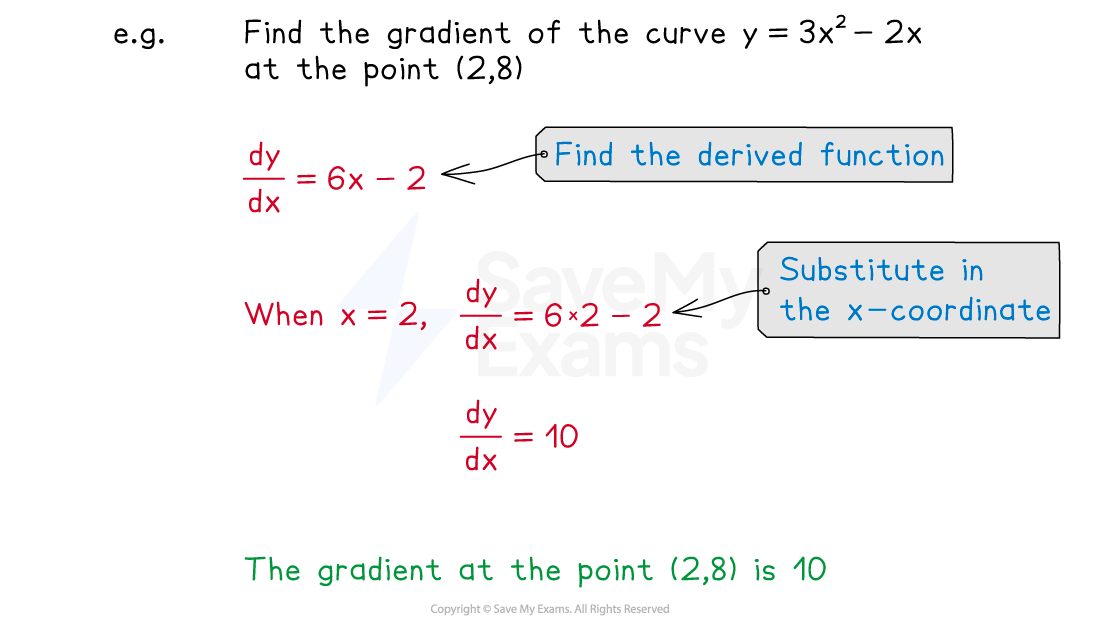
Find the x-coordinate of the point on the curve you're interested in
-
Use differentiation to turn the equation of the curve, , into the gradient function,
-
Substitute the x-coordinate into the gradient function to find the gradient
- The y-coordinate is not needed
-
If instead you are given a gradient and asked to find the x-coordinate
- set equal to that gradient and solve the equation
Exam Hint Don't forget to write the left-hand sides of and to avoid mixing up the curve equation with the gradient function!
How is the gradient function related to drawing tangents?
-
The gradient of a curve changes as you move along the curve
-
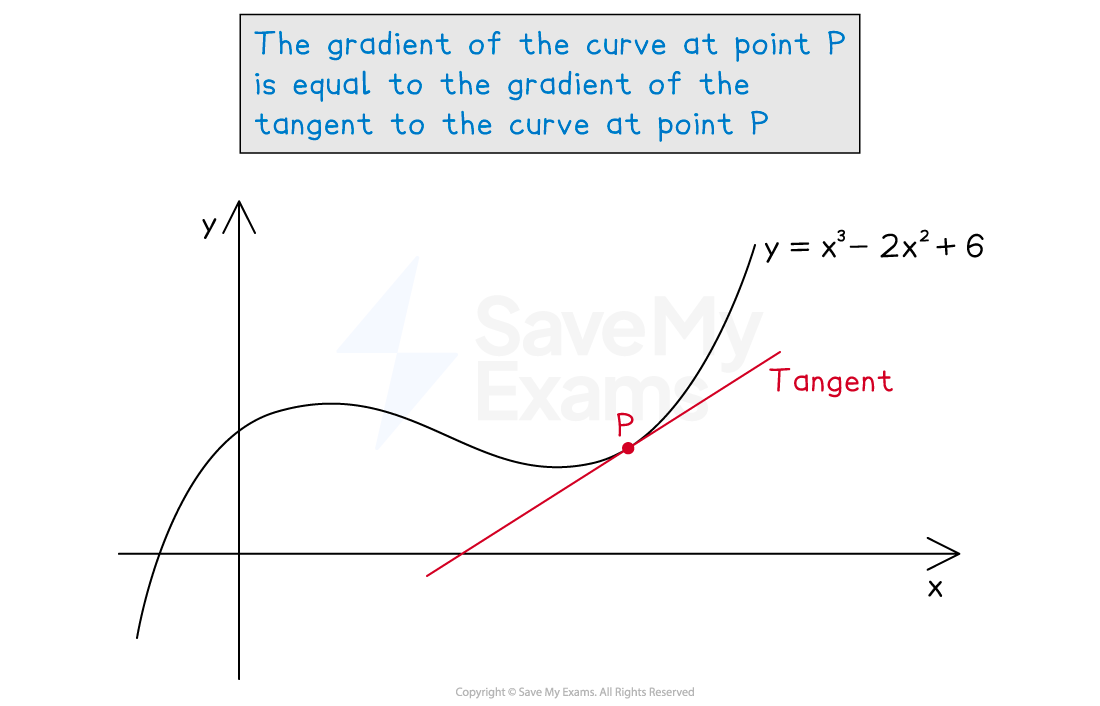
To find the gradient at a particular point you can draw a tangent and find its gradient
-
This is a graphical method that is not accurate
- It depends on how well you draw the tangent
-
-
Instead, you can use differentiation to find the gradient function, then substitute the x-coordinate of the point into the gradient function to find the gradient
- This is an algebraic method that is exact
-
For example, to find the gradient of the curve at the point P where
-
either try to draw a tangent at and measure its gradient (see below)
-
or differentiate the equation to get
- Substitute in to get
- The gradient is 4
-
Worked Example A curve has the equation .
(a) Find the gradient of the curve at the point .
Answer:
Find the gradient function using differentiation
Substitute into the gradient function
The gradient when is -7 (The y-coordinate of the point is not needed)
Final answer: The gradient atis -7
(b) Find the coordinates of the two points on the curve with a gradient of 5.
Answer:
This is saying that (This is not the same as substituting in )
Form an equation using from above
This is a quadratic equation Bring the terms to one side and solve (for example, by factorisation)
These are the -coordinates of the two points on the curve with gradient 5 Substitute into to find the -coordinate of this point
Similarly, substitute into the equation for
Write out the two sets of coordinates
Final answer: The pointsandhave a gradient of 5
Was this revision note helpful?