Types of Graphs (Edexcel IGCSE Maths)
Spec point —
3.3I
Types of graphs
What types of graphs do I need to know?
-
You need to be able to recognise, sketch, and interpret the following types of graph:
-
Linear ()
- or
-
Quadratic()
-
Cubic()
-
Reciprocal ()
-
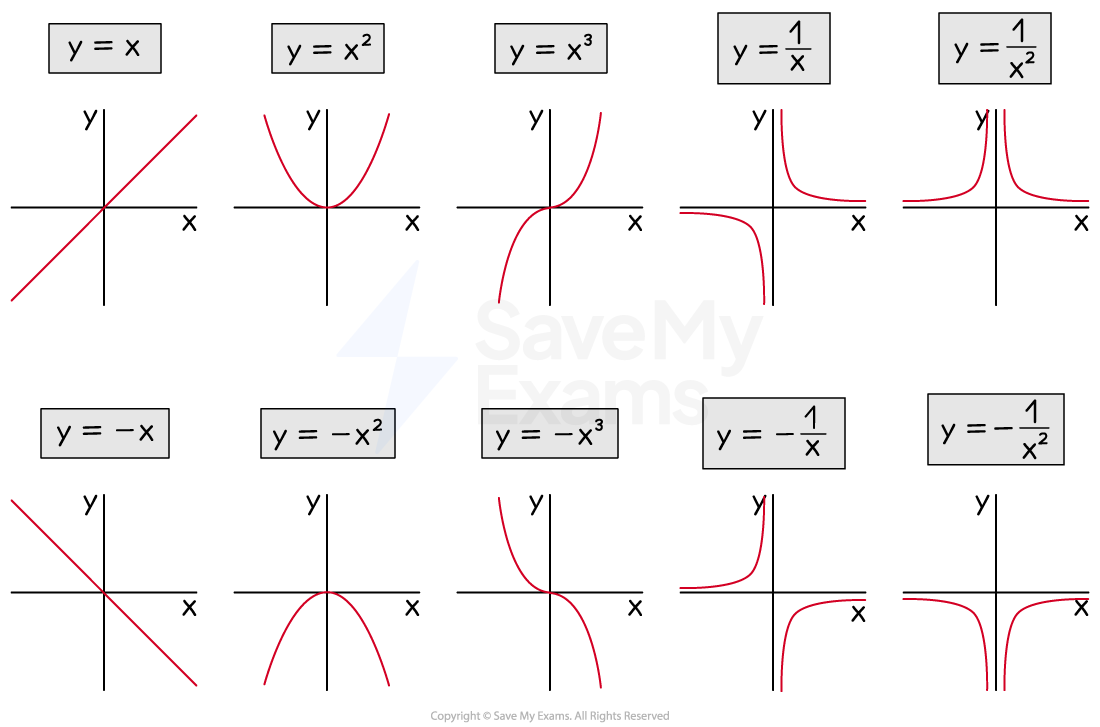
- You must also be able to recognise the three basic trigonometric graphs, covered in a separate section
Where are the asymptotes on reciprocal graphs?
-
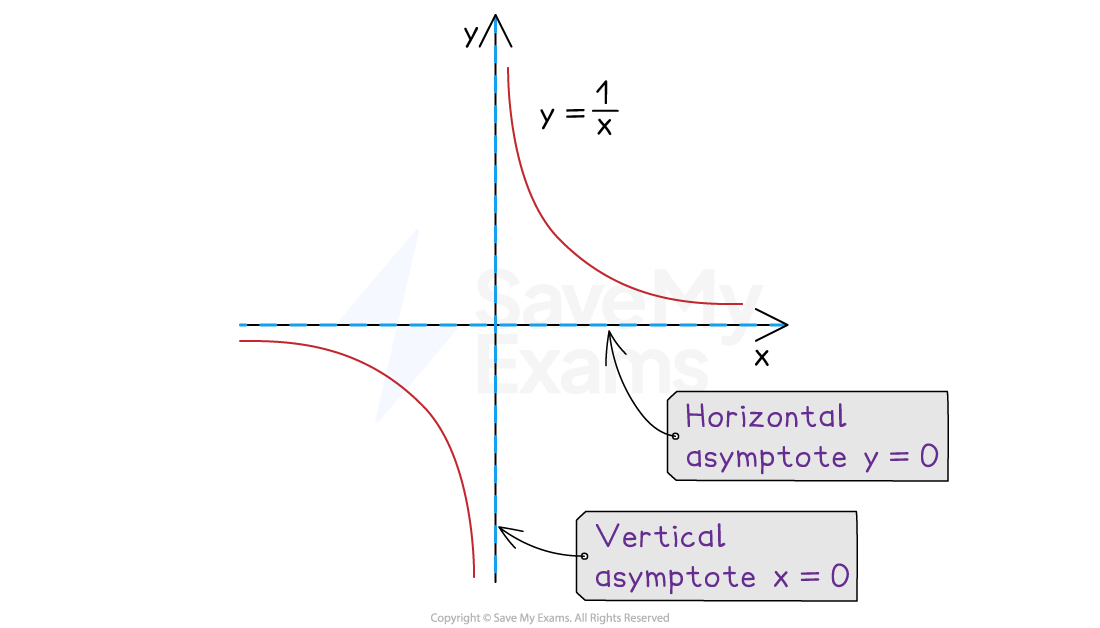
An asymptote is a line on a graph that a curve becomes closer to but never touches
- These may be horizontal or vertical
-
The reciprocal graph, (where is a constant)
- does not have a y-intercept
- and does not have any roots
-
This graph has two asymptotes
-
A horizontal asymptote at the x-axis:
- This is the limiting value when the value of x gets very large (or very negative)
-
A vertical asymptote at the y-axis:
- This is the value that causes the denominator to be zero
-
-
The reciprocal graph, (where and are both constants)
-
is the same shape as
-
but is shifted upwards by units
- would be shifted down by 3 units
-
This means the horizontal asymptote also shifts up by units
- The vertical asymptote remains on the y-axis
-
-
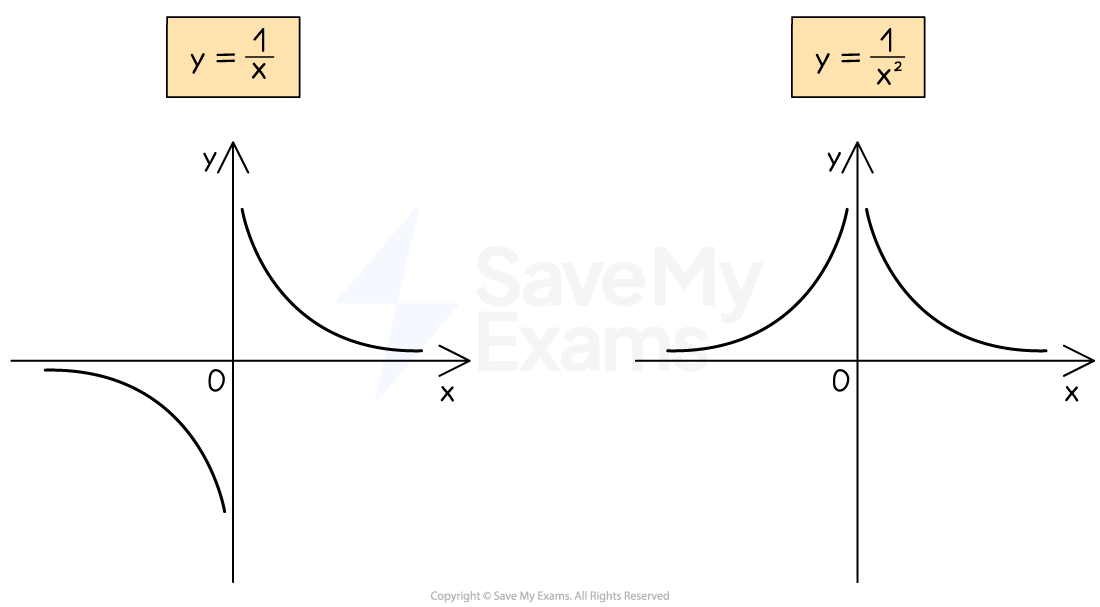
The graph of is similar to but has two key differences
- is steeper than
- is always positive, even when is negative
What does the graph of a cubic look like?
-
A cubic is a function of the form
- and are constants
- It is sometimes referred to as a polynomial of degree (order) 3
-
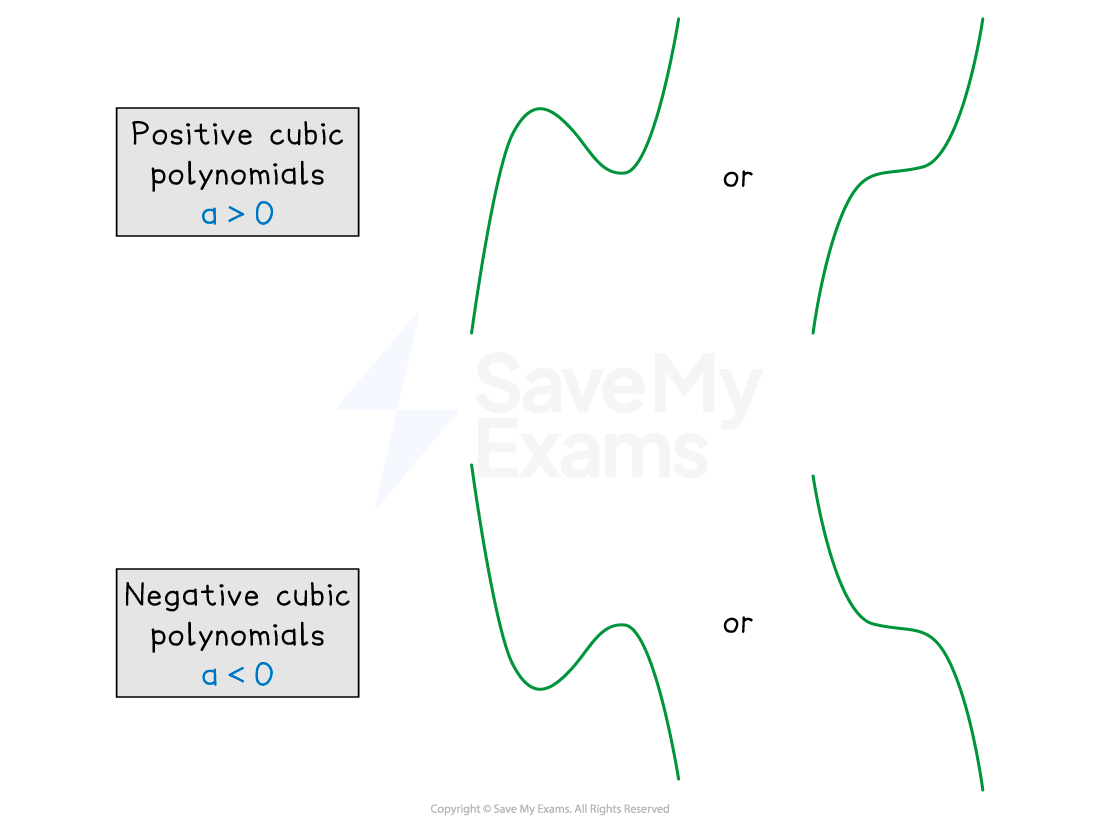
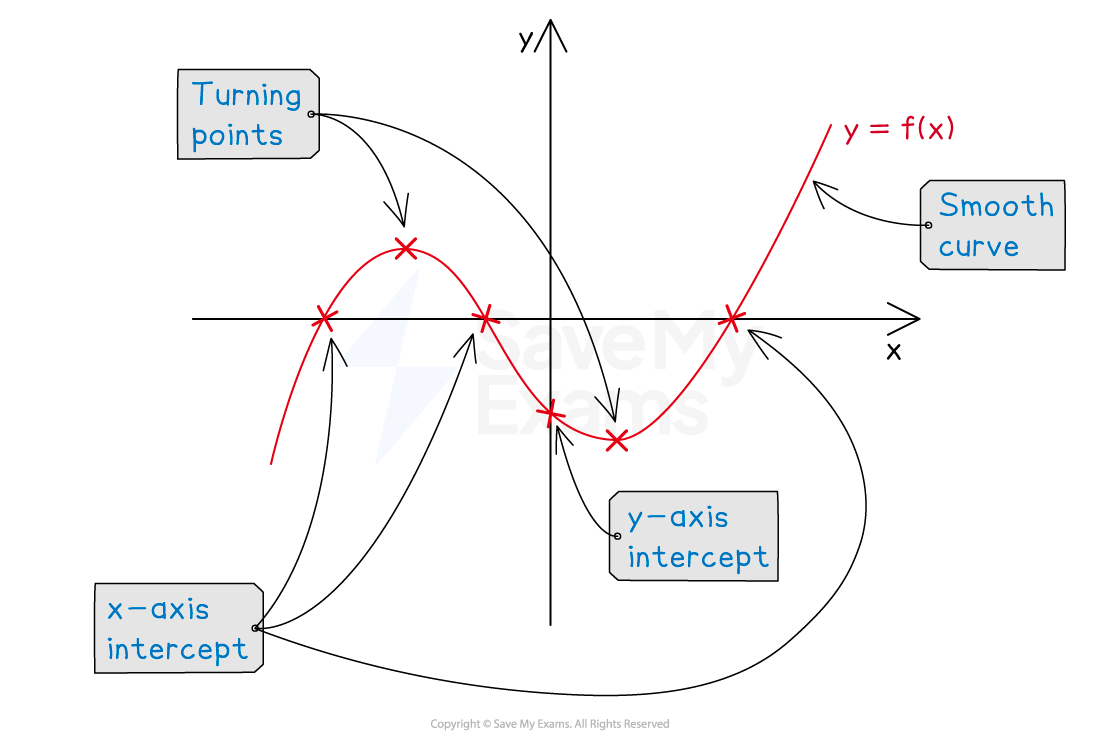
In general the graph of a cubic will take one of the four forms
- All are smooth curves
-
The exact form of a particular cubic will depend on:
-
The number (and value) of roots (-axis intercepts)
-
The -axis intercept
-
The sign of the coefficient of the term ()
- If the graph is a positive cubic ('starts' in the bottom left, 'ends' in the top right)
- If the graph is a negative cubic ('starts' in the top left, 'ends' in the bottom right)
-
The turning points
-
-
Cubics can have two turning points
- a maximum point and a minimum point
-
However, note that the graphs of and :
- Do not have a maximum or minimum (turning points)
- Only cross the -axis once, at
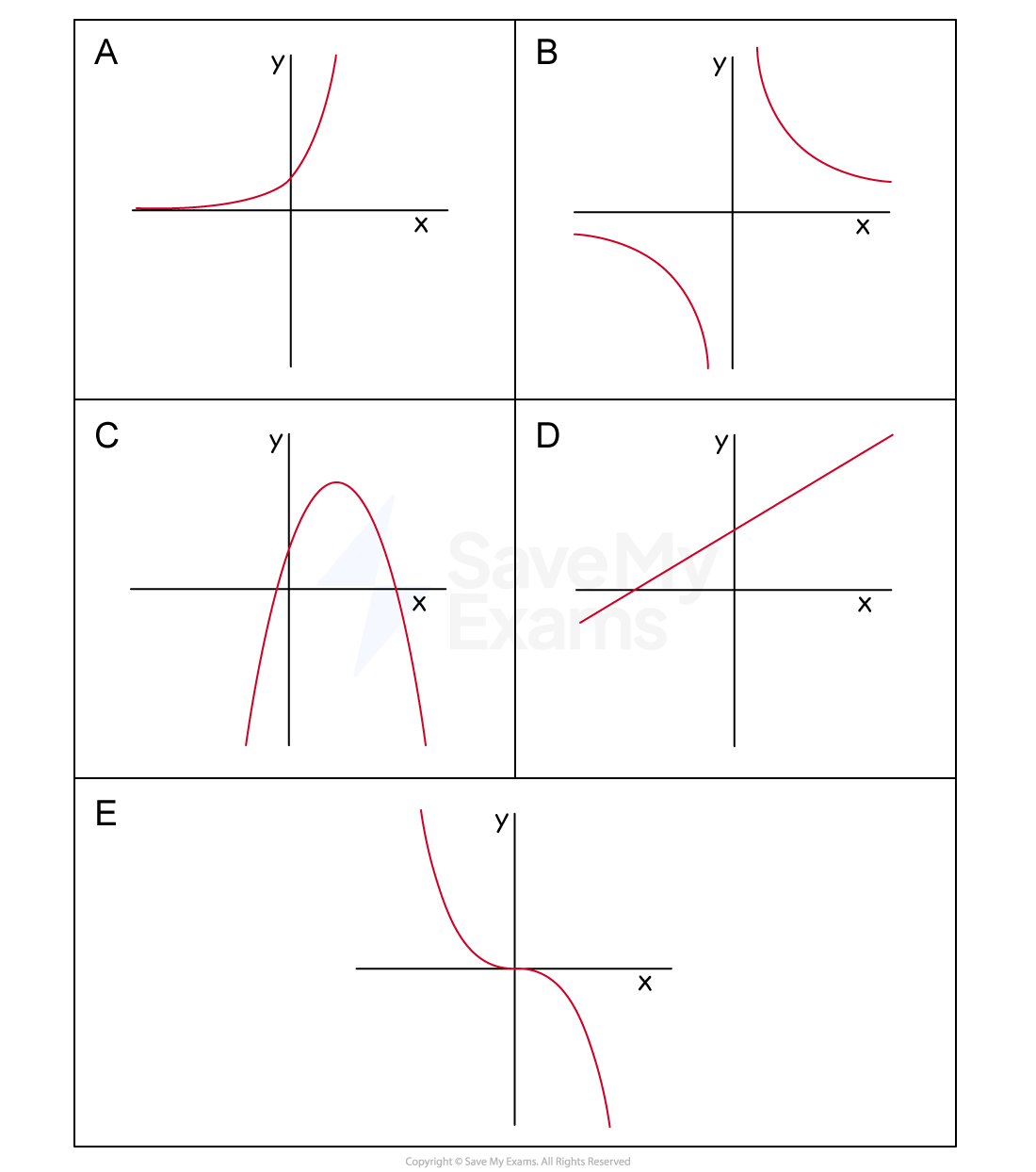
Worked Example Match the graphs to the equations.
(1), (2), (3), (4), (5)
Answer:
Starting with the equations,
(1)is a linear equation (y = mx + c) so matches the only straight line, graph D
*(3) **is a cubic equation with a negative coefficient so matches graph *E
(4)* is a reciprocal equation with a positive coefficient so matches graph** B*
(5) is a quadratic equation with a negative coefficient so matches graph C
(2) is the only equation not yet used, so by elimination it is graph A
Final answer: Graph A → Equation 2
Final answer: Graph B → Equation 4
Final answer: Graph C → Equation 5
Final answer: Graph D → Equation 1
Final answer: Graph E → Equation 3
Was this revision note helpful?