Distance-Time Graphs (Edexcel IGCSE Maths)
Spec point —
3.3F
Distance-time graphs
How do I use a distance-time graph?
-
Distance-time graphs show the distance travelled at different times
- Distance is on the vertical axis
- Time is on the horizontal axis
-
The gradient of the graph is the speed
-
The steeper the line the faster the object is moving
-
Lines with positive gradients represent objects moving away from the start point
-
Lines with negative gradients represent objects moving towards the start point
-
Lines that are horizontal represent rest
- The object is stationary (not moving)
-
How do I work out the overall average speed?
-
For journeys with multiple parts
- the overall average speed for the whole journey is
- The total time includes any rests
Exam Hint These questions often have a lot of parts that depend on each other, so always double check each answer before continuing.
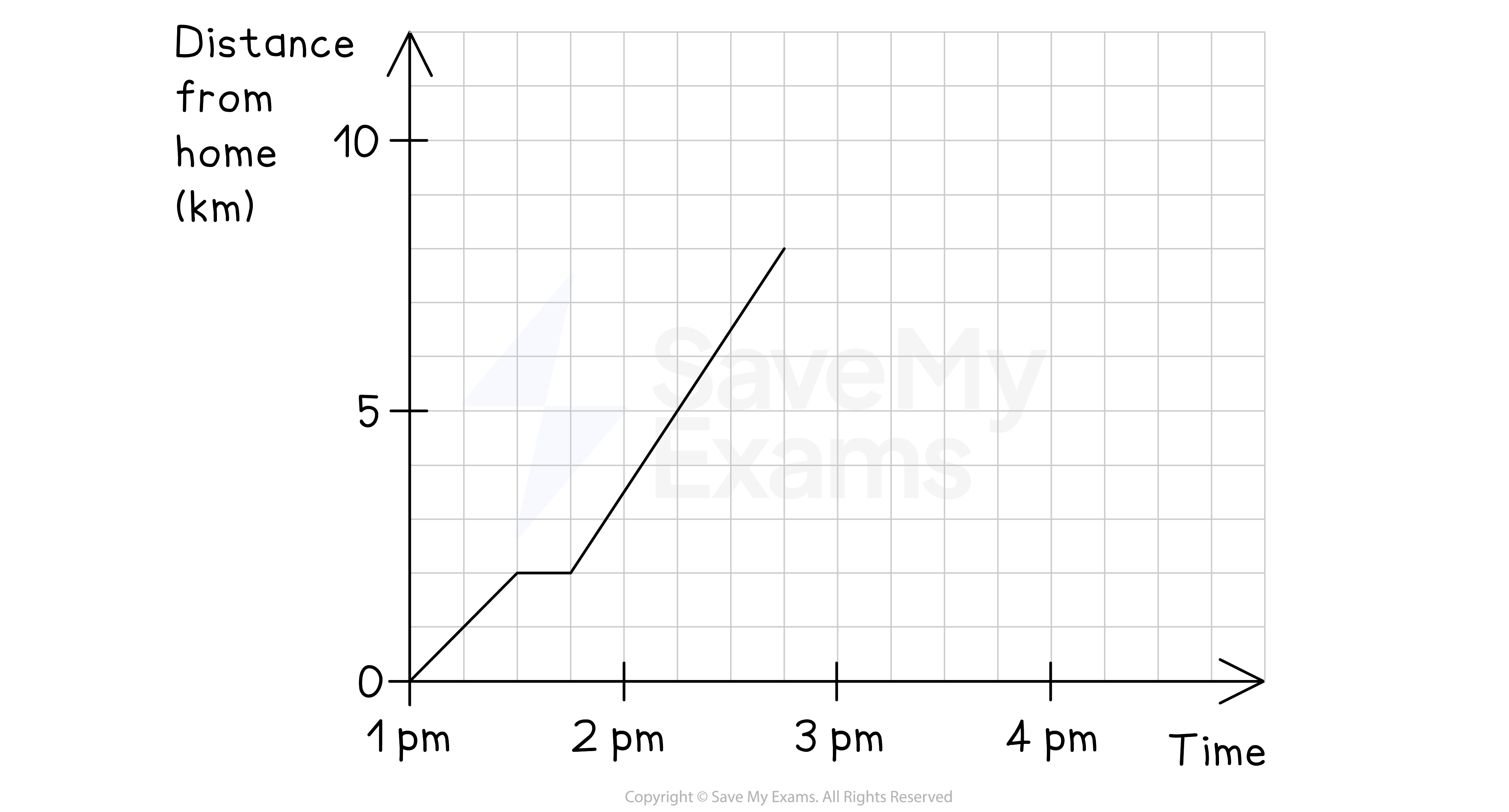
Worked Example One afternoon, Mary jogged 8 km from her home to her grandfather's house. Part of the travel graph for her journey is shown.
(a) Find Mary's speed at 2 pm.
Answer:
The speed is the gradient of the line at that point The gradient at 2pm is the same as the gradient for all points between 1:45pm and 2:45pm It is easiest to use for that bigger section
Final answer: 6 km/h
(b) Calculate, in minutes, how long Mary stopped on the way to her grandfather's house.
Answer:
The horizontal line is where Mary stops The scale is 1 square = 15 minutes
Final answer: 15 minutes
(c) Calculate Mary's overall average speed from leaving her home to arriving at her grandfather's house, giving your answer correct to 3 significant figures.
Answer:
Overall average speed is * *
Total distance travelled is 8 km Total time (including rests) is 1.75 hours
Round the answer to 3 significant figures
Final answer: 4.57 km/h (to 3 s.f.)
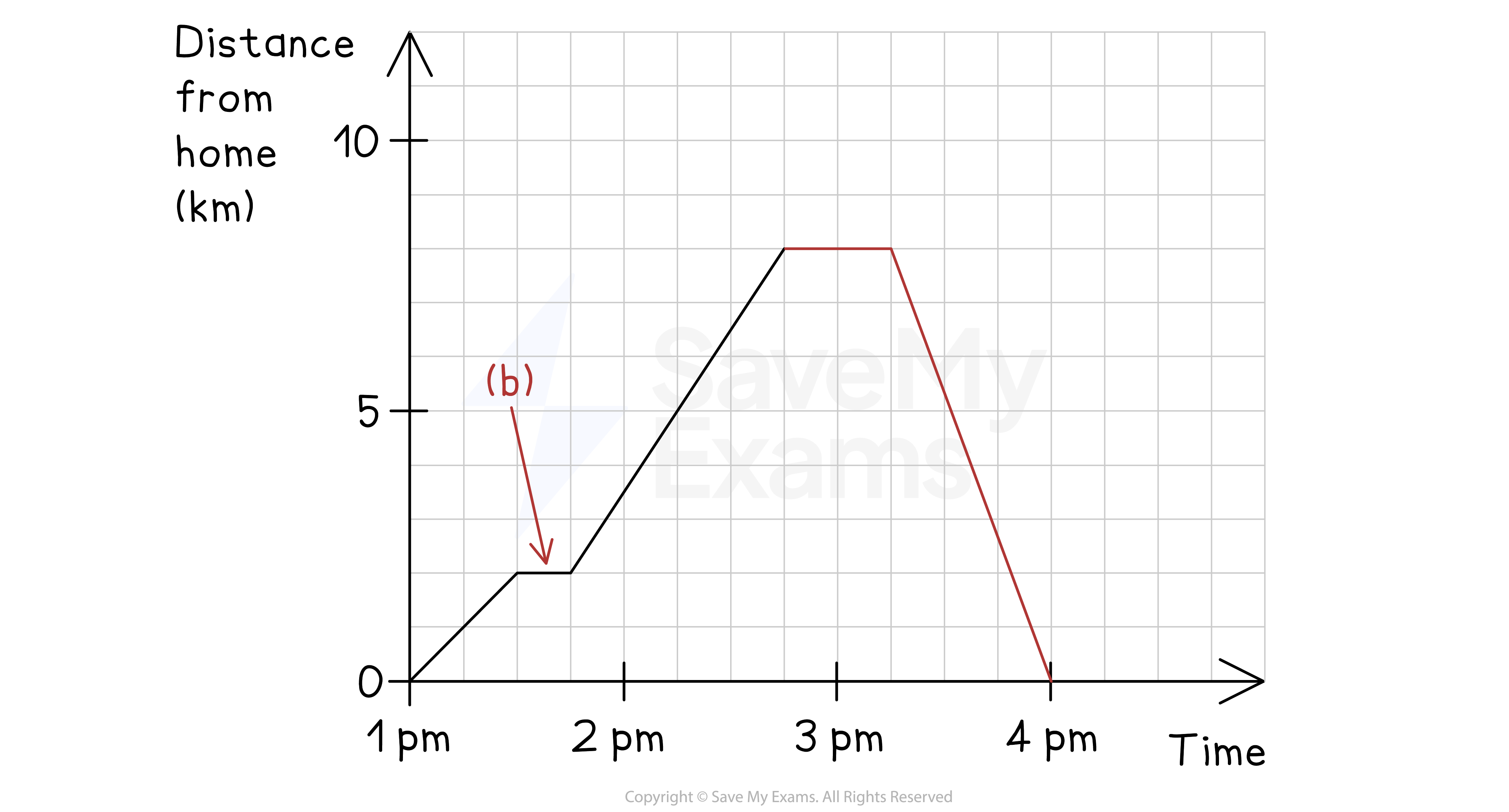
(d) Mary stayed at her grandfather's house for half an hour, then jogged home at a steady speed without stopping, arriving home at 4pm.
Complete the travel graph for Mary's journey.
Answer:
Rest is a horizontal line Returning home is a straight line with a negative gradient
Was this revision note helpful?