Geometrical Proof (Edexcel IGCSE Maths)
Spec point —
4.7A
Geometrical proof
What is a geometrical proof?
-
Geometric proof involves using known rules about geometry to prove a new statement about geometry
-
A proof question might start with “Prove…” or “Show that …”
-
The rules that you might need to use to complete a proof include;
-
Properties of 2D shapes
- Especially triangles and quadrilaterals
-
Basic angle properties
-
Angles in polygons
-
Angles in parallel lines
-
Congruence and similarity
-
Pythagoras theorem
-
-
You will need to be familiar with the vocabulary of the topics above, in order to fully answer many geometrical proof questions
How do I write a geometrical proof?
-
Usually you will need to write down two or three steps to prove the statement
-
At each step, you should write down a fact and a reason
- For example, “AB = CD, opposite sides of a rectangle are equal length”
-
The proof is complete when you have written down all the steps clearly
-
Use the diagram!
-
Add key information such as angles or line lengths to the diagram as you work through the steps
- but you must write them down in your written answer too
-
What geometric notation should I use?
-
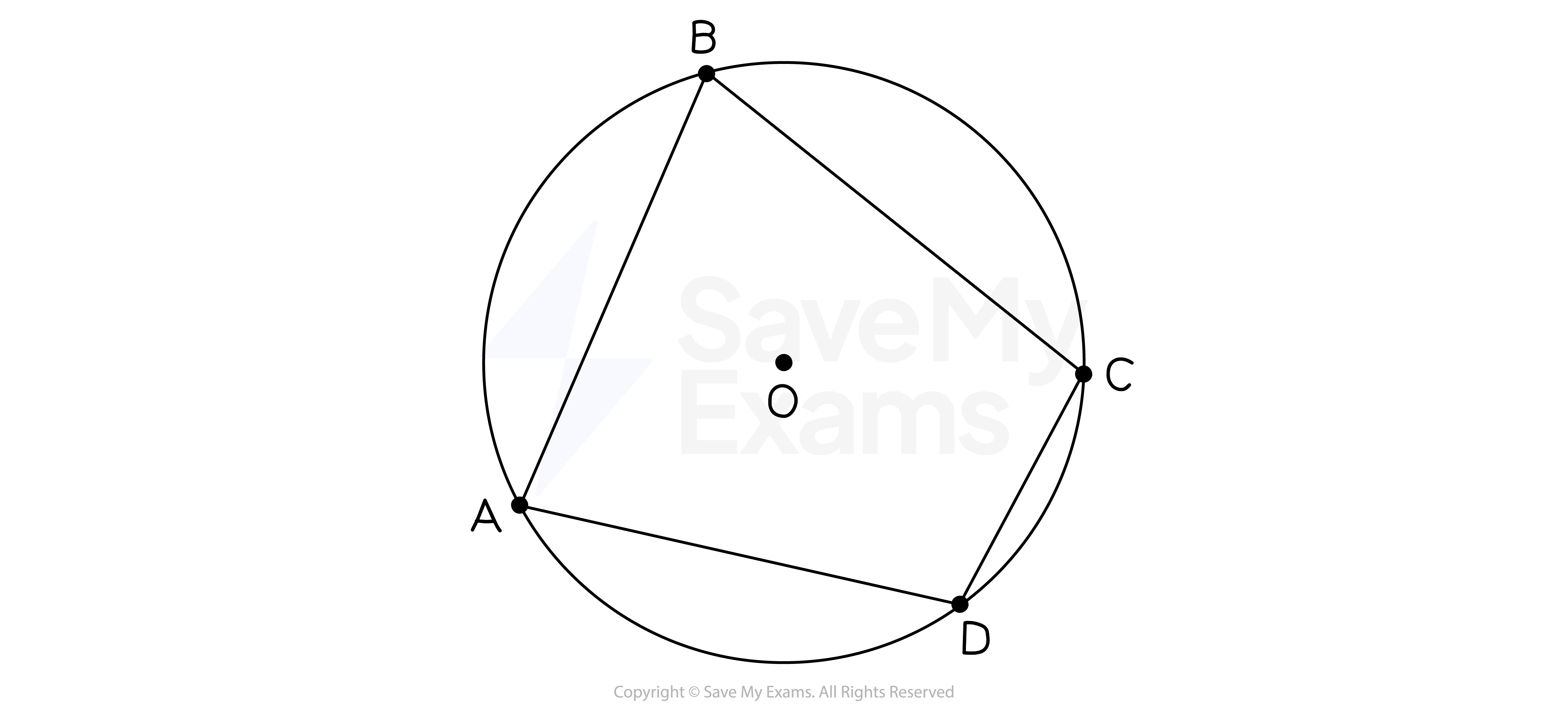
Points or vertices of a shape are labelled with capital letters
- A, B, C and D are the vertices of the quadrilateral
- O is the centre of the circle
-
Two letters are used to represent the line between the points
- AB is the line between points A and B
-
Three letters are used to represent the angle formed by the three points
- Angle ABC is the angle between lines AB and BC
- The letter in the middle is the point where the angle is at
-
Multiple letters are used to represent the whole shape
- ABCD is a quadrilateral
- The letters are written down so that they go clockwise around the shape
-
If you use a variable to represent a length or an angle then write it down
- Angle ABC =
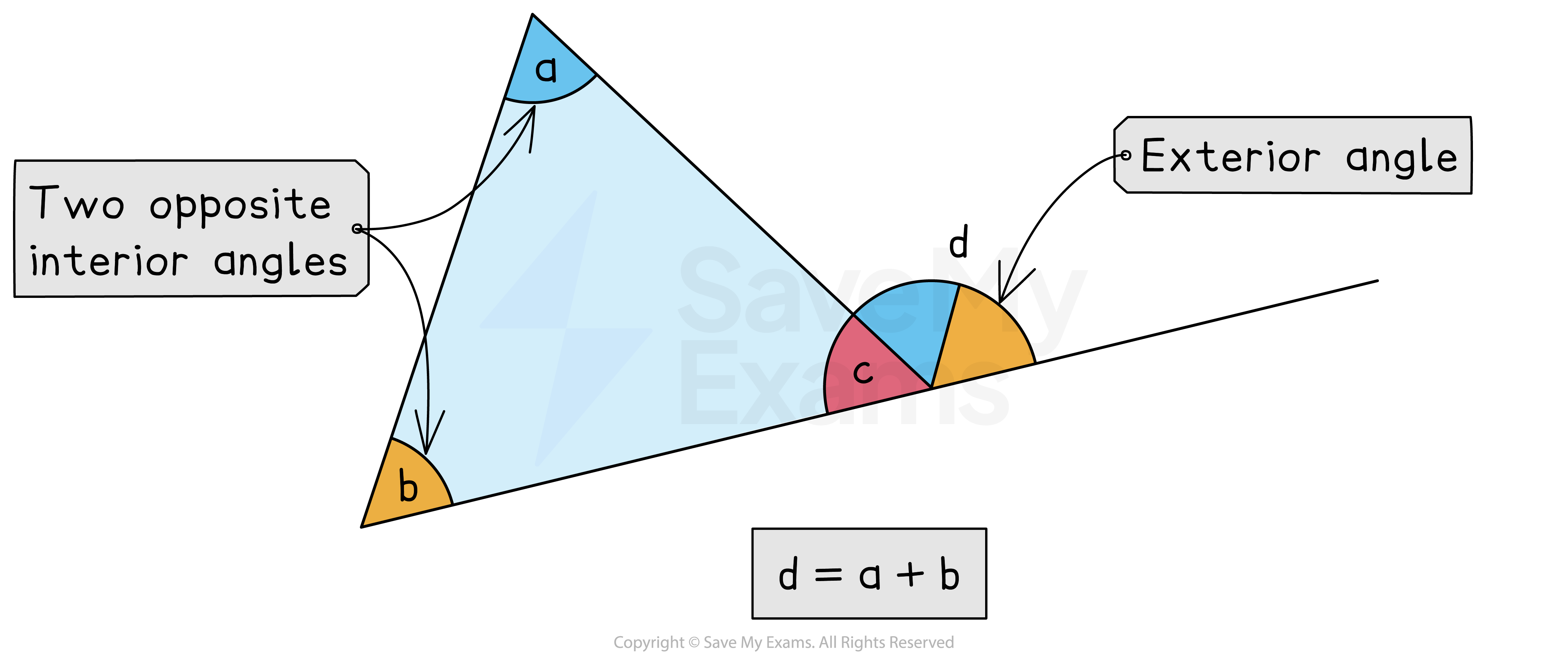
How can I prove that the exterior angle of a triangle is equal to the sum of the interior angles at the other two vertices?
- Let a, b and c be the three interior angles in a triangle
- Let d be the exterior angle next to the interior angle c
Method 1 - Using angles in a triangle
-
The interior angles in the triangle add up to 180°
- a + b + c = 180°
-
An interior angle and its exterior angle add up to 180°
- c + d = 180°
-
The right-hand sides of the equations are both equal (180°)
-
Therefore, the left-hand sides are equal
- a + b + c = c + d
-
Subtract c from both sides
- a + b = d
-
-
Therefore the exterior angle is the sum of the two opposite interior angles
Method 2 - Using parallel lines
-
Split d into two angles by drawing a parallel line to the other side of the triangle
- There will be an angle alternate to angle a
- There will be an angle corresponding to angle b
-
Therefore the exterior angle is the sum of the two opposite interior angles
What are common geometric reasons I can use?
-
There are common phrases that are sufficient as explanations and should be learnt
- These will be what mark schemes look for
-
For triangles and quadrilaterals
- Angles in a triangle add up to 180°
- Base angles of an isosceles triangle are equal
- Angles in an equilateral triangle are equal
- Angles in a quadrilateral add up to 360°
- An exterior angle of a triangle is equal to the sum of the interior opposite angles
-
For straight lines
- Vertically opposite angles are equal
- Angles on a straight line add up to 180°
- Angles at a point add up to 360°
-
For parallel lines
- Alternate angles are equal
- Corresponding angles are equal
- Allied (or co-interior) angles add up to 180°
-
For polygons
- Exterior angles of a polygon add up to 360°
- The interior and exterior angle of any polygon add up to 180°
Exam Hint
DO show all the key steps
- If in doubt, include it
DON'T write in full sentences
- For each step, just write down the fact, followed by the key mathematical reason that justifies it
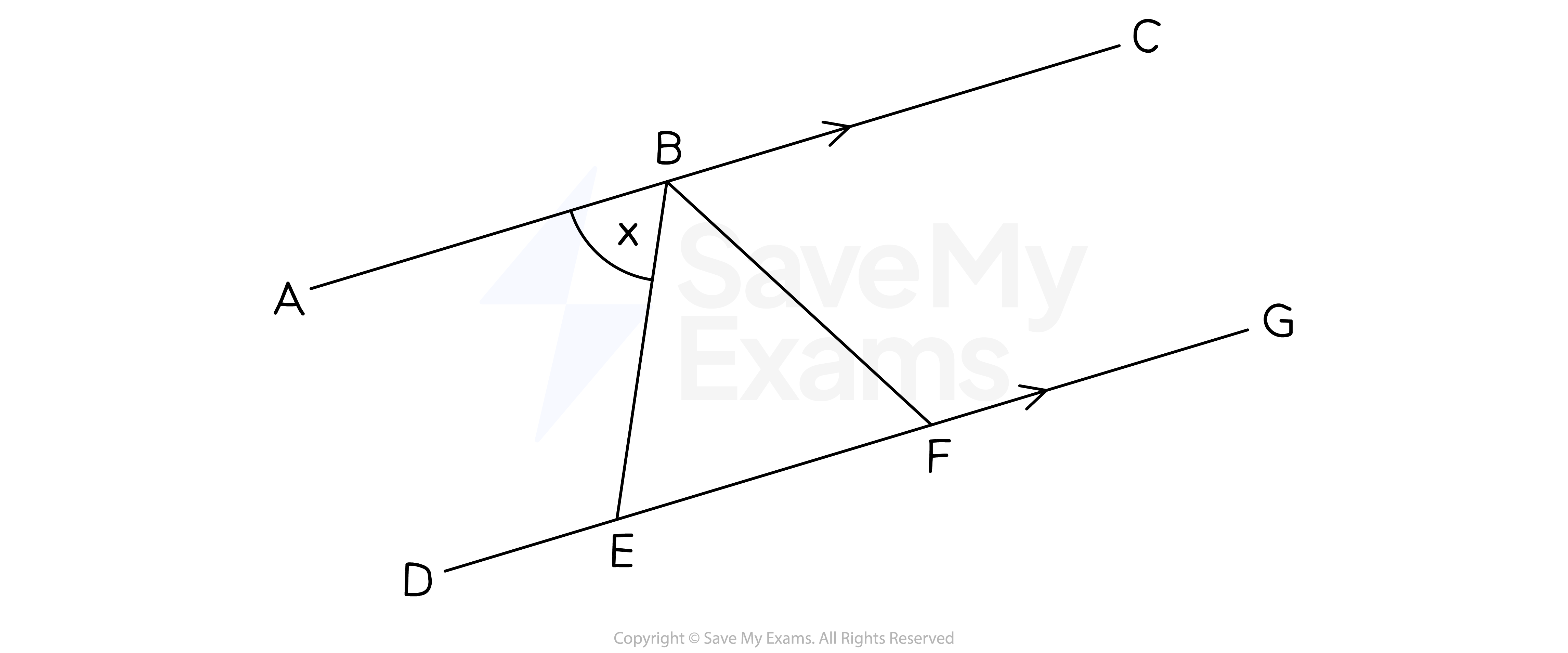
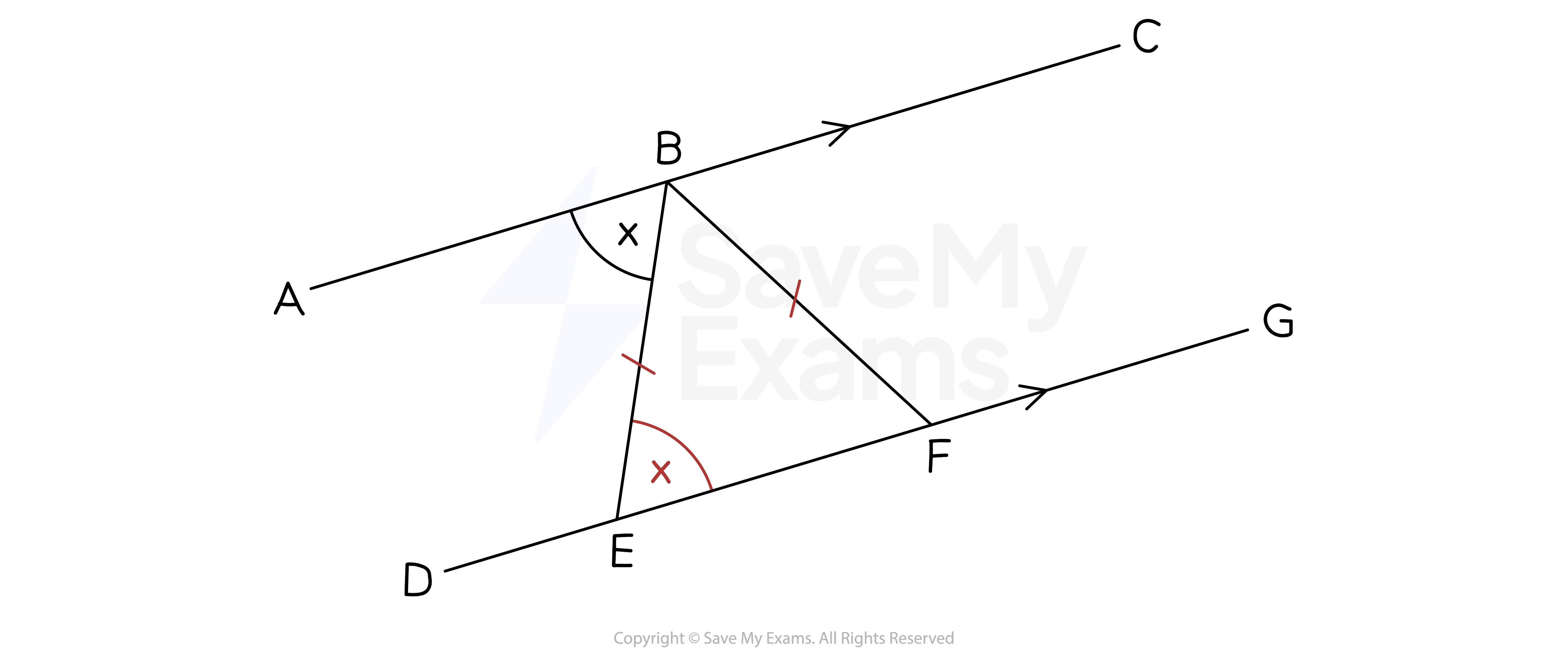
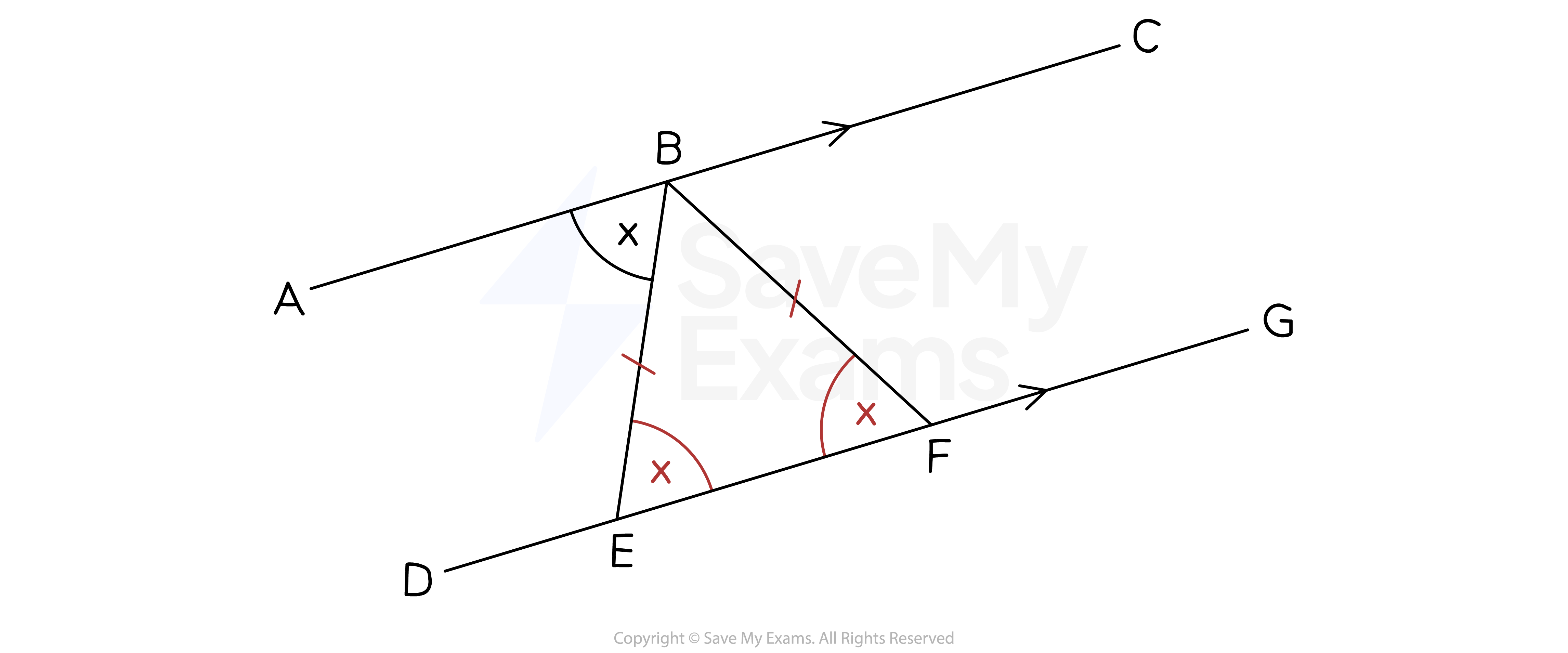
Worked Example In the diagram below, AC and DG are parallel lines. B lies on AC, E and F lie on DG and triangle BEF is isosceles.
Prove that angle EBF is . Give reasons for each stage of your working.
Answer:
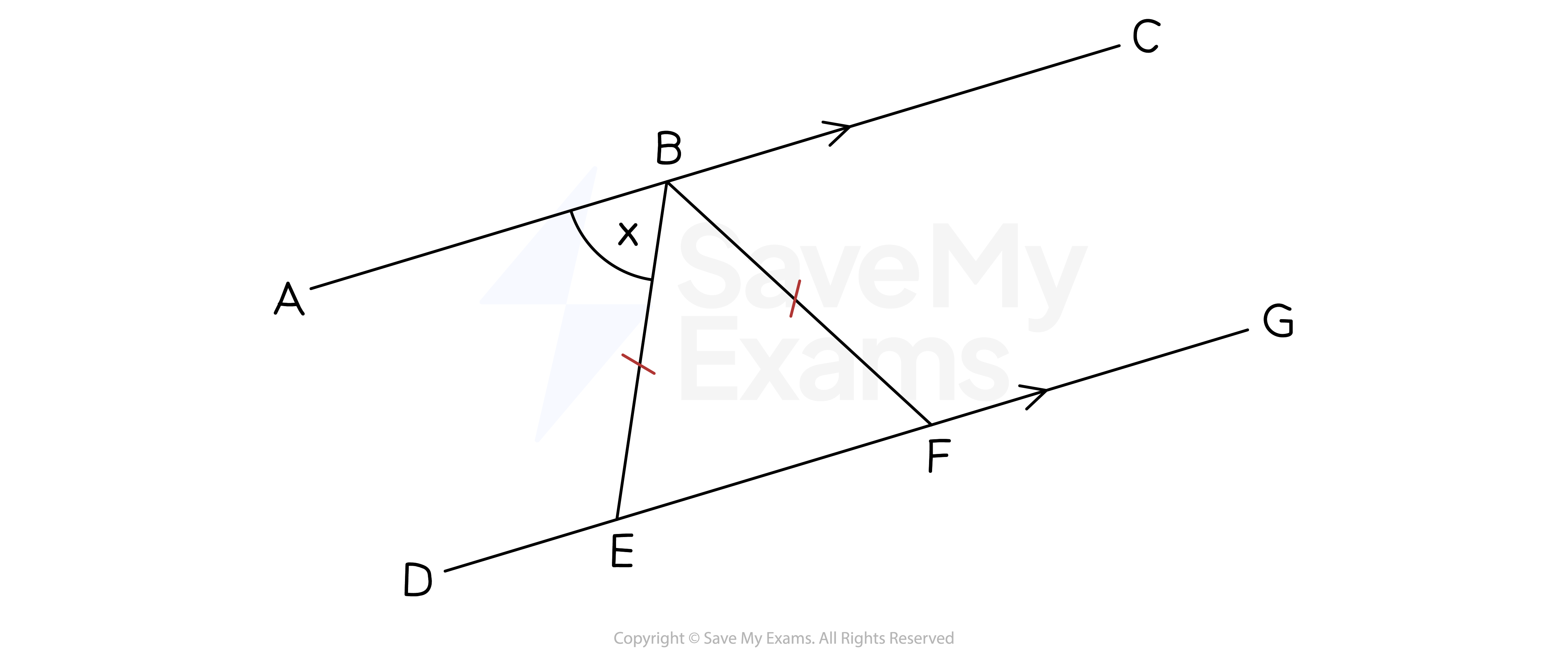
Mark on the diagram that triangle BEF is isosceles
*AC and DG are parallel lines, so using alternate angles we know that angle BEF = * Mark this on the diagram
Write the fact, and the reason using the key mathematical vocabulary
Final answer: angle BEF =, alternate angles are equal
*Now using the fact that triangle BEF is isosceles, we can see that angle BFE = * Mark this on the diagram
Write the fact, and the reason using the key mathematical vocabulary
Final answer: angle BFE =, base angles of an isosceles triangle are equal
*Now we can see that angle EBF is the last remaining angle in a triangle, and as the angles in a triangle sum to 180, angle EBF = *
Write the fact, and the reason using the key mathematical vocabulary
Final answer: angle EBF =, angles in a triangle sum to 180
Was this revision note helpful?
Build on this topic