Introduction to Sequences (Edexcel IGCSE Maths)
Spec point —
3.1A
Introduction to sequences
What are sequences?
-
A sequence is an ordered set of numbers that follow a rule
-
For example 3, 6, 9, 12...
- The rule is to add 3 each time
-
-
Each number in a sequence is called a term
-
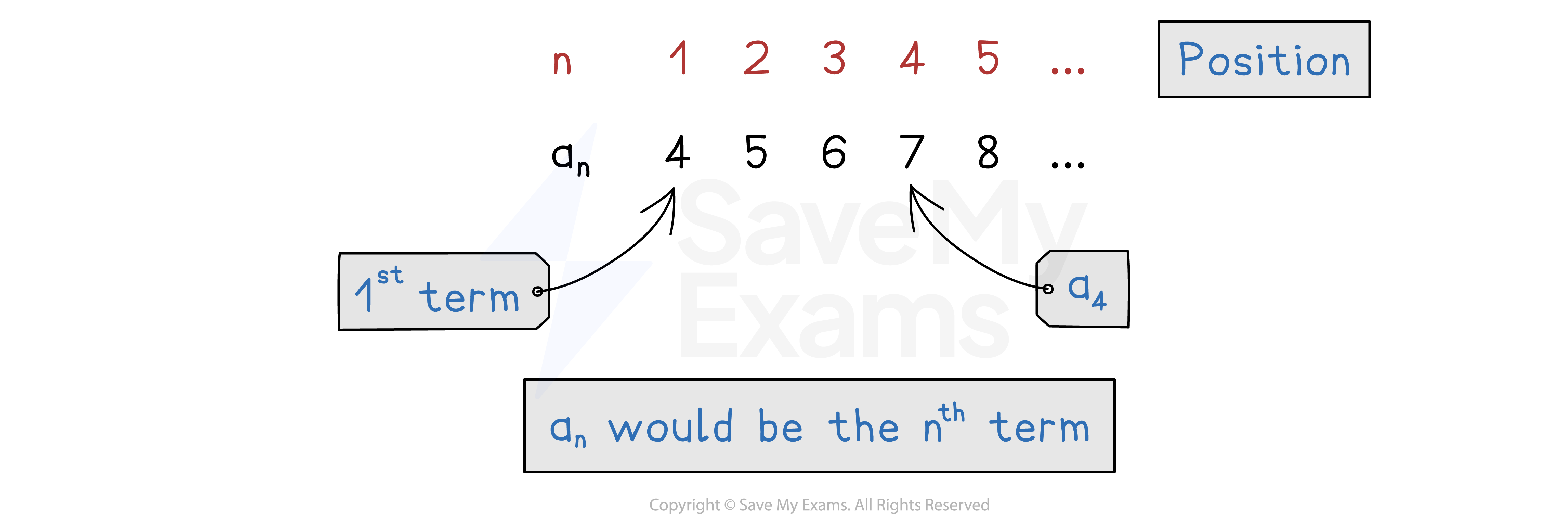
The location of a term within a sequence is called its position
-
The letter n is used for position
- n = 1 **refers to the 1st term
- n = 2** refers to the 2nd term
- If you do not know its position, you can say the n th term
-
-
Another way to show the position of a term is using subscripts
-
A general sequence is given by a1, a2, a3, ...
- a1 represents the 1st term
- a2 represents the 2nd term
- an represents the nth term
-
How do I write out a sequence using a term-to-term rule?
-
Term-to-term rules tell you how to get the next term from the term you are on
-
It is what you do each time
-
For example, starting on 4, add 10 each time
- 4, 14, 24, 34, ...
-
-
The common term-to-term rules are:
-
adding or subtracting a number
- 3, 7, 11, 15, ... the rule is add 4 each time
-
multiplying or dividing by a number
- 2, 6, 18, 54, ... the rule is multiply by 3 each time
-
How do I write out a sequence using a position-to-term rule?
-
A position-to-term rule is an algebraic expression in n that lets you find any term in the sequence
- This is also called the n th term formula
-
You need to know what position in the sequence you are looking for
- To get the 1st term, substitute in n = 1 **
- To get the 2nd term, substitute in n = 2**
-
You can jump straight to the 100th term by substituting in n = 100
- You do not need to find all 99 previous terms
-
For example, the n th term is 8n + 2
- The 1st term is 8×1 + 2 = 10
- The 2nd term is 8×2 + 2 = 18
- The 100th term is 8×100 + 2 = 802
-
For example, the n th term is n2 + 1
- The 1st term is 1 2 + 1 = 2
- The 2nd term is 22 + 1 = 5
- The 100th term is 1002 + 1 = 10 001
How do I know if a value belongs to a sequence?
-
If you know the n th term formula, set the value equal to the formula
- This creates an equation to solve for n
-
For example, a sequence has the n th term formula 8*n * + 2
-
Is 98 in the sequence?
- It is in the sequence, it is the 12th term
-
Is 124 in the sequence?
- n is not a whole number, so it is not in the sequence
-
Exam Hint In the exam, it helps to write the position number (the value of n) above each term in the sequence.
Worked Example A sequence has the n th term formula 3n + 2.
(a) Find the first three terms in the sequence.
Answer:
Substitute n = 1, n = 2 and n = 3 into the formula
3×1 + 2 = 5
3×2 + 2 = 8
3×3 + 2 = 11
Final answer: 5, 8, 11
(b) Find the 80th term.
Answer:
Substitute n = 80 into the formula
3×80 + 2
The 80th term is 242 *
(c) Determine whether the number 96 is in the sequence.
Answer:
Set the formula equal to 96
Solve to find n If n is a whole number, it is a term in the sequence
94 is not divisible by 3 The nearest possible value is 95 ((95-2) ÷ 3 = 31, the 31st term)
Final answer: 96 is not in the sequence
Was this revision note helpful?