HCF & LCM (Edexcel IGCSE Maths)
Highest Common Factor (HCF)
Spec point —
1.4E
What is the highest common factor (HCF) of two numbers?
-
A common factor of two numbers is a value that both numbers can be divided by, leaving no remainder
-
**1 **is always a common factor of any two numbers
-
Any** factor** of a common factor will also be a common factor of the original two numbers
- 6 is a common factor of 24 and 30
- Therefore 1, 2 and 3 are also common factors of 24 and 30
-
-
The highest common factor is the largest common factor of the two numbers
- The highest common factor is useful when simplifying fractions or factorising expressions
How do I find the highest common factor (HCF) of two numbers?
-
To find common factors:
- write out the factors of each number in a list
- identify the numbers that appear in both lists
-
The highest common factor will be the largest factor that appears in both lists
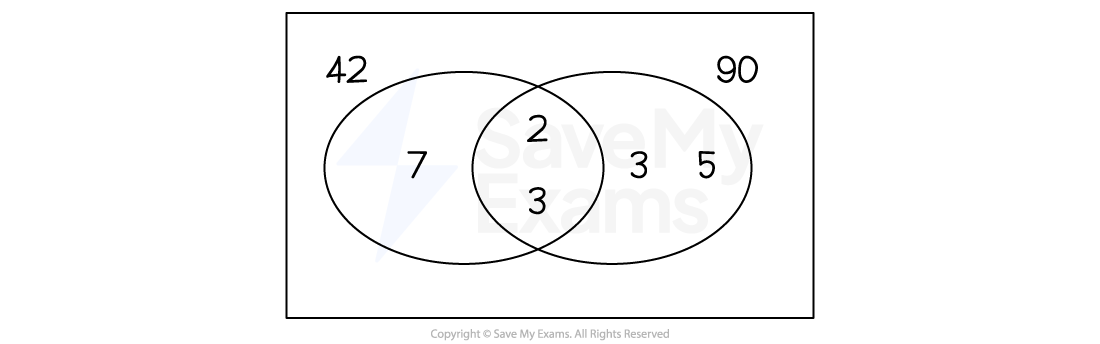
How can I use a Venn diagram to find the highest common factor (HCF) of two numbers?
-
Write each number as a product of its prime factors
- 42 = 2×3×7 and 90 = 2×3×3×5
-
Find the prime factors that are common to both numbers and put these in the centre of the Venn diagram
-
42 and 90 both have a prime factor of 2
- Put 2 in the centre of the diagram
-
Although 3 appears twice in the prime factors of 90, it appears once in the prime factors of 42
- Put a single 3 in the centre of the diagram
-
If there are no common prime factors, put a 1 in the centre of the diagram
-
-
Put the remaining prime factors in the respective regions
- 7 would go in the region for 42
- 3 and 5 would go in the region for 90
-
The highest common factor is the product of the numbers in the centre
- The HCF of 42 and 90 is 2×3, which is 6
-
If there are no common prime factors then the HCF is 1
How can I use the powers of prime factors to find the highest common factor (HCF) of two numbers?
-
Write each number as a product of the powers of its prime factors
- 24 = 23×3 and 60 = 22×3×5
-
Find all common prime factors and identify the highest power that appears in both numbers
-
The highest power of 2 in both is 22
- 22 is a common factor
-
The highest power of 3 in both is 31
- 3 is a common factor
-
No other prime number appears in both
-
-
The highest common factor is the product of the common powers of primes
- The HCF of 24 and 60 is 22×3 which is 12
Exam Hint The highest common factor of two numbers could be one of the numbers!
E.g. The highest common factor of 4 and 12 is 4.
Worked Example Find the highest common factor of 36 and 120.
Answer:
Write both numbers as a product of prime factors
36 = 2×2×3×3 = 2 2 × 3 2 120 = 2×2×2×3×5 = 23**× 3 × 5
Write the prime factors in a Venn diagram
Multiply the common prime factors in the centre
HCF = 2 × 2 × 3
Alternatively, list the factors for each number
36: 1, 2, 3, 4, 6, 9, 12, 18, 36 120: 1, 2, 3, 4, 5, 6, 8, 10, 12, 15, 20, 24, 30, 40, 60, 120
Another alternative is to find the highest common powers of primes
2*2and 31are the highest common powers of primes HCF = 22× 31*
Final answer: HCF = 12

Lowest Common Multiple (LCM)
Spec point —
1.4E
What is the lowest common multiple (LCM) of two numbers?
-
A common multiple of two numbers is a number that appears in both of their times tables
-
The product of the original two numbers is always a common multiple (but not necessarily the lowest)
-
Any multiple of a common multiple will also be a common multiple of the original two numbers
- 30 is a common multiple of 3 and 10
- Therefore 60, 90, 120, ... are also common multiples of 3 and 10
-
-
The lowest common multiple is the smallest common multiple between two numbers
- This is useful when finding a common denominator and when adding or subtracting fractions
How do I find the lowest common multiple (LCM) of two numbers?
-
To find the lowest common multiple of two numbers:
-
write out the first few multiples of each number
-
identify the multiples that appear in both lists
- If there are none then write out the next few multiples of each number until you find a common multiple
-
-
The lowest common multiple will be the smallest multiple that appears in both lists
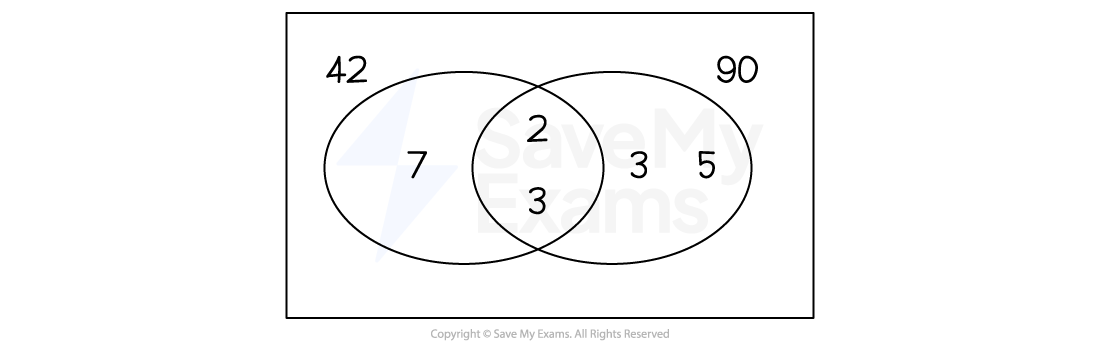
How can I use a Venn diagram to find the lowest common multiple (LCM) of two numbers?
-
Write each number as a product of its prime factors
- 42 = 2×3×7 and 90 = 2×3×3×5
-
Find the prime factors that are common to both numbers and put these in the centre of the Venn diagram
-
42 and 90 both have a prime factor of 2
- Put a 2 in the centre of the diagram
-
Although 3 appears twice in the prime factors of 90, it appears once in the prime factors of 42
- Put a single 3 in the centre of the diagram
-
If there are no common prime factors then put a 1 in the centre of the diagram
-
-
Put the remaining prime factors in the respective regions
- 7 would go in the region for 42
- 3 and 5 would go in the region for 90
-
The lowest common multiple is the product of all the numbers in the circles
- The LCM of 42 and 90 is 7×2×3×3×5, which is 630
How can I use the powers of prime factors to find the lowest common multiple (LCM) of two numbers?
-
Write each number as a product of the powers of its prime factors
- and
-
Find the highest power of each and every prime that appears in either number (they do not have to be common primes)
-
23 is the highest power of 2 shown (from 72)
-
33 is the highest power of 3 shown (from 540)
-
51 is the highest power of 5 shown (from 540)
- Note: 5 is not a common prime in 72 and 540, but it is still needed for the LCM
-
-
The lowest common multiple is the product of these highest powers
- The LCM of 72 and 540 is 23×33×5, which is 1080
Exam Hint The lowest common multiple of two numbers could be one of the numbers!
E.g. The lowest common multiple of 4 and 12 is 12.
Worked Example Find the lowest common multiple of 36 and 120.
Answer:
Write both numbers as a product of prime factors
36 = 2×2×3×3 = 2 2 × 3 2 120 = 2×2×2×3×5 = 23**× 3 × 5
Write the prime factors in a Venn diagram
Multiply all the prime factors in the diagram
LCM = 3 × 2 × 2 × 3 × 2 × 5
An alternative method is to write out the multiples
36: 36, 72, 108, 144, 180, 216, 252, 288, 324, 360, 396, ... 120: 120, 240, 360, 480, ...
Another alternative method is to find the highest powers of each and every prime that appears Then multiply these together
2*3× 32× 51*
Final answer: LCM = 360

Was this revision note helpful?