Factors Influencing Digital Communication (Edexcel IGCSE Ict)
Exam board Pearson Edexcel · IGCSEUpdated 2024-06-05
Bandwidth & latency
Spec point —
2.2.3
What is bandwidth?
- Bandwidth is the amount of data that can be carried by a connection in one second
- Measured in bits per second (bit rate)
- A smaller bandwidth means that less data can be sent and the network can slow down, potentially to the point of becoming unusable
Impact on user experience
-
A higher bandwidth means more data can be sent and received in one second
-
Higher bandwidth can improve:
- Upload and download speeds
- Online gaming
- Streaming high definition video
-
To stream content, enough data to play a few seconds is downloaded and stored in a temporary area of memory called a buffer
-
As the contents of the buffer are played, more data is downloaded at the same time to keep the buffer full
-
If the buffer ever becomes empty playback will pause
-
To stream successfully, data must be downloaded to the buffer at a faster rate than it is being emptied
What is latency?
- Latency is the delay between data being sent and received
- If there is a big delay between the two, more data will be on the network causing collisions
- This can lead to even more packets of data being sent as the error rate will increase
Impact on user experience
- Playing games online smoothly, requires a high bandwidth
- A high latency can cause lag and the game will not respond as quickly as a users commands
- This can cause big issues when users are playing fast paced games or playing against other users with a lower latency (have an advantage due to ****quicker response times)
- Streaming sport content with a high latency** can cause micro-stutters** and ruin a users watching experience
Speed & volume of data transfer
Spec point —
2.2.1
What else can affect the speed & volume of data transfer?
| Factor | Description |
|---|---|
| Interference | Devices that emit electromagnetic signals such as microwaves and fridges can disrupt wireless signals |
| Transfer method | Wired connections can carry more frequencies, meaning a higher bandwidth compared to wireless connections |
| Blockages | Walls and furniture can block wireless signals, lowering the bandwidth available |
| Distance | The strength of a wired and wireless signals reduces as data has to travel further |
Wired & wireless communication
Spec point —
2.2.1
What are the advantages and disadvantages of wired & wireless communication?
| Wired | Wireless | |
|---|---|---|
| Speed | Fast data transfer | Slower than wired |
| Portability | Location is limited by physical cable | Location only limited by range |
| Security | Better physical security | Less secure, easier to intercept data |
| Range | Less affected by interference | Affected by interference |
| Safety | Cables can be trip hazards, need routing along walls, under floors | None |
| Cost | Cables are cheap, more devices means more cables needed | No cables required, may require a wireless access point to be purchased |
Broadband, mobile broadband & cellular networks
Spec point —
2.2.4
- Internet Service Providers (ISP) provide access to high speed internet (broadband)
- ISPs use fibre optic or copper cable to create a wide area network (WAN)
What is fibre optic?
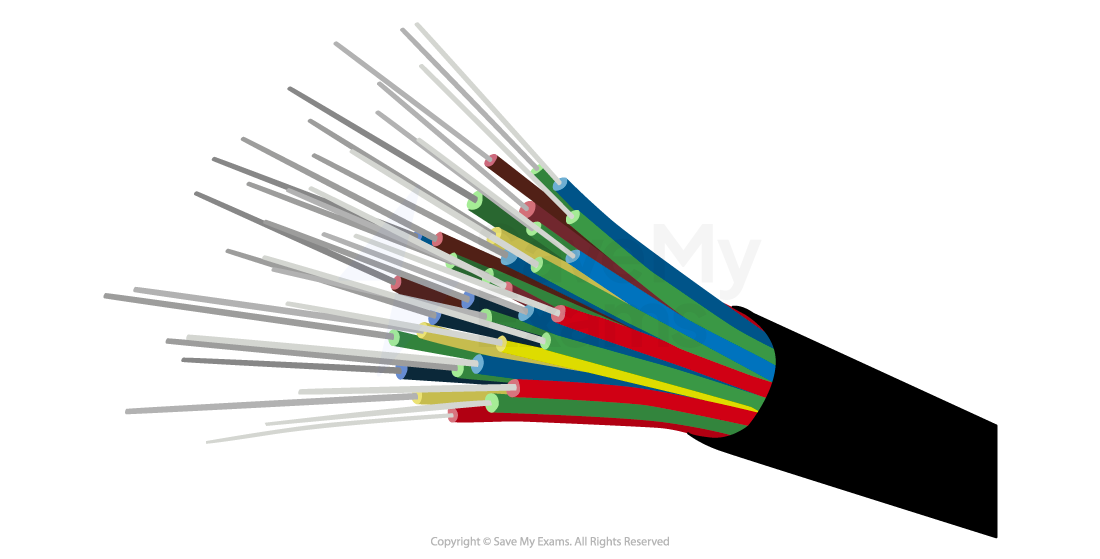
- Fibre optic is a type of cable that uses light to transmit data on a wide area network (WAN)
- Fibre transmits data at a much higher speed and has a much higher bandwidth compared to copper cables
- Fibre optic cable does not suffer from interference which makes them the most secure option to send sensitive data
- Fibre optic cables can cover a long distance without any degradation, they can span cities and countries
What is copper cable?
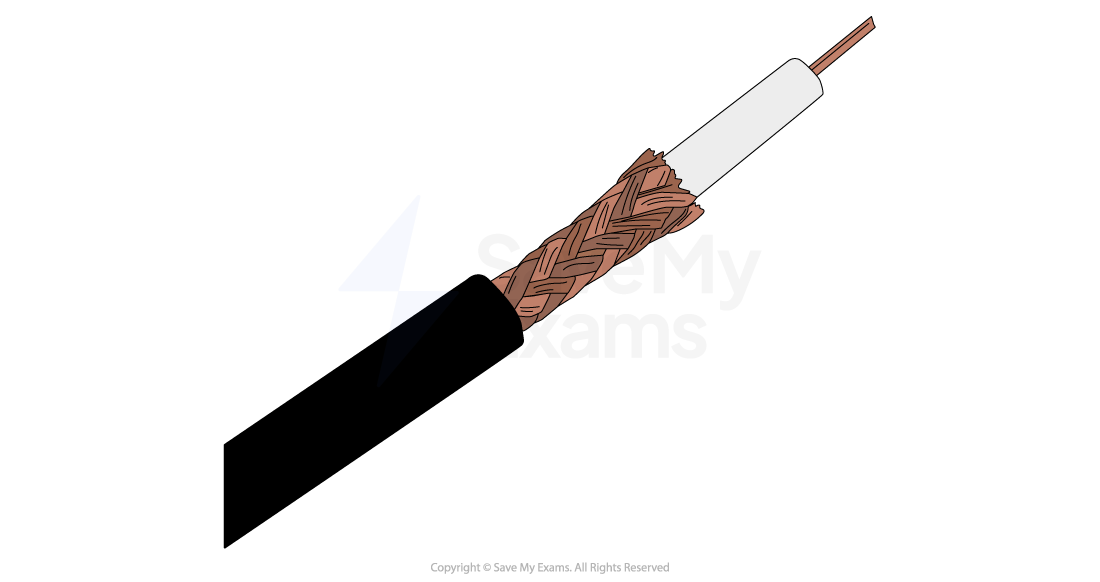
- Copper is a type of cable originally used in telecommunication to transmit voice signals, forming the traditional landline phone network
- The ability to use copper to deliver network traffic on a wide area network (WAN) made the internet possible
- Copper cables degrade over time which limits their range compared to fibre optic
- Copper cable suffers from interference which can disrupt data quality
- Copper transmits data at a much slower rate, and has a much lower bandwidth compared to fibre optic
Worked Example Describe how high latency can affect the experience of making a video call from a smartphone
[2]
Answer
- It increases the time it takes for data to be transferred between devices [1] meaning his voice/video is out of sync / lagging / delayed [1]
Was this revision note helpful?
Build on this topic