Given that is a factor of and that when is divided by the remainder is
show that and find the value of
Given that is a factor of and that when is divided by the remainder is
hence factorise completely
show that the equation has only one real root.
9 questions · 98 marks · ≈ 2 hours
Given that is a factor of and that when is divided by the remainder is
show that and find the value of
Given that is a factor of and that when is divided by the remainder is
hence factorise completely
show that the equation has only one real root.
where is a constant
Given that is a factor of
show that
Hence show algebraically that the curve has only one intersection with the -axis.
Given that can be expressed in the form where , and are positive constants
find the value of , the value of and the value of
Given that can be expressed in the form where , and are positive constants
Hence write down the maximum value of
The equation has roots and
Without solving the equation , form a quadratic equation, with integer coefficients, that has roots and
Show that
where and are constants
The equation has roots and where and are the roots of the equation
Using your answer to part (d), find in simplified exact form, the value of and the value of
Use the factor theorem to show that is a factor of
Hence, or otherwise, find the exact roots of the equation
A geometric series has first term and common ratio The third term of is 9 and the sum to infinity of is 192
Show that
A geometric series has first term and common ratio The third term of is 9 and the sum to infinity of is 192
Given that is a rational number
write down the value of
A geometric series has first term and common ratio The third term of is 9 and the sum to infinity of is 192
show that =144
The sum to terms of is
Using logarithms, find the least value of such that
Given that is a factor of
show that the curve with equation has only one intersection with the -axis.
where is an integer
The curve passes through the point with coordinates
Given that is a factor of
show that
where is an integer
The curve passes through the point with coordinates
Given that is a factor of
Hence, or otherwise, use algebra to solve the equation
The point has coordinates (–5, 3), the point has coordinates (4, 0) and the point has coordinates (–1, 5).
The line passes through and is perpendicular to .
Find an equation of . Give your answer in the form where , and are integers.
The line intersects at the point .
Show that the coordinates of are (-2, 2).
The point has coordinates (–5, 3), the point has coordinates (4, 0) and the point has coordinates (–1, 5).
Show that is not the perpendicular bisector of .
Find the value of . Give your answer in its simplest form.
where and are constants.
Given that is a factor of and that when is divided by the remainder is 8
(i) show that
(ii) find the value of
Hence, solve the equation

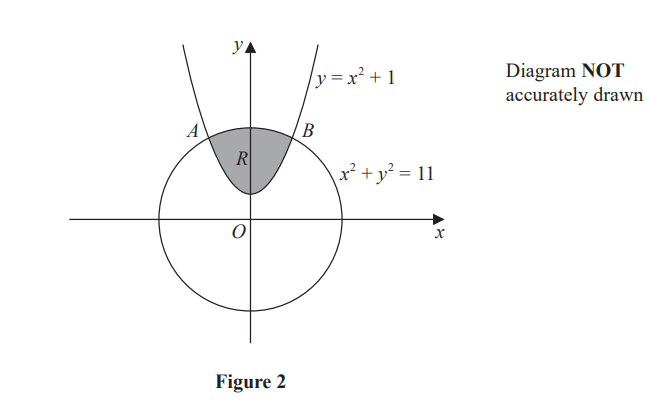
The region , shown shaded in Figure 2, is bounded by the curve with equation and the curve with equation
The two curves intersect at the point and at the point .
Find the coordinate of the point and the coordinate of the point .
The region is rotated through 360° about the ‑axis.
Use algebraic integration to find the volume, to 2 decimal places, of the solid generated.