Indicators (Edexcel IGCSE Chemistry)
Exam board Pearson Edexcel · IGCSEUpdated 2026-02-10
Two Colour Indicators
Indicators
What are two colour indicators?
- Two colours indicators are used to distinguish between acids and alkalis
- Many plants contain substances that can act as indicators and the most common one is litmus which is extracted from lichens
- Synthetic indicators are organic compounds that are sensitive to changes in acidity and appear different colours in acids and alkalis
- Phenolphthalein and methyl orange are synthetic indicators frequently used in acid-alkali titrations
- Synthetic indicators are used to show the endpoint in titrations as they have a very sharp change of colour when an acid has been neutralised by an alkali and vice-versa
- Litmus is not suitable for titrations as the colour change is not sharp and it goes through a purple transition colour in neutral solutions making it difficult to determine an endpoint
- Litmus is very useful as an an indicator paper and comes in red and blue versions, for dipping into solutions or testing gases
Two Colour Indicators Table
| Indicator | Colour in acid | Colour in alkali |
|---|---|---|
| litmus | red | blue |
| phenolphthalein | colourless | pink |
| methyl orange | red | yellow |
The pH Scale
Spec point —
2.15
-
The pH scale goes from 0 – 14
-
All acids have pH values of below 7, all alkalis have pH values of above 7
-
The lower the pH then the more acidic the solution is
-
pH 0-3 = strong acid
- Extremely acidic substances can have values of below 1
-
pH 4-6 = weak acid
-
-
The higher the pH then the more alkaline the solution is
- pH 8-10 = weak alkali
- pH 11-14 = strong alkali
-
A solution of pH 7 is described as being neutral
Universal Indicator
Spec point —
2.16
- Universal indicator is a wide range indicator and can give only an approximate value for pH It is made of a mixture of different plant indicators which operate across a broad pH range and is useful for estimating the pH of an unknown solution A few drops are added to the solution and the colour is matched with a colour chart which indicates the pH which matches with specific colours Universal indicator colours vary slightly between manufacturer so colour charts are usually provided for a specific indicator formulation
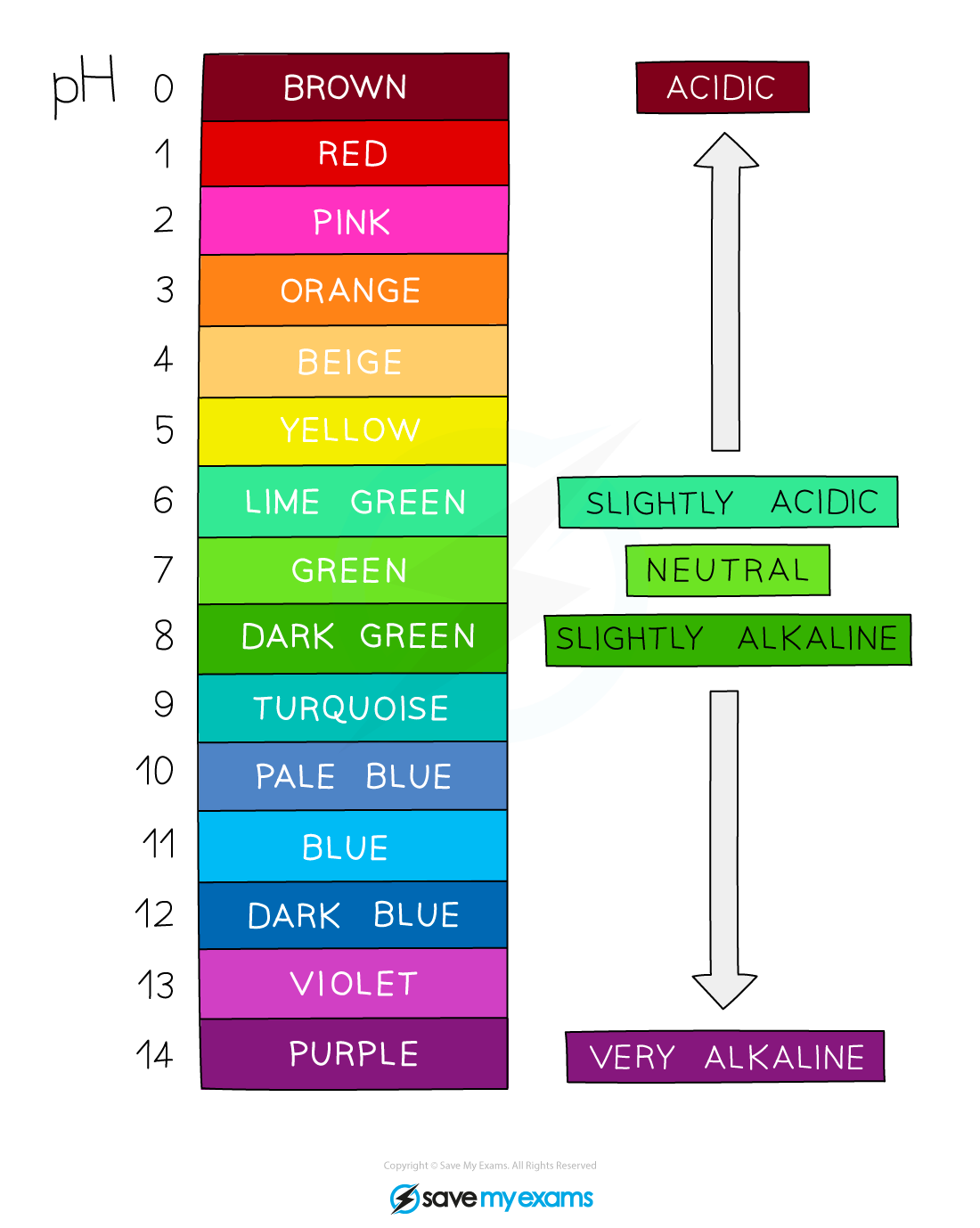
pH scale with the Universal Indicator colours used to determine the pH of a solution
Exam Hint A common error is to suggest using universal indicator as a suitable indicator for an acid-base titration. This is incorrect as a sharp colour change is required to identify the end-point, which cannot be achieved with universal indicator.
Was this revision note helpful?